

Royal Enfield Electric E Himalayan long-teased electric adventure bike—nicknamed the Him-E or E-Himalayan—has been spotted testing in Ladakh in what appears to be near-production trim.
Multiple test mules with finished bodywork, production-style lighting, and matured components were photographed, suggesting the project has moved well past early prototyping.
What was Spotted (and Where)
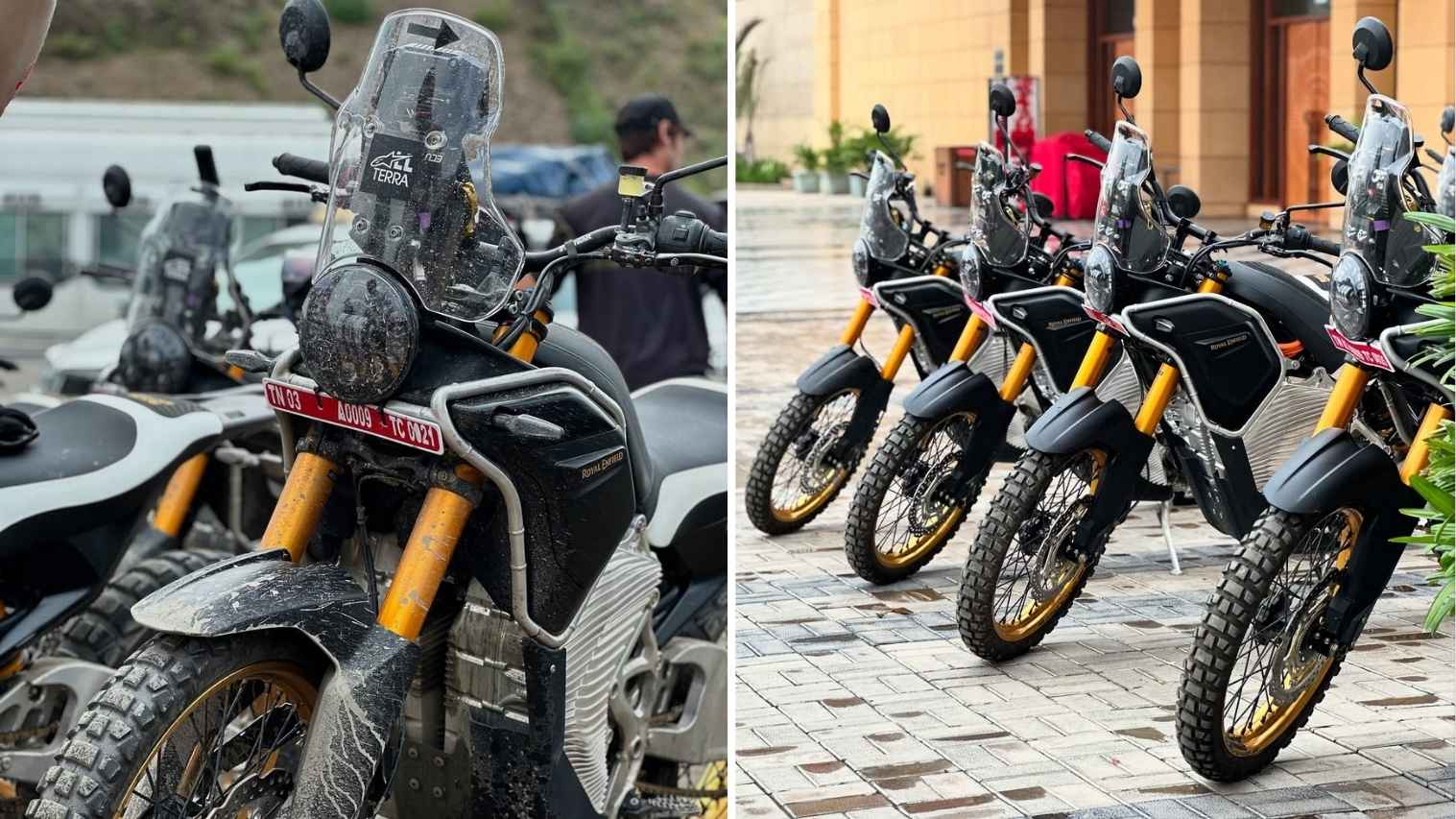
Recent spy shots show camouflaged bikes parked in Ladakh hotels and out on high-altitude roads. Outlets that published the images describe two prototypes that look much closer to showroom form than the concept shown earlier at EICMA. Team-BHP and BikeWale both call the mules “near production” or “production-ready,” pointing to complete tail sections, a new rectangular instrument panel, and fully finished body panels.
Design & Chassis: Aluminium Everywhere, with Premium Cycle Parts
Compared to the steel-trellis ICE Himalayan, the electric mule appears to pursue an aluminium-heavy architecture. Reports highlight an aluminium mainframe, subframe, and a custom aluminium swingarm, a choice that helps claw back the mass of a large battery and signals a clean-sheet EV platform rather than a retrofit.
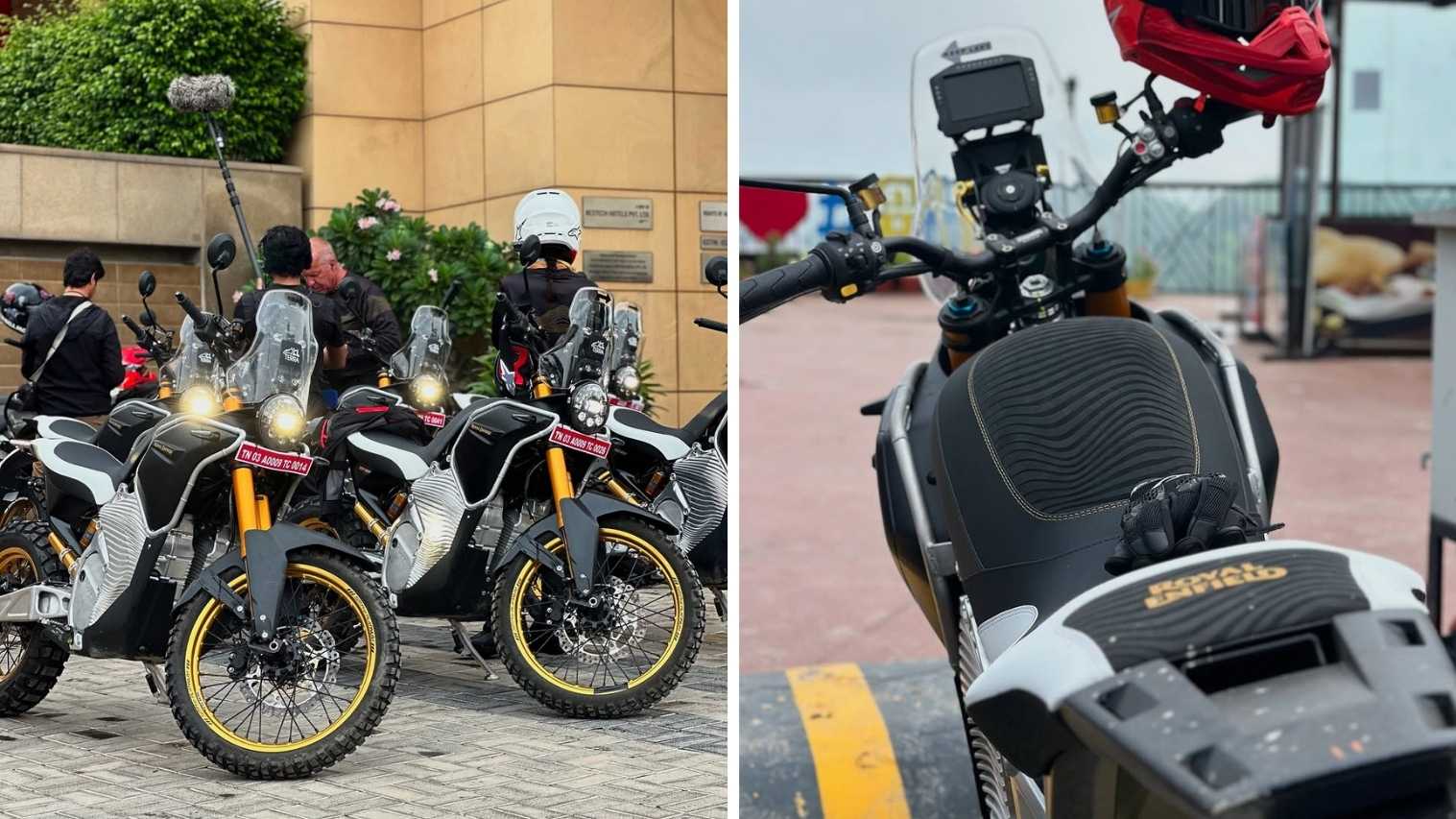
The battery case sits where the engine would be and appears to act as a stressed member of the chassis—again, a modern EV design approach meant to add rigidity while saving weight.
Motor Layout & Final Drive
The test bikes feature a mid-mounted electric motor sending power to the rear wheel via chain drive—a configuration adventure riders will find familiar and field-serviceable.
Instruments & Electronics (Test Gear vs. Final)
A rally-style tower-mounted display has been seen on some mules using an ECUMASTER screen—typical of development bikes using data-logging displays. Expect a different, production-grade cluster at launch, but the presence of a large, navigation-friendly screen hints at the feature set RE is exploring.
Given the segment (and what’s already on the ICE Himalayan), ride modes, switchable ABS, traction control, and connected navigation are reasonable expectations; several outlets explicitly anticipate a “decent range of electronics,” though nothing is official yet.
How “Near Production” is it?
Three signals stand out:
- Finished bodywork (including production-style lamps and tail) rather than rough cladding.
- High-altitude testing with multiple units and senior management present—typical of late validation runs in Indian OEM programs.
- Supplier-grade components (wheels, brakes, suspension) already integrated and photographed on more than one mule.
That said, specs are still officially undisclosed, and even some premium hardware may change to hit price targets.
Timelines & Price (what to realistically expect)
Royal Enfield hasn’t announced a date. BikeWale has floated an 18-month window from mid-2025, while other reporting suggests late 2026. Given the state of the mules, a 2026 calendar-year debut (India first) seems plausible, but it’s still speculative.
Pricing is equally unconfirmed. Listings and early desk estimates vary widely; treat numbers like “₹7 lakh and up” as placeholders until RE reveals official specs and trims.
Performance, Battery & Range: What’s Known vs. Rumoured
No official figures have been shared. One NDTV round-up cites an earlier report claiming ~14 kWh battery and ~74.5 kW (100 hp) motor with a 200–250 km claimed range—but clearly labels these as provisional. Until Royal Enfield publishes specs, treat such figures as rumours, not facts.
Why the E-Himalaya Matters
Royal Enfield has been positioning the Him-E not just as a one-off but as a platform born from the EICMA concepts, and the production-leaning mules show real progress toward a mainstream adventure EV.
If the final bike carries over the aluminium chassis, mid-drive layout, robust suspension, and rally-friendly ergonomics (screen tower, standing comfort, luggage points), it could become one of the first mass-market, long-travel electric ADVs from a high-volume Indian manufacturer.
FAQs
Is the E-Himalayan officially confirmed for production?
Royal Enfield hasn’t issued a formal launch confirmation with specs or dates, but multiple near-production test mules have been spotted in Ladakh, strongly indicating a production program in its late stages.
When will it launch?
There’s no official date. Credible reporting ranges from ~18 months from mid-2025 to late-2026. Bank on 2026 as a realistic timeframe unless RE announces otherwise.
How powerful will it be? What’s the range?
RE has not shared numbers. One media piece mentions ~14 kWh and ~100 hp with 200–250 km range, but those are unconfirmed estimates. Expect final figures at launch.
What chassis does it use? Is it just a converted Himalayan 450?
The mules point to an EV-first aluminium platform (mainframe, subframe, swingarm), with the battery case as a stressed member—not merely an ICE frame with a motor swap.
What motor and drive does it use?
A mid-mounted motor appears to drive the rear wheel via chain, visible in spy imagery. This is typical for off-road durability and gearing flexibility.
Will those premium parts (Öhlins, SM Pro wheels, Brembo/Nissin brakes) reach showrooms?
They’re on the mules, but manufacturers often “down-spec” certain parts to meet price targets. Consider the cycle parts on test bikes indicative, not guaranteed.
What electronics should I expect?
Likely ride modes, switchable ABS, traction control, and a navigation-capable display. An ECUMASTER tower display has been seen during testing, but the production cluster may differ.
How does cold weather at altitude affect it?
RE is testing at high altitude (Ladakh) for a reason—thermal management and energy efficiency. EVs avoid power loss from thin air (unlike ICE), but battery performance in extreme cold and energy consumption on climbs are engineering challenges the tests are meant to address. (The sightings themselves confirm the test environment; engineering impacts are general EV knowledge.)
Expected price?
Unannounced. Some trackers show placeholder pricing; treat any specific number as speculation until RE discloses trims and equipment.
How does it compare to other electric ADVs?
The global ADV-EV field is small (e.g., premium offerings from Zero or Energica in different price brackets). The E-Himalaya’s significance lies in bringing an electric ADV to the mass market—especially in India—if RE can balance range, cost, and durability.
Summary
The E-Himalayan looks real—and close. With aluminium architecture, a mid-drive/chain layout, serious suspension and wheels, and production-grade bodywork already on test mules, Royal Enfield’s adventure EV is clearly advancing. The key remaining questions—battery size, power, range, and price—are still unanswered, but the Ladakh sightings make one thing obvious: the electric Himalayan is no longer just a concept slide.