
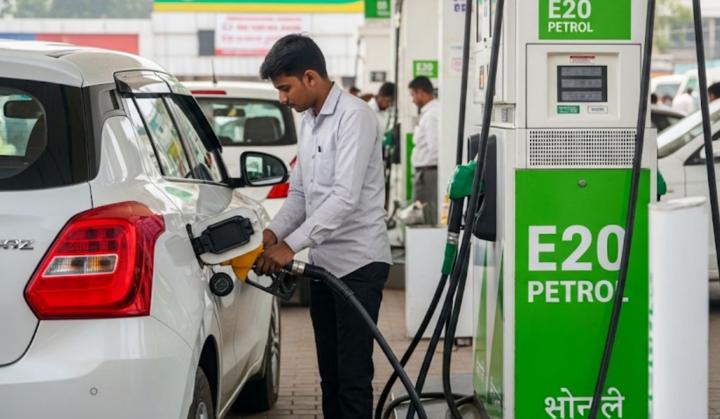
On Monday, September 1, 2025, the Supreme Court of India dismissed a Public Interest Litigation (PIL) challenging the mandatory rollout of 20% ethanol-blended petrol (E20) across the country.
The verdict effectively upheld the government’s ethanol blending policy and removed the option for consumers to purchase ethanol-free petrol (E0), despite the PIL’s assertions around vehicle compatibility and consumer choice.
The Legal Challenge
Petitioner’s Arguments
The PIL, filed by advocate Akshay Malhotra, contended that the government’s E20 policy was implemented without offering ethanol-free alternatives or adequate consumer information. Specifically, the plea argued that:
- Millions of motorists—particularly those with vehicles manufactured before April 2023, including some BS‑VI models—could not safely use E20 and were potentially forced to use fuel harmful to their engines.
- The PIL sought directions for mandatory labelling at fuel stations indicating ethanol content, as well as notices at dispensing units to inform consumers about their vehicle’s compatibility.
- It demanded a nationwide impact study to examine mechanical damage, reduced efficiency, insurance claim rejections, and rising repair costs attributed to E20 usage in non‑compatible vehicles.
- Reference was made to international practice—such as in the US and EU, where ethanol-free petrol remains available and labeled transparently to allow consumers to make informed choices.
Court’s Response & Government’s Defence
A bench headed by Chief Justice B.R. Gavai and Justice K. Vinod Chandran declined to entertain the PIL, simply stating, “We are not inclined to entertain the plea. Dismissed.”
Attorney General R. Venkataramani, appearing for the Union, forcefully opposed the plea, dismissing it as a stunt by a “name-lender for a large lobby.” He argued that:
- The E20 policy was rational, deliberate, and in the national interest, not an arbitrary imposition.
- The shift toward ethanol blending supports sugarcane farmers, enhances energy security, reduces oil imports, and aligns with environmental goals.
- Questioning foreign narratives, the AG rhetorically asked: “Will someone from outside the country dictate what fuel India should use?”
Notably, while the PIL sought clearer labelling and consumer notice, some reports indicate that authorities outlined steps to ensure visibility of ethanol content at fuel pumps and compatibility alerts—though it’s ambiguous whether these were court-mandated or administrative clarifications.
Policy Context & Technical Considerations
The E20 Initiative
The E20 policy forms part of India’s broader strategy to reduce dependence on fossil fuels and cut greenhouse gas emissions. The NITI Aayog‘s 2021 “Roadmap for Ethanol Blending in India (2020–2025)” set the blueprint for achieving 20% ethanol content in petrol by 2025.
Benefits Highlighted
- Economic Windfall: The roadmap estimated that successful E20 implementation could save India approximately USD 4 billion annually (around ₹30,000 crore).
- Agriculture Boost: By creating a stable demand for ethanol—largely derived from sugarcane—the policy is positioned as a boon to rural economies and sugarcane farmers.
- Environmental Gains: Ethanol use is estimated to significantly reduce life‑cycle greenhouse gas emissions by as much as 50–65%, depending on feedstock like sugarcane or maize.
- Air Quality & Energy Independence: The policy is touted to curtail vehicular pollution and reduce fossil fuel imports, aligning with national energy sustainability goals.
Concerns and Mitigation
- Vehicle Compatibility: The primary concern remains the compatibility of older vehicles with E20. Several articles cited reductions in fuel efficiency—ranging from 2% to 6%, depending on model and condition—with older cars possibly facing mechanical degradation or corrosion.
- Assurances of Safety: Industry bodies, such as the Society of Indian Automobile Manufacturers (SIAM), have played down these concerns:
- SIAM noted that while mileage may dip by 2–4%, there is no safety risk.
- Maruti Suzuki acknowledged mileage may vary based on driving conditions and vehicle maintenance, but did not predict widespread failures.
- Insurance & Warranty: Despite fears, SIAM and manufacturers stated that warranty and insurance claims would not be denied merely due to using E20 in older vehicles.
Implications of the Verdict
For Consumers & the Auto Sector
The Supreme Court’s dismissal signals that E20 is now effectively the sole standard fuel at most pumps, with no mandated E0 alternative. This amplifies anxiety among owners of older and possibly non-E20-compliant vehicles, even as the government and automakers attempt to reassure them.
Consumer advocates might argue that the lack of labelling and compatibility alerts undermines informed choice, even if, legally, the option to challenge this via PIL has been closed for now.
For Farmers & Energy Policy
The verdict removes a legal roadblock to the E20 rollout, supporting the government’s efforts to:
- Expand the domestic ethanol market, benefiting sugarcane producers.
- Advance environmental and energy self-reliance goals.
- Signal steadfastness in the face of consumer pushback.
Wider Legal & Policy Message
The Supreme Court’s stand can be seen as a clear message: policy shifts—even those affecting millions—require evidence-based challenges, not speculative PILs. The bench’s terse dismissal reinforces that advocacy must be grounded in robust empirical proofs, not generalized concerns.
Conclusion
In dismissing the PIL against the E20 petrol rollout on September 1, 2025, the Supreme Court affirmed the government’s clean energy trajectory while implicitly upholding its broader objectives of economic, environmental, and energy security.
As E20 becomes the new norm, the onus now lies on policymakers and industry to ensure consumer awareness, maintain vehicle warranties, and monitor real-world vehicle impacts—so that India’s push for sustainable fuel does not come at the cost of trust or equity in the transport ecosystem.