
The highly anticipated return of Tata Motors’ legendary SUV nameplate, the Sierra, is now confirmed — the all-new Tata Sierra is slated to launch in India on 25 November 2025.
Here’s a full breakdown of what we know so far — from its place in the market, to design cues, power-trains, features, and rival set.

Positioning & Legacy
The original Tata Sierra, produced in the 1990s, remains a nostalgic icon in India. The new Sierra revives that name with a modern interpretation: it will sit between the Tata Curvv and the Tata Harrier in Tata’s portfolio. In terms of competition, expect it to target rival mid-size SUVs such as the Hyundai Creta, Kia Seltos, Maruti Grand Vitara, and the Volkswagen Taigun.
Launch & Variants
- Launch date fixed: 25 November 2025 for the internal-combustion-engine (ICE) versions.
- A fully electric version (EV) of the Sierra is expected to follow in the near term — though it will come after the petrol/diesel variants.
- The production version reveal (before commercial availability) is indicated around 15 November, ahead of the full launch.
Design & Exterior
The new Sierra blends retro cues from the original with contemporary design language:
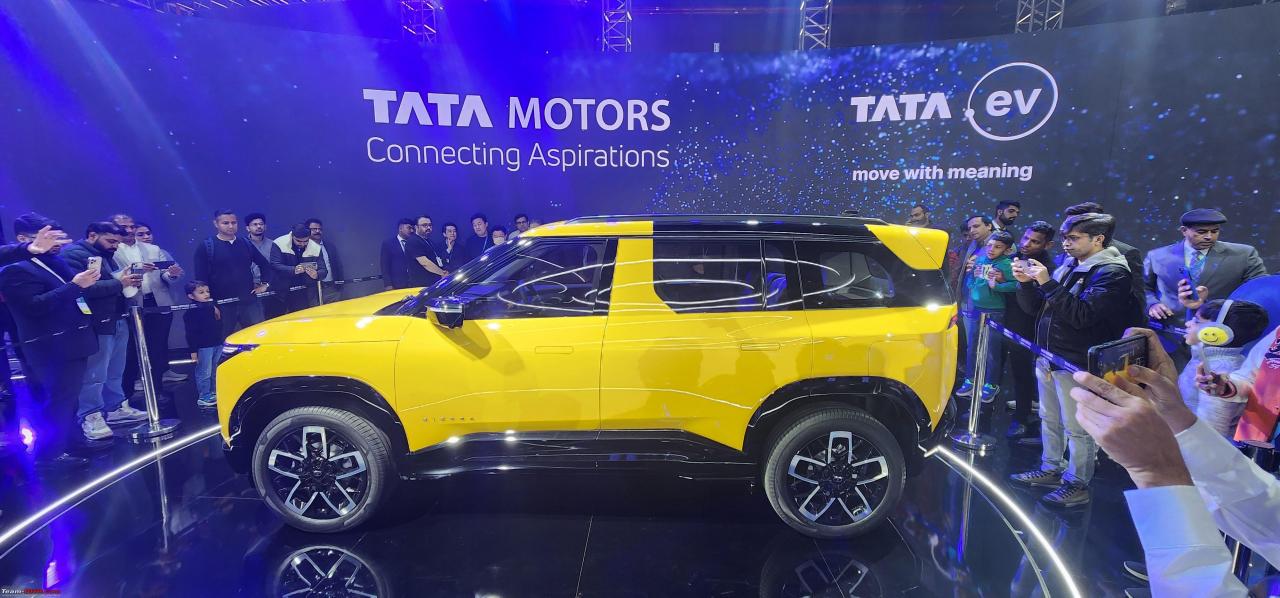
- Retains boxy proportions, a tall bonnet, and a strong shoulder line reminiscent of the 1990s Sierra.
- Front end: slim LED headlamps, full-width LED DRL light bar, gloss-black grille, silver skid plate, and robust lower bumper cladding.
- Side profile: signature curved “Alpine-window” style rear-quarter insert (tribute to original), flush door handles, thick gloss-black cladding, roof-rails, and chunky alloy wheels.
- Rear: flat tailgate, large roof-spoiler, connected LED tail-strip, short overhangs reinforcing the SUV’s stance.
Dimension-wise, the Sierra is expected to be around 4.3–4.4 metres in length (based on reports).
Interior & Features
The cabin promises to be tech-rich and premium:
- A triple-screen layout is expected: digital instrument cluster, central touchscreen, and a passenger‐side display — all under a unified glass fascia.
- Features likely to include: ambient lighting, panoramic sunroof, wireless phone charging, ventilated front seats, dual-zone climate control, and an advanced sound system.
- Safety and driving aids: Level-2 ADAS suite (e.g., adaptive cruise, lane keep, automatic emergency braking), 360° camera, ESC, hill-hold assist, and possibly up to 6 airbags.
Powertrain Options
ICE Versions:
- A new 1.5-litre turbo-petrol engine (TGDI) is expected to debut with the Sierra.
- A 1.5-litre diesel (carried over from other Tata models) or possibly a 2.0-litre turbo-diesel variant may be offered.
- Transmissions expected: 6-speed manual, 6-speed torque-converter automatic, or 7-speed DCT in specific trims.
EV Version:
- Built on Tata’s EV architecture (likely shared with the Harrier EV), the Sierra EV is expected to offer strong range and potentially dual-motor AWD in higher trims.
Expected Pricing
Though official pricing is yet to be announced, estimates suggest:
- ICE versions may start from ≈ ₹15 lakh (ex-showroom) and go up to ~₹25 lakh, depending on trim and powertrain.
- The EV variant is expected to be priced in the ballpark of ₹18-25 lakh, according to early speculation.
What This Means
The revival of the Sierra name is significant for Tata Motors — it taps into nostalgia while delivering on modern expectations of design, technology, and electrification. Positioned smartly, it could attract buyers who want something distinctive in the SUV market: a blend of heritage appeal and contemporary substance.
From a market-strategy viewpoint:
- It strengthens Tata’s mid-SUV portfolio between Curvv and Harrier.
- It broadens choice (petrol, diesel, and EV), which is increasingly important in India’s transition phase.
- It raises the competitive bar for rivals in design and features at its price point.
Conclusion
If the all-new Tata Sierra delivers on its promise — with crisp design, premium cabin, advanced tech, and multiple powertrain options — it could become a major player in India’s crowded but booming SUV segment. It will be particularly compelling for buyers who value style, brand legacy, and modern utility.
We’ll have to wait for the official pricing, variant lineup, and full specifications post-launch on 25 November 2025 to see how it fares in the real world. Until then, it remains one of the most eagerly awaited launches of the year.