
Here’s an article on Ather’s milestone of crossing 5 lakh (500,000) electric scooters in production:
In a significant achievement for India’s electric two-wheeler industry, Ather Energy has announced that it has rolled out its 500,000th electric scooter from its manufacturing facility in Hosur, Tamil Nadu.
The milestone vehicle was none other than the Ather Rizta, the company’s family-oriented scooter that has quickly become a key volume driver since its launch last year.
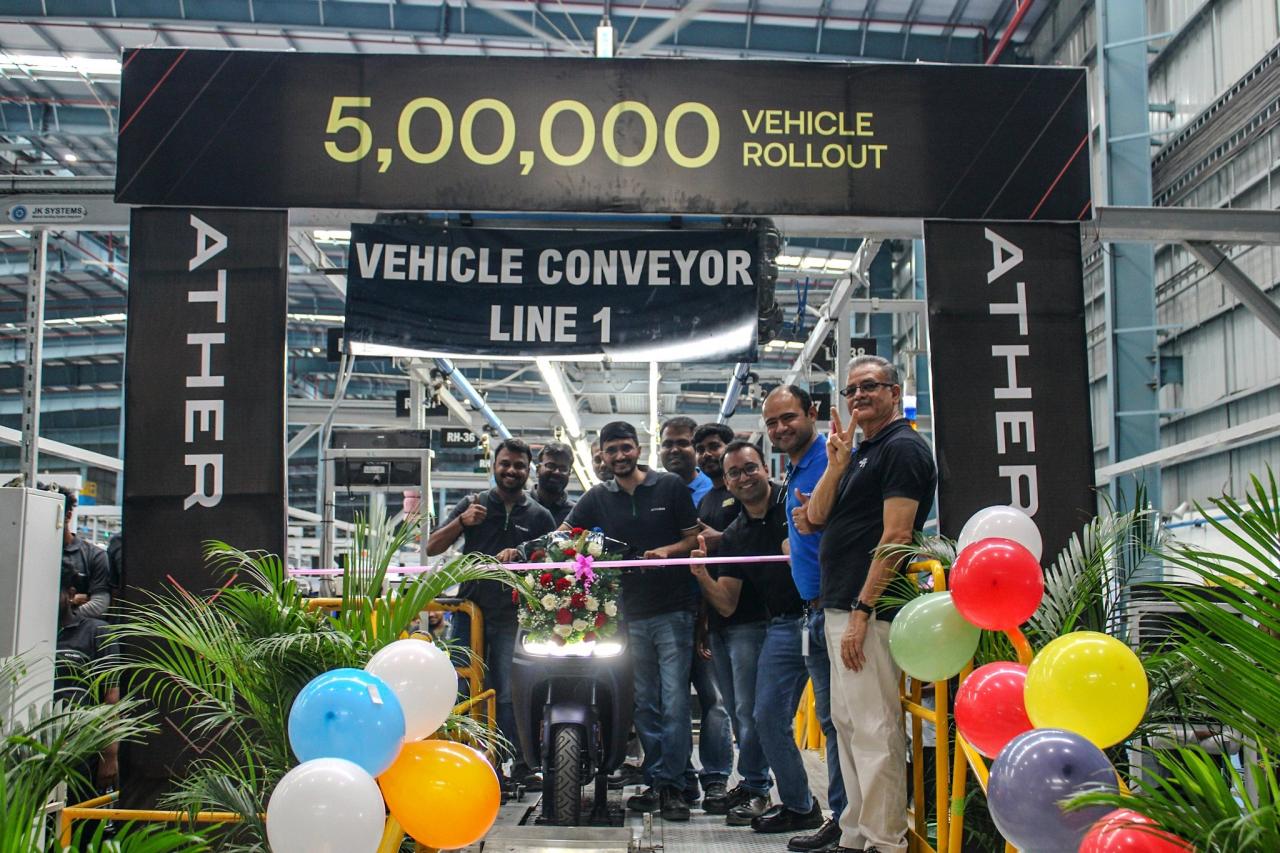
From Niche Player to Mass Scale
Ather started deliveries of its flagship Ather 450 in 2018, catering more to performance and tech-savvy users. Over time, the company broadened its product strategy and, in April 2024, launched the Rizta, positioned more for family and everyday mobility. Within just a year, the Rizta began contributing over one-third of Ather’s total production volume, underlining how well the market has responded to the more mass-market offering.
This transition from a niche, premium EV brand to one capable of mass production underscores Ather’s ambition and evolution in India’s competitive EV space.
Manufacturing and Capacity Expansion
Ather currently operates two facilities in Hosur — one for vehicle assembly, and another dedicated to battery production — combining to an annual output capacity of 420,000 scooters. To address growing demand, the company is setting up Factory 3.0 in Bidkin, Auric (Chhatrapati Sambhajinagar), Maharashtra.
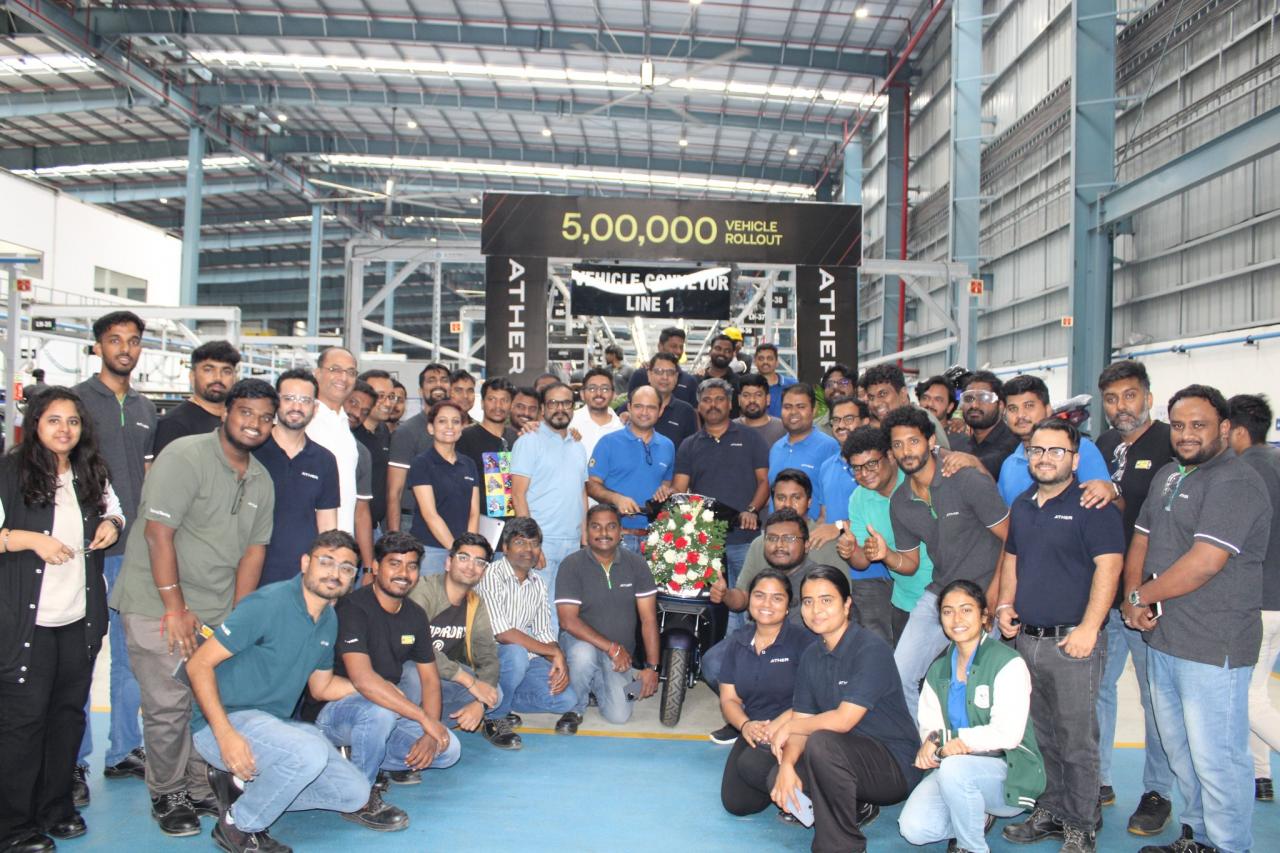
When this new plant—being built in two phases under Industry 4.0 norms—becomes fully operational, Ather’s aggregate capacity is expected to rise to 1.42 million electric two-wheelers annually. This expansion is critical because while the company has crossed the 5 lakh mark, demand is accelerating, especially with the Rizta helping open broader markets.
Strategic & Market Implications
- Geographic expansion: Beyond its traditional strongholds in South India, Ather is pushing aggressively into North, Central, and Tier-2/3 cities. This reach is vital to tap India’s vast two-wheeler user base.
- Retail and service network growth: To support the sales and after-sales infrastructure, Ather plans to expand its dealer and service presence.
- Production scalability & resilience: Reaching 5 lakh units is a validation of their manufacturing processes, supply chain stability, and quality controls. The scale also helps in further optimizing costs.
- Competitive positioning: As the broader EV two-wheeler market intensifies—with competitors like TVS, Bajaj, Ola, and others—Ather’s ability to deliver high volume with brand strength gives it a stronger standing.
- Product breadth & platform strategy: The success of Rizta underlines how choice in model strategy (performance + family) can help in capturing different segments. Ather has hinted at new platforms (like an “EL” platform) for future models.
Key Comments & Observations
Swapnil Jain, Ather’s Co-founder & CTO, remarked, “Crossing 5,00,000 scooters is a major milestone for Ather … building not just vehicles, but a scalable, reliable, and consistent manufacturing ecosystem.” His comments emphasize that the achievement is not just about numbers, but about systems, engineering culture, and execution discipline.
Despite achieving this production number, Ather’s plants are currently operating close to capacity. That makes the third factory important not only for growth, but also to buffer against supply chain disruptions, allow model diversification, and shorten lead times.
On the market side, Ather recently reported its highest-ever monthly sales of 18,109 units in September 2025, showing that the demand is indeed there.
Challenges & Forward Risks
- Profitability pressures: As many EV manufacturers know, scaling production is one thing, making it profitable is another. Margins can be squeezed by component costs (batteries, semiconductors) and logistics.
- Competition and pricing: Rivals may engage in aggressive pricing, subsidies, or volume plays to gain share. Ather must retain its brand differentiation and avoid a race to the bottom.
- Execution risk in new factory: Building and ramping up an advanced Industry 4.0 plant is nontrivial. Delays, cost overruns, or supply chain bottlenecks could slow the scaling.
- Market adoption & policy support: EV incentives, subsidies, or regulatory frameworks will matter, especially in less affluent or rural markets.
- After-sales & service capability: As volumes and geographies expand, ensuring service quality, spare parts availability, and customer support will become harder but critical.
Conclusion
Crossing the 5 lakh production milestone is a landmark moment for Ather Energy — both a badge of industrial maturity and a signal of its ambitions for scale. The milestone tells us that India’s electric two-wheeler sector is no longer niche; it is moving into mainstream manufacturing and demand territory.
But for Ather, this is more of a stepping stone than a final destination. With Factory 3.0 underway, the success of the Rizta, and growing reach into untapped markets, the coming years will decide whether it can convert volume achievements into sustained profitability and leadership in India’s EV mobility future.