
Here’s a write-up on Bavaria’s Biggest EV Charging Hub Launched at Munich Airport. Let me know if you want a shorter/news-style version. On September 16, 2025, Munich Airport officially opened Bavaria’s largest public facility for charging electric vehicles (EVs), as part of its “NetZero 2035” climate strategy.
The charging park, built within parking garage P44, brings 275 new charging points to the airport and aims to combine mobility, renewable energy, and infrastructure to reduce carbon emissions.
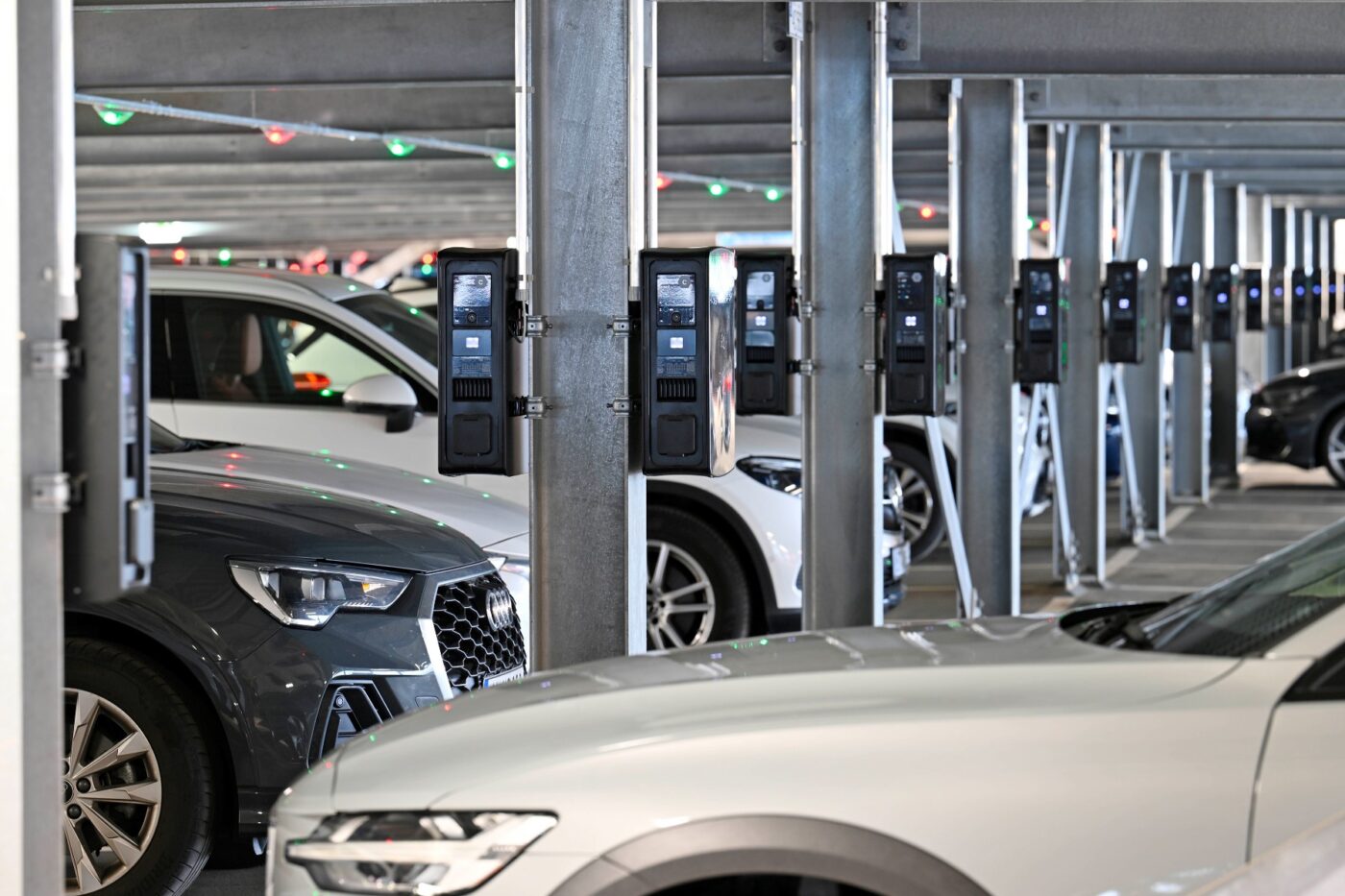
Key Features
- 275 charging points are now operational in P44, each capable of up to 22 kW of output.
- The energy is partially supplied by two new photovoltaic (PV) solar systems installed on the roofs of P43 and P44, which include 7,216 solar modules. These have a combined peak output of about 3 megawatts – sufficient to power roughly 1,000 three-person households.
- Total investment for the project: €5.2 million, entirely financed by Munich Airport, developed in collaboration with regional companies.
- The inauguration was attended by dignitaries, including Bavarian State Prime Minister Markus Söder, Finance Minister Albert Füracker, and Munich Airport CEO Jost Lammers.
Context & Strategic Importance
- This new charging park is a major component of Munich Airport’s NetZero 2035 strategy, which aims to eliminate its CO₂ footprint by 2035.
- The airport already has over 1,140 EV charging points in operation (these include apron/ground service equipment and other airport-use chargers).
- In terms of renewable energy infrastructure, the airport currently operates solar generation capacity of around 7 megawatts, with plans to expand that to 50 megawatts by 2030 through additional rooftop and open-space installations.
Broader Regional Implications
- The project plays into a larger competition among German states over EV infrastructure. Until recently, Bavaria led Germany in the number of public charging points, but North Rhine-Westphalia (NRW) has overtaken it. As of August 1, 2025, NRW had about 34,063 publicly accessible charging points, while Bavaria had 33,909.
- The addition of 275 new chargers at Munich Airport may help Bavaria reclaim its leading position in sheer numbers of public charging points.
Why This Matters
Scaling Infrastructure for EV Adoption
A common barrier to electric mobility is “range anxiety” and a lack of charging infrastructure. By putting 275 chargers in an accessible, high-traffic location like an international airport, Munich is reducing those barriers—especially for travellers, airport staff, ground service vehicles, or anyone using the airport as a node.
Integrated Renewable Energy Use: Using solar energy to power the charging points helps reduce the carbon footprint of EV charging itself. Charging with grid electricity isn’t always zero emissions; using on-site PV makes it much cleaner.
Symbolic & Practical Lead
Airports are often visible symbols of transportation and technological progress. For Munich to invest heavily here, it sends a strong message about priorities. At the same time, if the facility is reliable and well used, it sets a model that other airports (in Germany, Europe, elsewhere) can follow.
Contribution to State/National Climate Goals
With Germany’s push toward decarbonization, more EVs + clean charging = fewer emissions. Moves like this help Bavaria meet its targets, and are part of the wider European agenda to reduce dependence on fossil fuels.
Challenges & Questions
- Utilization & Maintenance: Will the charging points be used at high capacity? If many remain unused, the investment’s return (both environmental and financial) could be sub-optimal.
- Grid Impact: With 275 × 22 kW chargers, peak loads could be high. The airport likely has addressed this via grid capacity and smart load management, but scaling further (towards 50 MW of solar) will likely require more grid upgrades.
- User Experience: Charging speed (22 kW) is moderate (suitable for several hours parking, not fast charging), so this facility is more for longer stays rather than quick top-ups. How the airport handles pricing, availability, reservation systems, etc., will matter.
- Further Expansion: To meet ambitious state goals (e.g., tripling EV charging points in Bavaria by 2030, as quoted by Markus Söder), comparable projects will need to be replicated widely. One large charging park isn’t enough on its own.
Conclusion
Munich Airport’s new EV charging park in P44 is a strong and timely infrastructure investment. With 275 new charging points, on-site solar power, and full alignment with broader NetZero targets, the project represents a blend of ambition and practical implementation. It helps Bavaria remain competitive in EV infrastructure, supports transit-oriented charging access, and lays the groundwork for further growth in clean energy and e-mobility.
If successfully managed and expanded, this charging park could be both a beacon and blueprint — shaping how airports and large transport hubs integrate sustainable mobility in the coming years.