

BYD Atto 2 Electric SUV India Launch next mass-market EV, the Atto 2, has been sighted testing on Indian roads—camouflaged but unmistakable—signalling that a launch is drawing close.
Multiple sightings over the past few weeks back up the momentum, and they arrive just as BYD has begun confirming UK/Europe pricing and specs for this compact-to-midsize SUV internationally. Put together, it paints a clear picture: the Atto 2 is coming soon, and it’s aimed squarely at India’s hottest EV segment.
What Exactly is the Atto 2?
Globally, the Atto 2 sits below the Atto 3 in the brand’s SUV lineup. In China, it’s sold as the BYD “Yuan Up,” and in many export markets, it adopts the Atto 2 badge. That dual identity explains why early coverage sometimes used different names for what is essentially the same vehicle. In India, expect the “Atto 2” branding to stick—press reports and a prior Indian design patent filing suggest exactly that.
Dimensionally, the Atto 2 measures about 4,310 mm long, 1,830 mm wide, and 1,675 mm tall, on a 2,620 mm wheelbase. That footprint places it bang in the “Creta/Seltos” territory in India—often described locally as “midsize”—even though European literature also calls it a “compact” SUV. Either way, this is the sweet spot for Indian family crossovers.
Spied in India: What the Prototypes Reveal
Recent spy shots from across India show heavily camouflaged test mules. Even so, the distinctive full-width tail-light signature and side surfacing are consistent with the Euro-spec Atto 2 that BYD has begun promoting in Europe and the UK. Media reports indicate the test programme is for real-world validation and localisation—expect suspension tuning, tyres, and feature sets to be adjusted for our roads before launch.
The sightings line up with earlier statements about BYD’s plan to introduce a new SUV positioned below the Atto 3 by the second half of 2025. With the test cars out, that timeline looks realistic.
Powertrain, Range, and Charging: Market-Specific Mix
Here’s where things get interesting. The Atto 2 runs on BYD’s e-Platform 3.0 and Blade Battery tech—foundational pieces we already know from the brand’s other models. In Europe/UK, BYD has confirmed two battery options (51.1 kWh and 64.8 kWh) with a WLTP range up to 261 miles, and 0–100 km/h in 7.9 seconds for the punchier variants.
On the continent, BYD’s official model page currently lists “up to 312 km WLTP combined” for the compact SUV variant shown—reflecting a configuration closer to the smaller pack offered in some regions. Differences in the quoted numbers largely come from differing battery sizes offered market-to-market and the test cycles used.
China’s “Yuan Up” spec provides more clues for what India could get if BYD looks to balance range and price aggressively: there, BYD offers 32 kWh and 45.12 kWh Blade batteries with CLTC ranges of 301 km and 401 km, respectively. Don’t be surprised if India receives a mix that targets real-world ~300–400 km claimed range (test-cycle dependent), with DC fast-charging and V2L (vehicle-to-load) capability positioned as everyday conveniences.
Independent databases corroborate performance basics seen on European cars: a front-mounted 130 kW (177 PS) motor, 290 Nm, 0–100 km/h in around 7.9 seconds, and ~160 km/h top speed. That’s plenty to keep pace with ICE rivals while delivering EV smoothness.
Interior and Features
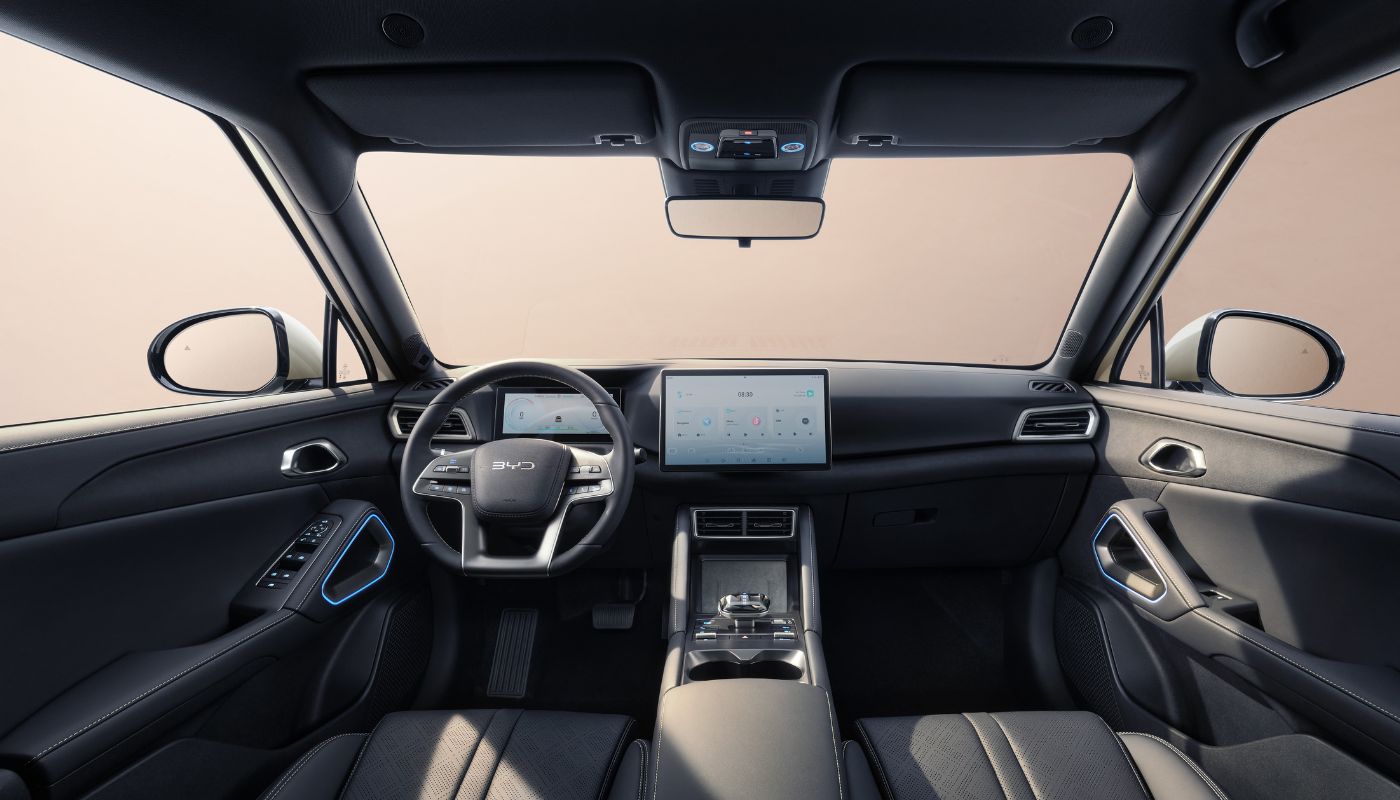
Inside, the Atto 2 follows the familiar BYD recipe: a clean, airy cabin with a rotatable central touchscreen (screen size varies by market), a digital driver’s display, and a hefty standard-features list. Expect ADAS to be part of the story too, given BYD’s recent equipment strategies.
Some Indian reports expect the international-spec layout to carry over with minimal changes—think a 12.8-inch class rotating screen and an ~8.8-inch instrument cluster, plus wireless smartphone integration. Localisation could add India-specific navigation, voice features, and connected-car telematics.
Rivals and Positioning
BYD’s pricing strategy will decide who the Atto 2 fights most directly. The brand seems to be lining it up against India’s fast-forming midsize EV crop: Hyundai’s upcoming Creta EV, Maruti Suzuki’s e-Vitara (e-Escudo in some markets), Tata’s Harrier EV, and Mahindra’s XEV 9e. Slotting under Atto 3’s price band while delivering a competitive range and features will be the key to traction beyond major metros.
Internationally, the Atto 2’s UK prices—£30,850 OTR for the Boost and £34,950 OTR for the Comfort—suggest BYD is positioning it to undercut or meet mainstream compact EV crossovers while touting big-brand tech and safety credentials. That template, translated to India through local duties and spec, points to a starting price that aims to tempt ICE-SUV upgraders and early EV adopters alike.
Why the Atto 2 Matters For India
The Atto 3 proved BYD can sell a premium-leaning EV here; the Atto 2 is the volume play. This size class is the country’s heartbeat, and with charging infrastructure improving in top cities, buyers are increasingly open to EV crossovers—if the range/price balance feels right.
BYD’s Blade Battery reputation (thermal safety, longevity) and e-Platform 3.0 efficiency are strong calling cards, and the company has been expanding its retail/service footprint steadily. If BYD can achieve competitive localisation and keep equipment levels rich, it could kick-start a fresh wave of EV adoption in the ₹20–25 lakh zone.
Summary
Camouflaged Atto 2s on Indian roads, a prior design patent filing, and a steady drumbeat of spy-shot reports all point to an imminent debut. Expect a feature-packed cabin, familiar BYD design cues, and a battery menu tailored for India. If the pricing lands where the chatter suggests, the Atto 2 will enter the market not as a niche experiment but as a serious mainstream EV option—one that could redefine expectations for range, tech, and safety in India’s midsize SUV space.