
Here’s a detailed write-up on BYD’s newly unveiled e-Bus Platform 3.0, its technologies, strengths, and likely implications.
What is the e-Bus Platform 3.0?
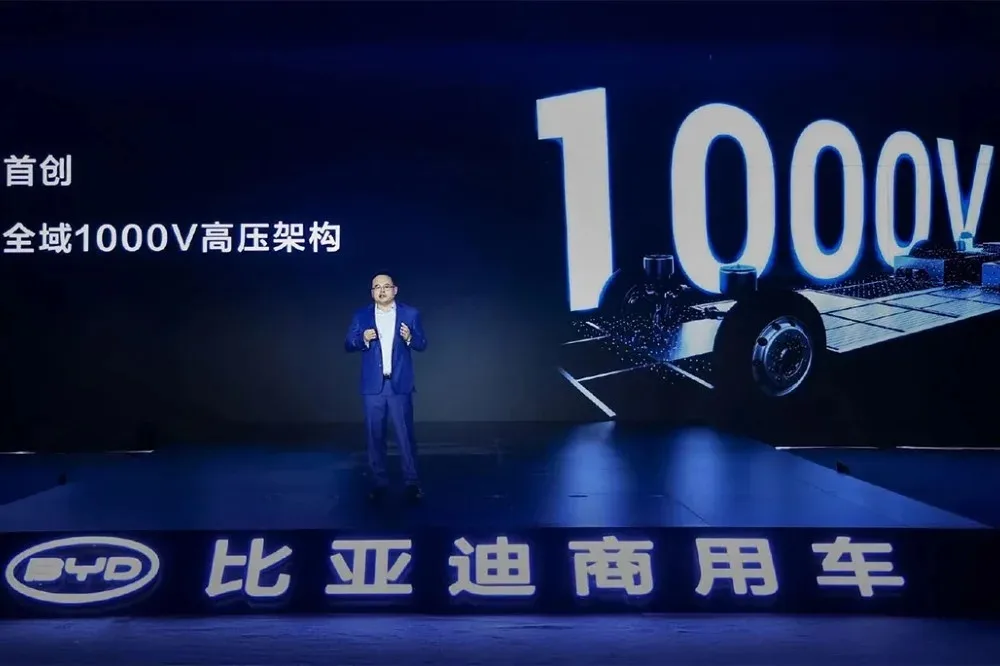
On September 15-16, 2025, BYD introduced its third-generation electric bus platform, called e-Bus Platform 3.0, along with a first production model based on it: the BYD C11.
This platform represents a major technological leap for BYD in its commercial electric-bus division, drawing on advances made in its passenger EV divisions. Key features include a 1,000-volt system architecture, a chassis battery design (cell-to-chassis), safety & intelligence upgrades, and options for a wide range of battery sizes & driving ranges.
Key Technical Features
Here are the most important technical innovations in the new platform:
1,000-volt High-Voltage Architecture
-
- The entire electrical system is standardized on a 1,000 V architecture, including the drivetrain, charging, power distribution, and HVAC / air conditioning.
- Use of silicon carbide (SiC) power electronics to improve efficiency and reduce losses in high-voltage components.
Cell-to-Chassis (CTC) Battery Integration
-
-
- BYD uses its Blade battery cells (based on LFP – lithium iron phosphate chemistry) that are built directly into the structure of the chassis (“cell to chassis”). This differs from conventional designs where battery packs are mounted separately.
- The Blade modules are ultra-thin and bus-specific, forming part of the chassis frame between the axles. This increases usable interior/space efficiency (e.g., for luggage or passenger areas) and helps with vehicle body strength.
-
Battery Capacity & Range Options
-
- The first model, C11, will be offered with a variety of battery sizes: 184, 257, 311, 425, and 593 kWh.
- Corresponding range claims are from about 220 km up to ~730 km, depending on the battery option. These are under Chinese test cycles, which are often more optimistic than many international standards.
- Under full load with air conditioning, the C11 is claimed to exceed 400 km, which suggests good real-world usability, especially in hot & loaded conditions.
Efficiency, Thermal & Cold-Weather Performance
-
- A 7-in-1 thermal management system helps control the temperatures of the battery, power electronics, etc.
- The platform claims up to 18% reduction in energy consumption overall, and significantly enhanced range retention (50-80 km more) in cold conditions (around -15 °C) relative to previous versions.
Ride Comfort, Safety & Intelligence Enhancements
-
- An optional active (adaptive) suspension, called DiSus-A, is available to improve ride comfort and handling.
- Stability control system, including a “high-speed tire blowout stability system” which can react in milliseconds if a tire fails while driving at up to ~100 km/h.
- Driver Disability / Incapacitation Assistance System 2.0: a one-touch emergency stop button on the dashboard so passengers can safely bring the vehicle to a halt if the driver becomes unable to drive.
Safety Protection & Structural Strength
-
- The battery pack, integrated into the chassis, has “ten layers of protection” and is claimed to withstand the pressure of a 50-tonne truck. This is to improve safety in crashes, etc.
- The chassis design benefits both safety/resilience and the usage of interior space.
The First Production Bus: BYD C11
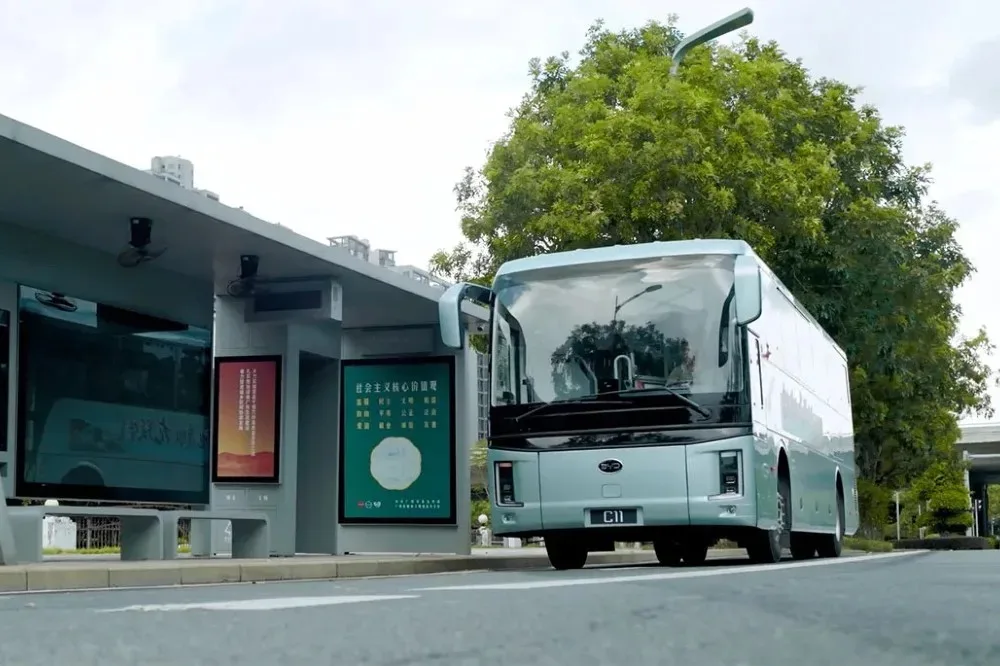
The C11 is the debut vehicle built on the e-Bus Platform 3.0. Important specs:
- Length: 11 metres.
- Various battery options (184-593 kWh) give ranges from ≈ 220 km to ≈ 730 km (CLTC or Chinese test cycles).
- Over 400 km range claimed under full load with air conditioning on.
- Comfort/design features: improved ride, safety systems, better interior space, perhaps better ergonomics & NVH (noise, vibration, harshness) refinements.
Significance & Implications
Why this matters and what could be the broader consequences:
Performance Parity / Leap in Commercial EVs
BYD is pushing electric buses into higher-voltage regimes (1,000 V), which have hitherto been more common in high-performance passenger EVs.
This allows for faster charging, lower current for a given power (thus less loss, less heat), and potentially lighter wiring/components. BYD is effectively bringing passenger-EV innovations into the large vehicle / commercial EV class.
Charging Speed and Infrastructure
Higher voltage systems allow for faster high-power charging infrastructure to be used more efficiently. It potentially shortens charging times or enables more power throughput per unit of cable & connector, which helps fleet operations.
While BYD hasn’t disclosed exact 10-80% or similar fast-charge times for the largest battery yet, the 1,000 V architecture sets the groundwork.
Cold Weather & Energy Savings
Retaining a useful range in cold weather has been a persistent challenge for electric buses, especially in colder climates. The claimed improvements (50-80 km better range in −15 °C) matter for places with winter operations.
Combined with better thermal management and improved drivetrain efficiency, this platform may reduce the cost of operation (less heating overhead, less battery loss).
Structural Efficiency & Safety
The cell-to-chassis integration lends both structural strength and efficiency. Lower floor height possibly (since battery isn’t just an add-on) helps boarding, center of gravity, and stability. Also, safety features (battery pack toughness, blowout stability, and emergency stop) point toward more robust operations.
Global Market Potential
While the C11 is being launched first in China, BYD’s products are sold globally, and its commercial vehicle division has international traction. Having a platform with such capability positions it well to compete not only domestically but in markets with stricter safety or performance demands. Also, more ambitious transit agencies may prefer longer range, faster charging, better cold-weather performance, etc.
Challenges / Unknowns
Of course, there are a few gaps and challenges to watch:
- Real-world charging times with large packs (esp. 593 kWh) under operating conditions need to be known. High voltage helps, but infrastructure and actual charge power delivered matter.
- Cost trade-offs: ultra-thin Blade battery modules, more protection layers, and advanced systems (SiC chips, active suspension, safety sensors) add cost and complexity. Whether these are economically viable in low-margin transit contracts will be tested.
- Durability, reliability over many cycles, especially under heavy load, varied climates (heat, cold, vibration, moisture, etc.).
- Regulatory / certification challenges in non-Chinese markets: safety, crash testing, standards for high voltage, etc.
Comparison with Previous BYD / Industry
- BYD had earlier platforms, but this is its first system-wide 1,000 V high-voltage architecture for its buses.
- It reflects a trend: high voltage systems (800 V, 1,000 V) are increasingly used in passenger EVs (for faster charging, less loss). BYD is applying similar thinking to buses.
- Blade Battery technology (LFP) has been in BYD’s portfolio for a while; integrating that into the chassis is newer.
Potential Use Cases & Which Markets May Benefit Most
- Urban transit systems with high usage and demanding schedules, where downtime for charging is costly. Faster charging & higher durability will help.
- Cold climate cities where winter range losses are a challenge; the improved cold-weather performance is a plus.
- Long-haul or regional bus routes require a greater range. The higher-end battery capacities and improved energy consumption help.
- Operators who want high safety / advanced features, e.g., in developed markets or premium services.
Conclusion
BYD’s e-Bus Platform 3.0 is a substantial advance in electric bus technology. With its 1,000 V architecture, cell-to-chassis Blade batteries, enhanced safety and control systems, and wide range of battery and range options, it marks a new benchmark for what commercial electric buses can be.
If the platform delivers as promised, it could accelerate the adoption of electric buses, reduce operating costs, and help transit operators overcome common EV-bus problems (cold-weather performance, charging delays, safety concerns).
However, the real test will be in deployment: how the C11 and related buses perform in real operational testing (in multiple climates), what the lifecycle costs are, how infrastructure supports fast charging, and how cost-competitive they are compared to competing technologies.