
On September 26, 2025, BYD marked a significant milestone by rolling out the 1,000th electric bus from its Hungarian bus factory in Komárom. This achievement underscores BYD’s growing foothold in Europe’s public transport electrification landscape.
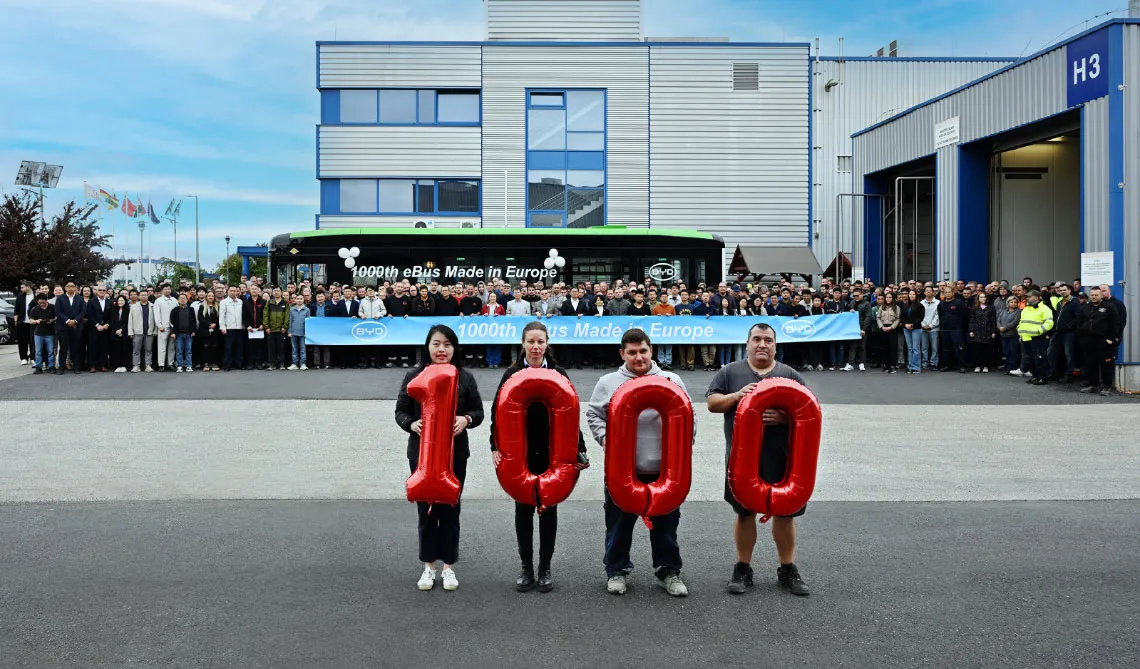
The Milestone Bus: B12.b Model & Technology
The 1,000th unit is a 12-metre B12.b model tailored for the German market, reflecting BYD’s ability to deliver region-specific electric buses. It features BYD’s CTC (Cell-to-Chassis) technology, which integrates blade battery cells directly into the chassis structure—enhancing efficiency by reducing redundant packaging. According to BusPlaner, the vehicle can carry up to 105 passengers. Its first destination is German operator STOAG.
Beyond being a symbolic milestone, the 1,000th bus also signals BYD’s commitment to long-term operations in Europe, particularly with regard to sustainable public mobility.
Growth, Capacity & Expansion
When BYD launched its Komárom bus assembly line in April 2017, the target was to produce up to 400 electric buses annually. Over time, production has scaled in response to demand.
To support further growth, BYD recently announced expansion plans: adding 29,000 square meters of new production facilities at Komárom. After expansion, the plant’s capacity is expected to surpass 1,000 vehicles annually, covering both electric buses and trucks.
On a broader scale, BYD is investing 32 billion forints (≈ USD 94 million) to triple its e-bus and e-truck output in Hungary, aiming for a combined capacity of about 1,250 units/year across the site. The project is expected to create over 600 jobs in the region.
Meanwhile, BYD is also building a separate passenger vehicle factory in Szeged, Hungary, which would further solidify its European manufacturing base.
Significance & Implications
For BYD’s European strategy
The 1,000th electric bus milestone strengthens BYD’s credibility in Europe’s competitive e-bus market. Its “built in Europe, for Europe” approach helps it avoid import tariffs and logistical complications. Localization also aligns with broader European industrial and green-transition goals.
The adoption of CTC / blade battery integration reflects BYD’s drive to push its battery and vehicle engineering synergies forward. Notably, BYD recently launched a new third-generation bus platform built on 1,000-volt architecture, aiming for faster charging and lighter system integration. The Komárom plant’s ongoing upgrades may position it to produce vehicles based on such advanced platforms in the future.
For European Public Transit & Decarbonization
The milestone highlights how Chinese new energy vehicle (NEV) manufacturers are playing an increasing role in Europe’s electrified transport infrastructure. BYD’s buses already serve more than 160 cities in 26 countries, with a total cumulative mileage exceeding 645 million km. As European cities push to decarbonize urban mobility, reliable electric bus production close to the market becomes a competitive advantage.
The job creation in Komárom and surrounding areas, along with broader regional industrial development, underscores how EV manufacturing investments can have tangible socio-economic impacts.