
The Renault–Dacia group has recently unveiled its bold vision for affordable electric mobility in Europe: the Dacia Hipster Concept. Built around a radical minimalism and ultra-light design, the Hipster aims to rethink what an electric city car can be — at a price point far below typical EVs.
While still a concept, the Hipster paints a compelling picture of how simplicity, weight control, and regulation might converge to unlock a new class of ultra-affordable urban EVs.
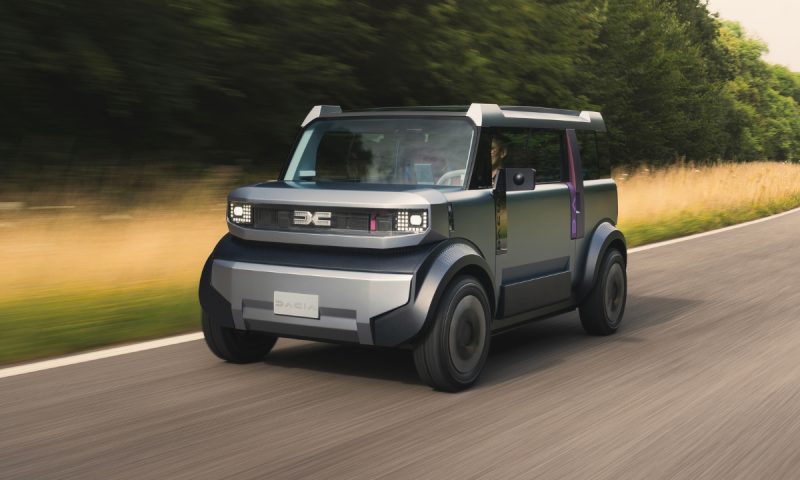
Core Specifications & Concept Intent
- According to Renault / Dacia, the Hipster weighs in at under 800 kg (kerb weight) — a drastic reduction relative to modern electric cars.
- The reported driving range is modest: media sources (e.g., RushLane) cite around 100 km, though in some contexts Dacia suggests a range that allows “two charges per week” to cover typical daily usage.
- In other accounts, the concept is said to aim for up to 150 km of range — likely under ideal conditions or as an upper bound.
- The top speed is expected to be limited at around 90 km/h, emphasizing practical urban use rather than highway performance.
- The vehicle’s dimensions are compact: 3,000 mm length, 1,550 mm width, 1,530 mm height.
- Cargo flexibility is part of the design: a small 70 L (2.5 cu ft) boot with all seats in place, expanding to 500 L (17.7 cu ft) when the rear seats are folded.
Thus, while some press sources highlight a 100 km range in more conservative usage scenarios, the concept itself seems to allow for somewhat longer range when conditions are favorable.
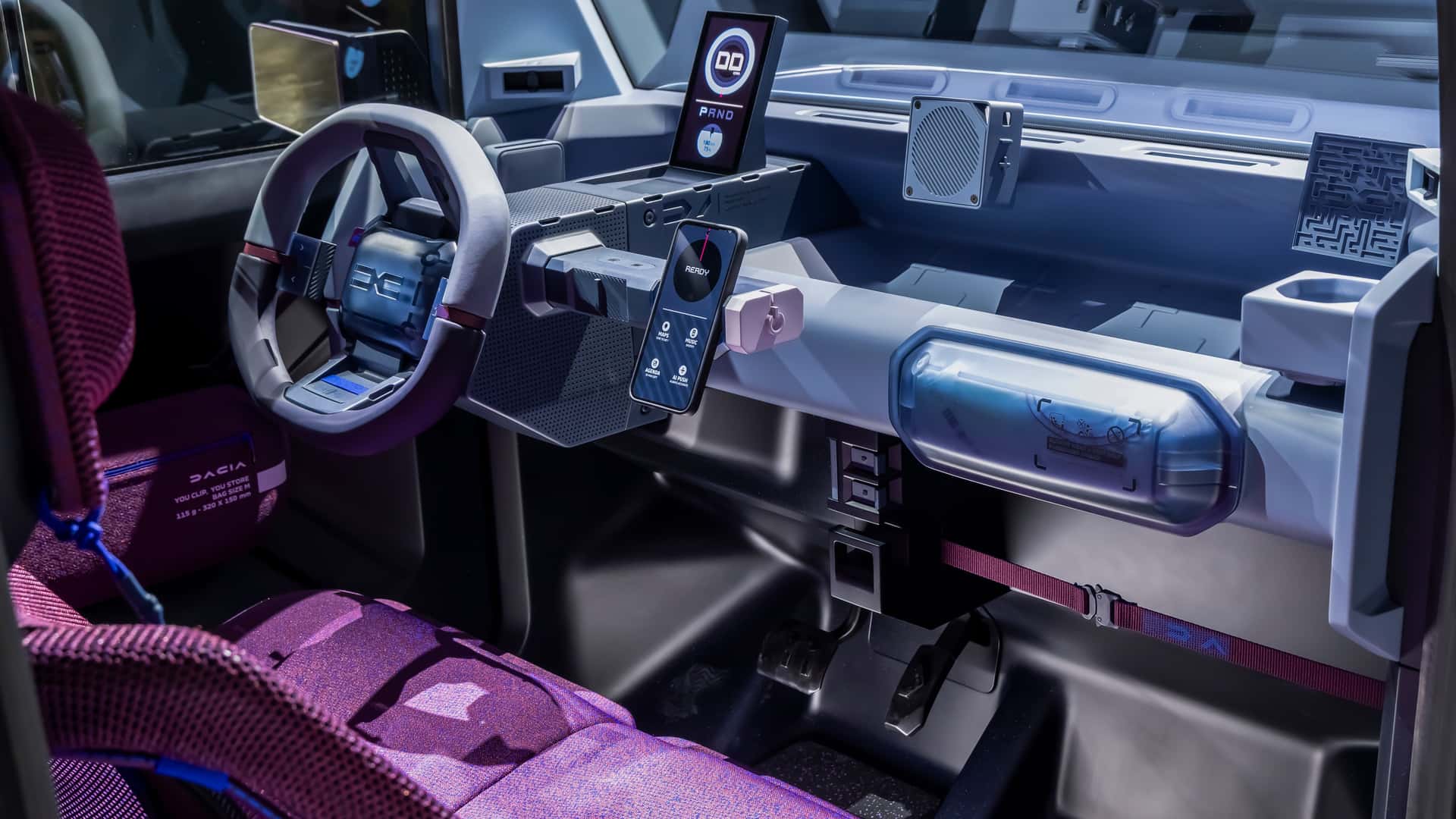
Design Philosophy & Trim-Down Approach
What makes the Hipster especially interesting is not just its light weight or compact dimensions, but how Dacia is aggressively cutting complexity and cost to make it viable:
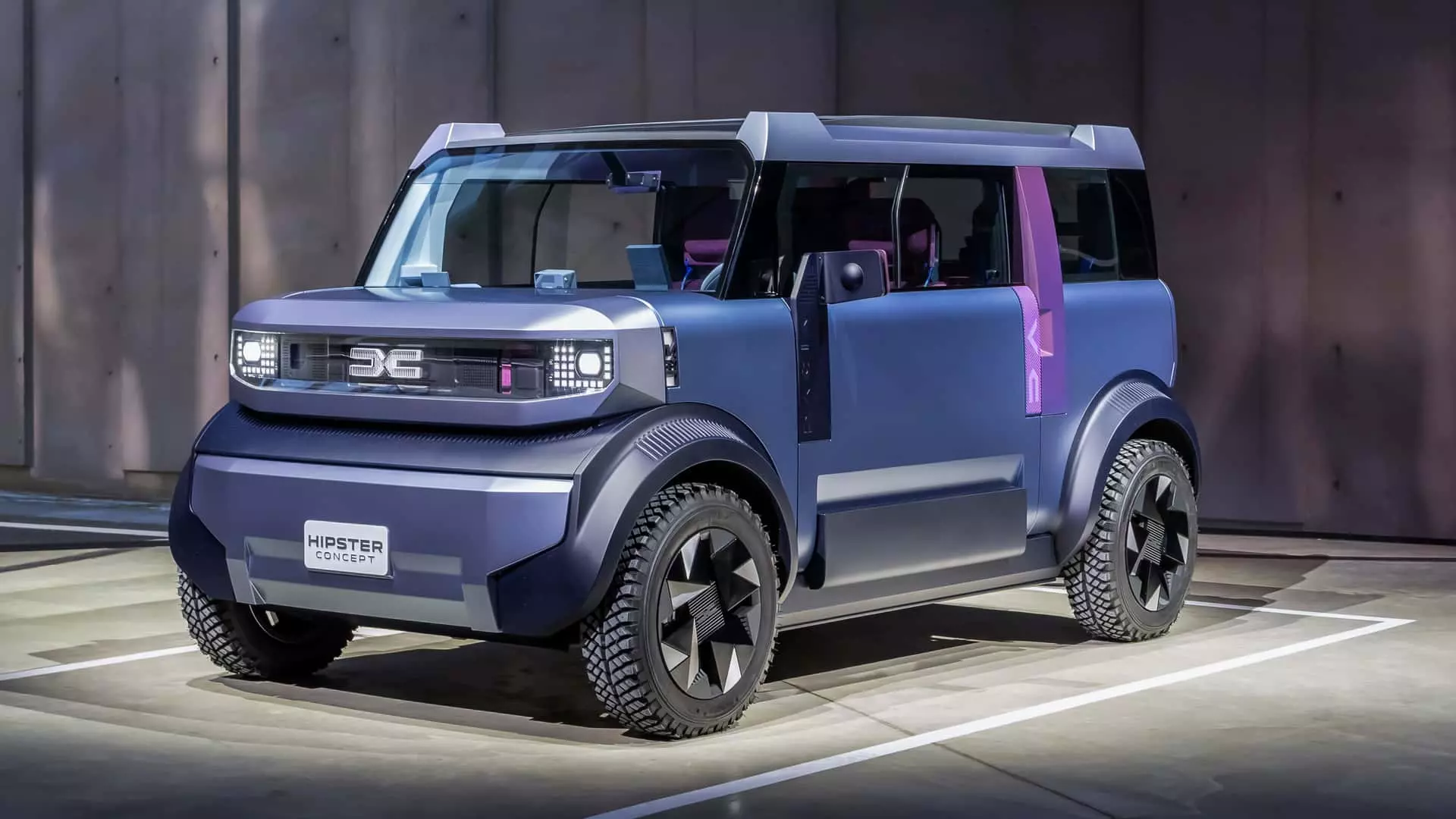
- Minimalist exteriors: The body employs recycled-plastic panels and a largely uniform single-color finish to reduce painting complexity.
- Strap door handles instead of mechanical handles to reduce parts count and weight.
- Full-width, split rear hatch (upper glass portion + lower opening) to reduce the need for separate glass housings for tail lamps.
- Sliding windows, rather than powered glass, to simplify mechanisms.
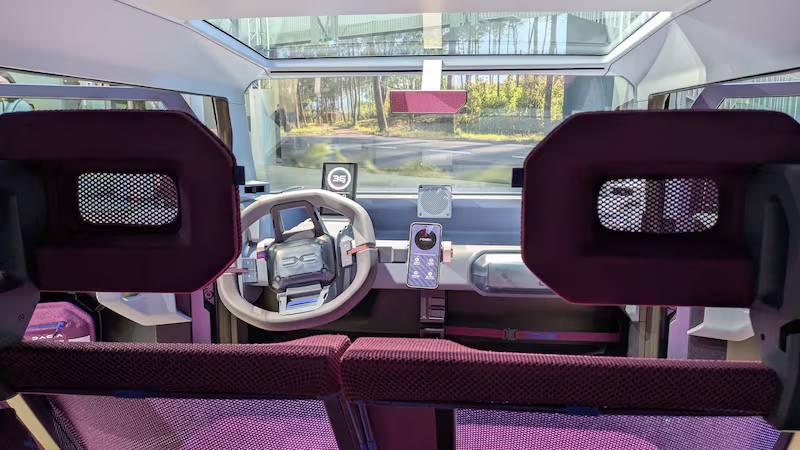
- Mesh / visible-frame seats, lighter materials, and a flat bench in front (with a tilting passenger side) to ease ingress and egress in a tight cabin.
- Minimal built-in electronics: rather than a dedicated infotainment screen, the Hipster reserves a dock for the driver’s smartphone to operate navigation/media.
- A “YouClip” modular mounting system inside (11 anchor points) to allow users to add cup holders, lights, armrests, etc.
- Dual airbags, a basic safety cage, and ISOFIX mounts for a child seat in the rear — enough to meet minimal safety norms without heavy extras.
Taken together, every element seems optimized for “just enough” — nothing wasted, no frills. It’s a philosophy of “what do people truly need for city mobility?” rather than designing for the extremes.
Strategic & Regulatory Context
Dacia is banking heavily on upcoming regulatory changes in Europe to make the Hipster feasible as a production model:
- The automaker is hopeful that the EU will approve a new class of lightweight, simplified electric vehicles (sometimes described as a European “kei-car” class) with relaxed safety/equipment rules for small urban cars.
- By reducing weight and complexity, Dacia aims to bring not just a lower purchase cost, but also a lower life-cycle carbon footprint, potentially halving the overall emissions from production to disposal vs. conventional EVs.
- The target price hinted by media outlets is under €15,000 (or under £15,000 in the UK), which would undercut most current affordable EVs (e.g. Dacia’s own Spring).
- However, Dacia has not publicly committed to a fixed production timeline. Observers speculate that production could begin in 2026–2027 if regulatory and market conditions align.
- A successful Hipster model would be a direct strategic counter to low-cost Chinese EV imports, which are pressuring European and Western makers in the budget segment.
In effect, the Hipster isn’t just an engineering exercise: it’s a gambit to reshape how we regulate, design, and price ultra-compact EVs.
Strengths, Challenges & Outlook
Strengths
- Lightweight basis: At sub-800 kg, energy demand is lower, meaning smaller battery packs can deliver usable range, reducing cost and resource use.
- Cost discipline: Its pared-down design can cut component, assembly, and maintenance costs.
- Urban fit: Modest top speed and short-range emphasize realistic usage patterns in cities, avoiding over-specification.
- Modular user personalization: The “YouClip” concept and modular add-ons allow supplementing function without embedding cost.
- Appeal to new segments: With a low price, many more people might be able to afford an EV, especially in Europe, where new car prices have risen sharply.
Challenges & Risks
- Safety vs regulations: Current safety and crash standards are tailored to heavier, more robust vehicles. Meeting them (especially in Europe) could force design compromises that add weight or cost — potentially eroding the advantages.
- Battery range & real-world conditions: The claimed ~100–150 km may shrink in cold weather, hilly terrain, or highway driving, limiting usability.
- Consumer perception: Many buyers expect certain conveniences (climate control, power windows, infotainment), and trading them away could hinder adoption.
- Economies of scale: To hit ultra-low cost, Dacia will need large volume — or highly efficient production methods — to amortize fixed costs.
- Regulatory pivot timing: If the EU or local regulators delay or reject the new lightweight-EV class, Dacia may be hamstrung by existing rules.
Conclusion
The Dacia Hipster Concept is a daring experiment — stripping down the electric car to its bare essentials while still delivering four seats, cargo space, and usable urban range. With a target weight under 800 kg and a modest quoted range (100–150 km), it is designed to rethink the assumptions around EVs: that they must be heavy, expensive, and bristling with high-tech features.
Whether it reaches production depends heavily on regulatory shifts in Europe, consumer acceptance of minimalism, and the ability to maintain safety without undercutting the core value proposition. But even as a concept, the Hipster signals a provocative direction: that the future of mobility might lie not in ever bigger, more powerful electric machines, but in smaller, lighter, simpler ones — ones built around real daily needs rather than aspiration specs.