
Huawei & SAIC Unveil Shangjie H5 Motor have kicked off pre-sales for the Shangjie H5, the debut model of their joint brand “Shangjie” (尚界), marking Huawei’s first push into China’s sub-RMB 200,000 intelligent EV segment in partnership with one of the country’s largest automakers.
The mid-size SUV opened reservations at a starting pre-sale price of RMB 169,800 (about USD 23,700), positioning it as the most affordable vehicle yet to carry Huawei’s full-stack cockpit and advanced driver-assistance tech.
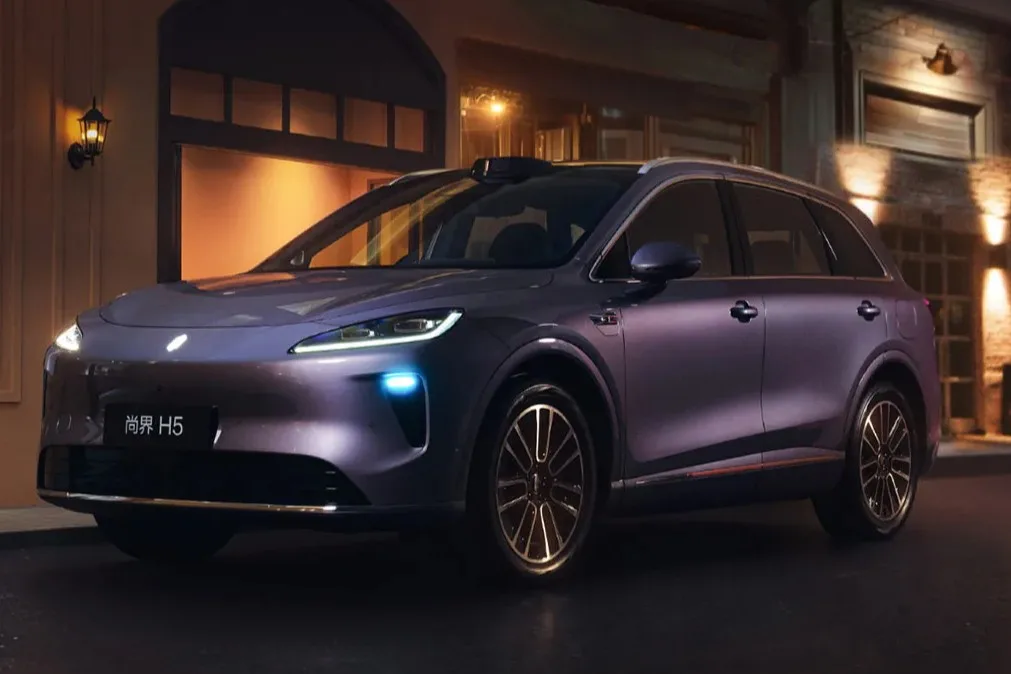
What Huawei and SAIC Are Bringing to Market
The H5 is offered in both BEV (battery electric) and REEV (range-extended electric vehicle) versions and will be sold across six trims during pre-sales, covering a band from RMB 169,800 to RMB 209,800. That dual-powertrain approach reflects SAIC’s manufacturing breadth and Huawei’s desire to “democratize” its software and sensing suite into China’s biggest volume price bands.
From a packaging standpoint, the H5 sits squarely in the mid-size SUV class. Chinese media list its wheelbase at 2,840 mm, with length/width/height around 4,780/1,910/1,657 mm—dimensions that line it up against best-sellers in the country’s fast-moving “mainstream intelligent SUV” cohort.
Performance, Range, and Variants
On the BEV side, the H5’s pure-electric variant is cited with a CLTC range of up to 655 km, while the REEV version is built around a 32.6-kWh LFP pack enabling about 181 km of electric-only range and a claimed combined CLTC driving range exceeding 1,300 km. These figures (CLTC is China’s relatively optimistic test cycle) underscore a strategy to address range anxiety while tapping China’s appetite for long-legged family SUVs.
The tech list aims to stand out at the price: ADS 4 for high-level assisted driving, lidar-based perception, and a HarmonyOS cockpit experience that Huawei has been refining across its “X-Jie” ecosystem (Aito/Wenjie, Zhijie, Xiangjie, Zunjie). Bringing those capabilities into a model that starts under RMB 170,000 is a deliberate move to expand Huawei’s installed base from premium down into the high-volume middle.
Demand Signal: A Hot Start
Early pre-sale signals were strong. Shangjie reported more than 25,000 pre-orders within the first hour, and over 50,000 within the first 18 hours—an indicator that the combination of price, features, and brand recognition is resonating. If those reservations convert at typical industry rates, the H5 could immediately rank among China’s best-selling intelligent SUVs this fall.
In line with that optimism, reporting indicates a monthly sales target of roughly 20,000 units for the H5 and a procurement plan implying up to 400,000 units annually across future lineup growth—ambitions that would put the Shangjie brand among the country’s most aggressive scale-up stories of 2025–2026. Launch Timing and Channel
Pre-sales commenced during Huawei’s HarmonyOS Smart Mobility autumn product event, with the full market launch scheduled for September 23. The vehicle is being promoted through Huawei’s HIMA channel strategy, which marries SAIC’s manufacturing and supply-chain strength with Huawei’s consumer-facing software, retail, and marketing playbook—a structure designed to pull more showroom traffic via Huawei’s nationwide footprint.
Competitive Set and Market Positioning
By price and silhouette, the H5 lands in one of China’s most contested battlegrounds. At its entry price, it lines up against successful domestic nameplates that mix smart features with pragmatic range and space, including models such as the Leapmotor C11, Xpeng G6, and Deepal/SL03-derived SUVs—segments where value, software fluency, and energy efficiency drive share gains. For the REEV, the promise of >1,300 km combined range and strong ADAS at <RMB 200k could be particularly compelling for buyers outside Tier-1 cities.
This is also Huawei’s first clear attempt to push its high-end intelligent driving experience into a true mass-market sticker. In previous collaborations, Huawei’s smartest systems often sat on vehicles starting above RMB 200,000; dropping the threshold to RMB 169,800 instantly broadens the addressable base. That strategic shift matters because the RMB 150k–250k window accounts for the lion’s share of China’s new-energy volume, especially for family SUVs.
Why It Matters
- Scale for Huawei’s Software Ecosystem. Every vehicle running HarmonyOS and ADS adds data, user touchpoints, and recurring revenue opportunities via services, upgrades, and app ecosystems. Moving those users into a sub-200k model can meaningfully accelerate adoption.
- A Manufacturing and Cost Story for SAIC. SAIC brings years of platform work, supplier leverage, and manufacturing capacity. The decision to field both BEV and REEV taps different buyer profiles and helps SAIC balance battery availability with market demand. The six-trim pre-sale structure (and top trim still under RMB 210k) shows an effort to hit multiple willingness-to-pay bands quickly.
- The China EV Middle Is Where the Action Is. Premium gets headlines, but the middle is where brands are built and sustained. If Huawei and SAIC can consistently ship ADS-equipped, HarmonyOS-powered SUVs with competitive efficiency at these prices, the H5 could pressure rivals to either lower prices or add costly sensors and compute—fueling another round of China’s EV feature-price competition.
Summary
Official deliveries are slated to begin after the September 23 launch, and all eyes will be on order-to-delivery conversion and production ramp. If Shangjie can keep monthly sales near the cited 20,000-unit target and avoid supply bottlenecks, the H5 could quickly join China’s mainstream best-sellers—especially in regions where mixed charging infrastructure makes REEVs attractive.
Meanwhile, reports suggest two additional Shangjie models are due next year, signaling a rapid cadence intended to hold consumer attention and maximize the benefits of a shared software stack and retail channel.
In short, the Shangjie H5 isn’t just another new SUV. It’s a marker: Huawei expanding its intelligent mobility footprint into mass-market territory, and SAIC leveraging its industrial scale to deliver high-spec electrified hardware at disruptive prices.
The early reservation numbers, the accessible pre-sale pricing, and the feature loadout make the H5 one of the most closely watched launches of the season. Whether it becomes a sustained volume hit will hinge on execution—software reliability at scale, production quality, aftersales, and continued pricing discipline—but the opening volley has clearly landed.
Key Facts at a Glance
- Pre-sale price: RMB 169,800–209,800; starts at RMB 169,800.
- Powertrains: BEV and REEV (range-extended) variants.
- Tech highlights: HarmonyOS cockpit; Huawei ADS 4, lidar-forward sensor suite.
- Size class: Mid-size SUV; ~2,840 mm wheelbase.
- Demand signal: 25k pre-orders in the first hour; 50k within 18 hours.
- Launch timing: Official launch set for September 23.