
Here’s a write-up on the confirmed “Hyundai affordable EV below Creta Electric” (meant to rival the Nexon EV and similar models) — based on what’s known so far.
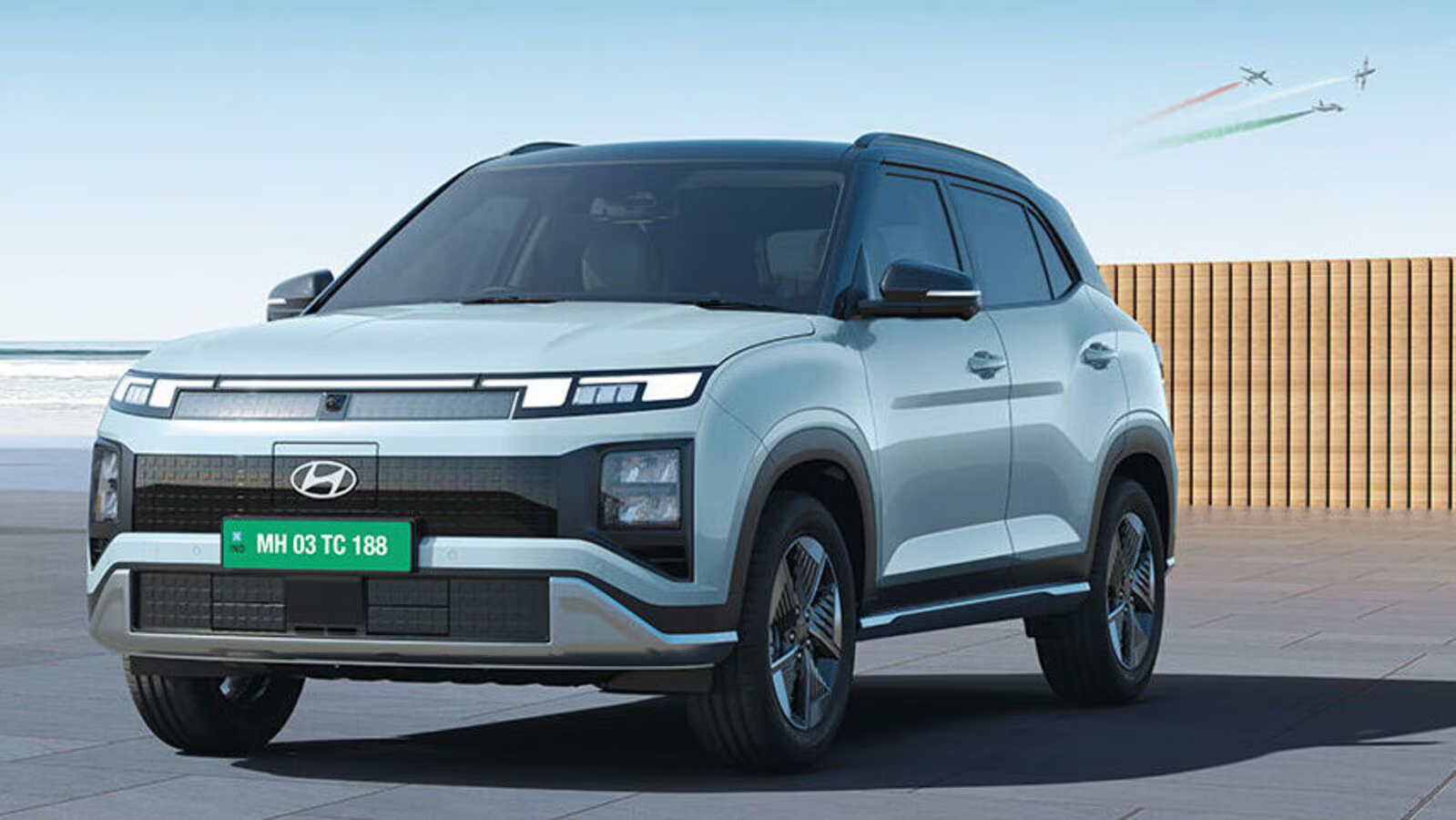
Hyundai’s Plan For a Mass-Market EV Below Creta
Hyundai has confirmed that it is working on an affordable electric SUV for the Indian market, one that will slot below the Creta Electric in its EV portfolio. The automaker uses a tagline akin to “India EV Accessible For All,” suggesting heavy localisation, cost control, and feature balancing to hit a competitive price point.
This new EV isn’t meant to replace Creta Electric but to complement it: Creta Electric serves the premium compact SUV (C-SUV) segment, while this new model will target the B-segment / sub-4m compact SUV (Venue-sized) class. In other words, Hyundai is trying to compete with existing electric subcompact SUVs such as the Tata Nexon EV, Tata Punch EV, and Citroën eC3.
According to Hyundai’s roadmap, this India-designed and manufactured EV is expected by 2027.
Key Expected Features & Technical Strategy
From leaks, reports, and industry speculation, here’s what to expect (or what to keep in mind as possibilities).
Battery / Range Options
Hyundai plans to offer two battery variants for this model:
- A Standard Range pack, tuned for city / urban driving duty cycles.
- A long-range pack, aimed at highway usability and longer trips.
The precise capacity and range figures are not yet revealed, but they will likely aim to deliver competitive numbers vis-à-vis Nexon EV and rivals (which currently offer ranges between ~275 km to ~480 km depending on variant).
To keep costs in check, Hyundai would rely on a high degree of localisation (parts, supply chain, manufacturing) specifically for India.

ADAS, Features & Tech
One of the more talked-about inclusions is Level-2 ADAS (Advanced Driver Assistance Systems). Hyundai says it will provide such driver aids — not just for driving but also for parking assistance functionality. That suggests features like adaptive cruise control, lane keeping, and perhaps automated parking (to a degree) could be part of the offering.
Given Hyundai’s recent launches, we can reasonably expect a decent tech stack: dual large screens (infotainment + digital cluster), connected car services, over-the-air (OTA) updates, regenerative braking, possibly V2L (vehicle-to-load) or V2X support (depending on cost tradeoffs), smart charging options, etc.
On the safety front, Hyundai would likely ensure basic crash safety standards, airbags, stability controls, and ideally structural strength to meet Indian safety norms. Whether the lower model would get higher safety tech will be a balance of cost vs value.
Design, Size & Positioning
Reports strongly indicate that the upcoming model will be built in the compact SUV / sub-4m SUV class, akin to the Venue in size. It will be physically smaller than Creta (which is a C-SUV). The focus will be on maximizing cabin space, efficient packaging, and cost-effective construction.
Styling will likely carry forward the modern electric / “EV signature” language that the brand is evolving (closed grilles, sharp lighting elements, aerodynamic surfaces, etc.). Hyundai’s global EV experiments (like the Ioniq series) may influence the aesthetic direction.
Pricing & Market Position
A big part of the value proposition will be hitting an attractive price point in a fiercely competitive and price-sensitive market.
- Some speculators expect the ex-showroom price to start under ₹10 lakh, and go up to maybe ₹18 lakh for better variants.
- That would place it well below Creta Electric, which currently has a starting price of ~₹18.02 lakh (ex-showroom) in India.
- In that sense, Hyundai is aiming for a model that trenches competition from Tata Nexon EV (₹12.49 lakh base and up), and also the smaller end of the Punch EV / eC3 class.
Such pricing ambition will depend heavily on Hyundai’s ability to localize parts, scale production, and optimize the supply chain.
Competitive Landscape & Challenges
Let’s see where Hyundai’s new EV will have to operate:
- Tata Nexon EV is a strong incumbent, with multiple battery/variant choices, improving feature set (it now also has Level-2 ADAS in newer variants).
- Tata Punch EV and Citroën eC3 are more entry-level electric SUVs; Hyundai’s model will likely aim to outperform them in features and perceived brand value.
- Newer offerings and upcoming EVs will intensify competition too; Hyundai must differentiate via features, quality, and after-sales network.
- Price sensitivity in India is high: buyers may reject features to save cost, or stick with ICE / hybrid options if EV prices remain high.
- Charging infrastructure, battery life/durability, resale perceptions, and servicing will all matter.
Hyundai has some advantages: brand trust, dealer/service footprint, global EV R&D, and scale. But it also must ensure that the final product delivers value without exceeding cost.
Timeline & Outlook
- Hyundai expects this India-designed and built electric SUV by 2027.
- Before that, Hyundai’s roadmap already marked this model as a key part of its “accessible EV” ambition for India.
- The launch might follow or accompany the upcoming new Venue petrol / ICE refresh (which is due soon).
- Between now and then, we’re likely to see teasers, concept leaks, and more concrete specs emerge.
If Hyundai can execute well, this model could become a game changer in India’s EV market — lowering the effective “entry barrier” into electric SUVs while maintaining brand promise. But it’s a tough balancing act: offering a compelling feature set and range while keeping costs low enough to rival established players.