
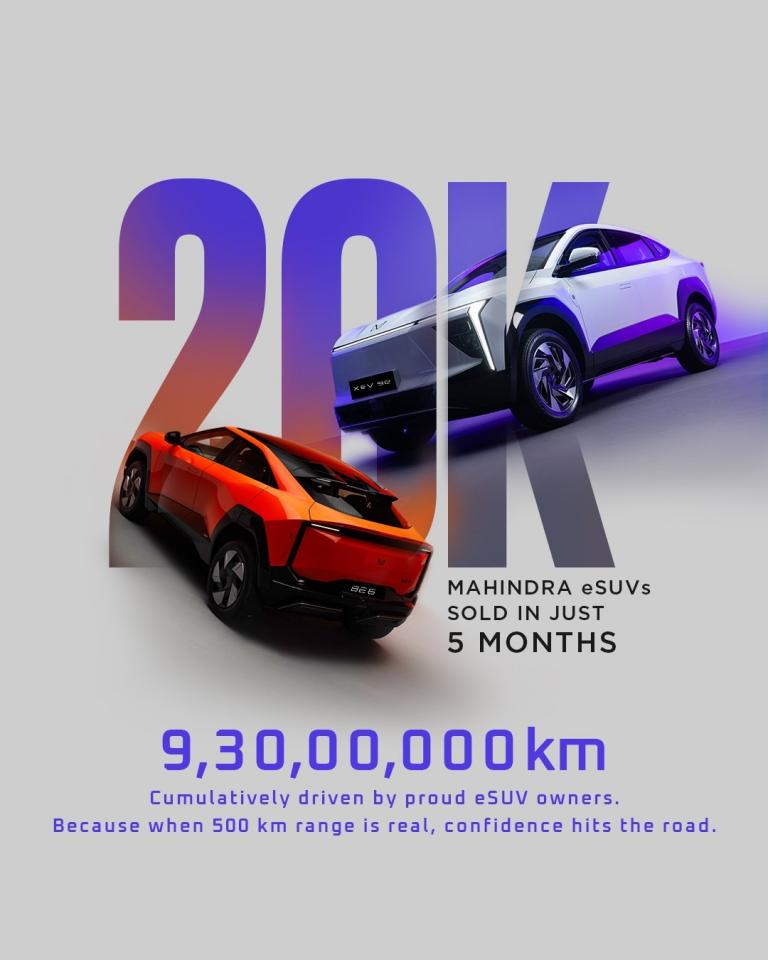
Mahindra’s Electric Origin SUVs—the BE 6 (Born Electric) and the XEV 9e—have achieved a remarkable milestone. As of early September 2025, these two SUVs have collectively surpassed 20,000 units sold in just five months, signaling a breakthrough in India’s EV adoption curve.
This is more than just a number—it’s emblematic of a paradigm shift. These e-SUVs are being embraced as primary family vehicles, not merely as niche city run-arounds, thanks to their bold design, practical range, swift charging, and strong value proposition.
From Launch to 20,000 Sales: The Journey
Launch & Early Momentum
- Launch and bookings: Introduced in early 2025, bookings for BE 6 and XEV 9e surged immediately, with over 30,000 bookings reported in early 2025.
- First 70 days: By early June 2025, Mahindra announced that both models had sold over 10,000 units in just 70 days—translating to roughly one SUV sold every 10 minutes.
Production & Sales by Mid-2025
- In the first half (H1) of 2025, Mahindra produced 19,915 units of these SUVs and dispatched 19,070 units to dealerships.
- Retail sales stood at 12,585 units, up from just 3,870 units in the same period in 2024—a staggering 225% year-over-year growth.
Five-Month Snapshot
- By May 2025 (five months post-launch), cumulative production and sales had already topped 15,000 units. May alone saw 3,692 units produced and 4,021 dispatched—the highest monthly volume yet for these e-SUVs.
- Since then, deliveries continued at this pace, pushing the collective sales beyond 20,000 units by early September 2025.
What’s Driving This Electrifying Growth?
Cutting-Edge EV Technology
Built on Mahindra’s INGLO modular skateboard EV platform, both models combine long-range batteries, fast charging, and family-friendly interiors.
- Range: The 79 kWh battery offers a certified ARAI range of up to 682 km for BE 6 and 656 km for XEV 9e, with real-world range comfortably in excess of 500 km.
- Fast charging: Both support DC fast charging from 20% to 80% in just 20 minutes.
Performance & Dynamics
- Powertrain: The 79 kWh variant delivers up to 286 bhp and 380 Nm torque, enabling a 0–100 km/h sprint in around 6.7 seconds, with top speeds exceeding 200 km/h.
- Ride & Handling: Rear-wheel drive dynamics plus features like multi-link rear suspension (with frequency-selective dampers in BE 6) result in a composed and comfortable ride tailored for Indian road conditions.
Interiors, Tech & Safety
- Cockpit & infotainment:
- BE 6: twin-screen layout.
- XEV 9e: standout triple-screen setup.
- Features: Both SUVs offer Level 2+ ADAS, self-parking, a 16-speaker audio system, and spacious layouts with flat-floor interiors, frunk, large boot, and superior rear-seat comfort—especially in XEV 9e.
- Safety: Both have earned a 5-star Bharat NCAP rating, with multiple airbags, a sturdy shell, and advanced driving aids.
Strong Value & Cost Savings
- Running cost is estimated at ₹1.1/km, compared to around ₹9/km for ICE SUVs—leading to savings of over ₹12-13 lakh over five years.
- Owners also benefit from EV incentives—state subsidies, road-tax exemptions, and loan interest deductions up to ₹1.5 lakh.
Market Momentum & Strategy
- Mahindra’s e-SUVs now account for 6% of its total SUV wholesales (January–May 2025), up from a negligible presence.
- In the EV passenger-vehicle segment, Mahindra’s share has surged to 17%, doubling from 8% a year earlier—placing them behind Tata (38%) and MG (32%).
Strategic Insights: Why the XEV 9e Often Edges Ahead
Several factors make the XEV 9e more appealing in India’s market:
- Size & comfort: Larger dimensions, higher road presence, and significantly more boot (663 L vs 455 L in BE 6 frunk included) make it more practical for families.
- Interior wow-factor: Triple-screen layout and more spacious rear seating provide a stronger ‘premium’ feel.
- Price perception: Base-model price difference (~₹3 lakh) between BE 6 and XEV 9e is small enough that buyers often choose XEV 9e for its added value.
- Sales data: In March and April 2025, XEV 9e outsold BE 6 by significant margins—e.g., in April, 2,441 XEV 9e units vs 550 BE 6 units.
What This Means for India’s EV Landscape
- Ev Bridging the Trust Gap: Strong adoption in real-world SUVs signals rising consumer confidence in electric mobility for mainstream usage.
- Mahindra’s EV Credibility
- Market Competition Heating Up: While Tata and MG remain leaders, Mahindra’s rise sets the stage for a fierce competition in 2026, especially as lower-priced variants roll out.
- Scaling Up to Mainstream: Early reliance on premium Pack Three variants (79 kWh) created hype, and as lower-priced 59 kWh variants (Pack One/Two) begin delivery, further acceleration in sales is likely.
Summary Snapshot
| Metric | Value / Insight |
|---|---|
| Sales (5 months) | 20,000+ units sold |
| First 70 days | 10,000+ units sold (~1 SUV every 10 min) |
| H1 production/dispatch | ~19,900 produced / ~19,070 dispatched |
| Started H1 retail sales | ~12,585 units (+225% YoY growth) |
| Range | 500 km+ real-world; 79 kWh certified ~656–682 km |
| 0–100 km/h | ~6.7 seconds |
| Charging (20–80%) | ~20 minutes (DC fast charge) |
| Cost savings vs ICE | ₹12–13 lakh over 5 years; ~₹1.1/km running cost |
| EV passenger vehicle market share | 17%, up from 8% a year earlier |
Conclusion
Mahindra’s BE 6 and XEV 9e crossing the 20,000 sales milestone in just five months is a watershed moment for Indian EVs. These e-SUVs don’t just offer cutting-edge EV technology—they deliver real value, range, performance, and practicality. They position electric SUVs as not just viable, but desirable first-choice family cars.
As variant availability broadens and Mahindra ramps up production, their share in the electric SUV space can only grow further—possibly setting the stage for challenging market leaders in the near future.