

Here’s a detailed look at GST 2.0 in India and what it means for the Mahindra Thar, which has seen price cuts of up to ₹1.35 lakh, depending on the variant. I’ll cover what GST 2.0 is, how the tax changes affect cars like the Thar, exactly how much cheaper the Thar is now, and what to keep in mind ahead.
What is GST 2.0?
“GST 2.0” refers to the revised Goods & Services Tax (GST) regime announced in 2025 by the Indian government, which overhauled how automobiles (among other goods) are taxed. Some of the principal changes are:
- The previous system of multiple GST slabs (28%, 18%, etc.) plus “compensation cess” has been simplified.
- For passenger vehicles, especially SUVs and large cars, the total tax load (GST + cess) was previously quite high—often approaching or exceeding 45-50% depending on the segment.
- Under GST 2.0, there are three key tax slabs relevant to cars:
- 5% for EVs (electric vehicles) remains.
- 18% GST for “small cars” (petrol/LPG/CNG cars ≤1,200 cc or ≤4,000 mm in length; diesel ≤1,500 cc ≤4,000 mm) and similarly small/massed segments.
- 40% GST for larger cars/SUVs/premium models, i.e., those exceeding the small-car thresholds (bigger engine, longer length, SUVs, etc.). The compensation cess is removed under the new regime.
- These tax changes are effective from September 22, 2025, for many models. In many cases, manufacturers have been allowed to pass on the benefits earlier (from around September 6 in Mahindra’s case).
How GST 2.0 Impacts the Mahindra Thar
Mahindra is among the manufacturers that have responded by reducing ex-showroom prices of its internal combustion engine (ICE) variants of SUVs, including the Thar family, to pass on the tax benefits to consumers.

Since the Thar is not a “small car” under the GST 2.0 definitions (because of size, engine capacity, etc.), it falls in the 40% GST slab now, which is lower than its earlier effective taxation (GST + compensation cess). That means its tax burden has come down, hence the price reductions.
How Much Has the Price of the Mahindra Thar Been Cut?
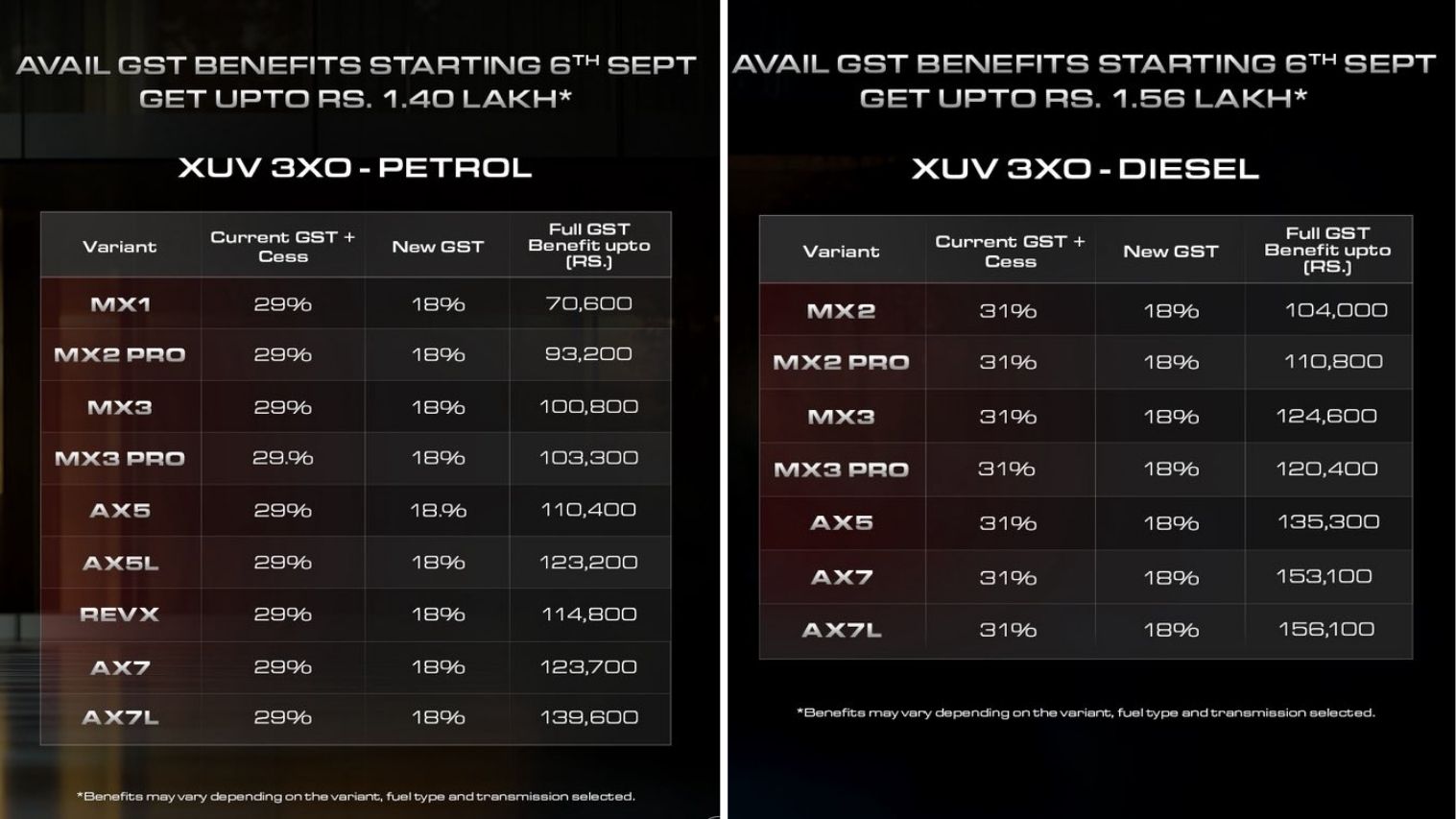
Depending on the variant, the Thar now costs ₹81,400 to ~₹1.35 lakh less than before the GST rate change. Here are some specific numbers:
| Variant | Earlier price burden (GST + Cess) | New tax slab | Approximate Price Cut |
|---|---|---|---|
| Thar 2WD (Diesel) | ~31% GST + Cess | 18% Slab | ₹1.35 lakh |
| Thar 4WD (Diesel) | ~48% (GST + Cess) | 40% Slab | ₹1.01 lakh |
| Thar Roxx (various variants) | ~48% old, now 40% | Savings vary by variant | Up to ₹1.33 lakh |
- The biggest cut for Thar is on the 2WD Diesel variant (~₹1.35 lakh).
- Even on the 4WD Diesel version, the reduction is significant (₹1.01 lakh).
- The variant-wise savings for the more premium Thar Roxx models vary (some lower, some higher) depending on engine and transmission.
Why These Specific Reductions?
A few nuances:
- Tax Slab Shift: The removal of the compensation cess and the shifting to a lower or more fitting GST slab is primarily why these savings materialize. A Thar 2WD Diesel, earlier taxed at a higher effective rate, now faces lower tax.
- Variant Differences: Variants with larger engines, additional features, or 4WD capability often had even higher old tax burdens, so while their price cuts are large, as a percentage of price, they might be less dramatic. Also, manual vs automatic versions, petrol vs diesel, etc., affect the savings.
- When the New Prices Apply: Although the formal effective date for the GST change is September 22, many automakers (including Mahindra) have started applying the new prices earlier (from September 6). This means you could benefit even before the formal date if you’re booking/delivering around this period.
What the Savings Mean to Buyers
- Affordability increases: A drop of ₹1 lakh+ on a car like Thar (especially on the 2WD Diesel variant) is significant—it can make the difference between stretch financing vs comfortable payments.
- Competitive dynamics: Other SUVs in similar segments will face pressure to also pass on tax benefits, which could lead to competitive pricing, better offers, or more value-added features.
- Festive season advantage: As these cuts happen ahead of major sales periods (like festivals), buyers may be more inclined to buy now rather than later, especially as waiting could mean losing this benefit or seeing other costs creep up.
- Clarity & simplification: With the new tax system, there is less confusion about how much of the price is due to GST vs cess, and the tax slabs are more predictable. That gives both buyers and dealers clearer visibility.
Things to Watch / Caveats
While the reduction in price is good news, some caveats:
- On-road price vs ex-showroom price: The numbers quoted are ex-showroom price savings. Once you add registration, road tax, insurance, and other fees, the total savings will be somewhat less. The tax reduction only affects the GST portion, not state taxes or other local levies.
- Variant/feature dependency: More loaded variants with features or different engine/transmission combos may see smaller (percentage-wise) reduction, even if the absolute amount is big. Always check variant-wise pricing with the dealership.
- Availability & delivery: Since many buyers might rush after the GST change, there could be constraints in delivery, waiting periods, or limited stock for certain trims/colors. If you’re interested, it may make sense to act sooner rather than later.
- Future price changes: Auto manufacturers often revise prices – for example, cost escalation in materials, logistics, or inflation might lead to new hikes later, especially after the festive season. The current reduction might be one-off, tied to the tax reform.
Broader Impact & What This Suggests
- The GST 2.0 move signals the government’s intent to stimulate demand in the auto sector by making vehicles more accessible. Reducing tax burden, especially on popular SUVs, can help boost sales.
- It also levels the playing field between ICE and EV vehicles a bit, although EVs already had low GST (5%), so their comparative advantage remains. But for consumers who were delaying buying SUVs due to high taxation, this could tilt decisions.
- Manufacturers like Mahindra passing on full benefits (instead of partially or delaying) show competitive pressure and consumer sensitivity. It’s also good optics for brand reputation. Anand Mahindra (chairman) acknowledged this in communications.
Summary
- Under GST 2.0, the Mahindra Thar (especially its ICE variants) has become cheaper by up to ₹1.35 lakh, depending on the model and variant.
- The tax realignment (removal of cess, revised slabs) is the key driver.
- Buyers interested in the Thar should check with local dealers for exact variant pricing, how much goes off ex-showroom, and what the final on-road price (with state taxes, etc) comes out to.