
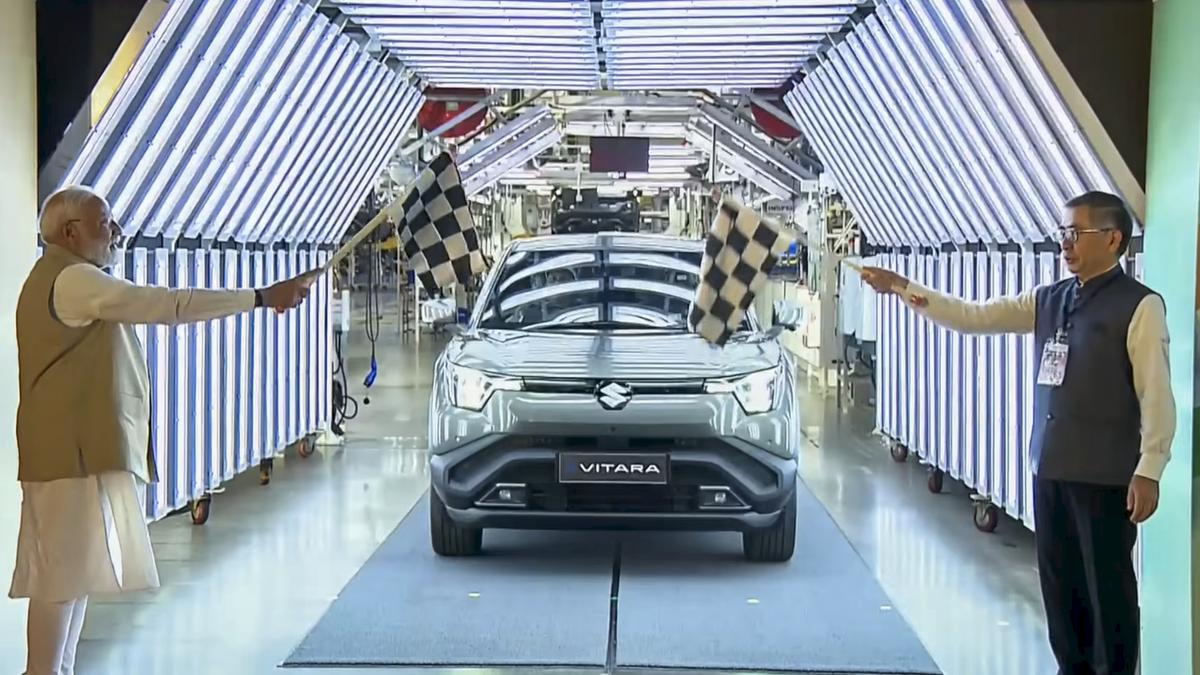
On August 26, 2025, Prime Minister Narendra Modi officially flagged off the Maruti Suzuki e‑Vitara, marking a historic milestone as the company’s first fully battery electric vehicle (BEV). The event took place at the Hansalpur manufacturing facility in Gujarat, positioning India as a key global hub for EV production and exports.
Context & Significance
- The e‑Vitara is the first mass-produced electric vehicle by Maruti Suzuki, representing a pivotal shift in the automaker’s strategy towards cleaner, sustainable mobility.
- PM Modi’s address emphasized that this launch is a major “big leap” for the Make in India and Aatmanirbhar Bharat initiatives, underscoring India’s growing self-reliance in clean technology.
- With production beginning from this facility, India is set to become Suzuki’s global production hub for EVs, in line with the company’s strategic vision.
Production & Export Plans
- The Hansalpur plant in Gujarat, wholly owned by Suzuki Motor Corporation, will serve as the manufacturing base for the e‑Vitara.
- The vehicle is slated for export to over 100 countries, including key markets such as Japan and Europe.
- Suzuki has pledged to invest approximately ₹70,000 crore (around $8 billion) in India over the next five to six years to scale up its operations, launch new models, and strengthen its foothold in the EV space.
EV Ecosystem & Infrastructure
- As part of the electric ecosystem expansion, PM Modi also inaugurated a hybrid battery electrode production facility at the TDS Lithium-Ion Battery plant—a joint venture involving Toshiba, Denso, and Suzuki.
- With this, over 80% of the battery value chain will now be domestically manufactured, including cells and electrodes, reinforcing India’s battery supply ecosystem.
- The government also launched the National Critical Mineral Mission, aimed at bolstering exploration and ensuring domestic sourcing of rare-earth minerals essential for EV batteries.
The e-Vitara: Technical & Market Outlook
- Originally introduced in November 2024 in Milan (Suzuki e‑Vitara) and showcased at the Bharat Mobility Global Expo in January 2025, the vehicle represents Suzuki’s global EV debut.
- Built on the Heartect‑e platform—an EV-specific iteration of Suzuki’s lightweight Heartect architecture—the e‑Vitara uses LFP (lithium-iron-phosphate) batteries, offered in 49 kWh and 61 kWh configurations.
- Power outputs range from 106 kW to 128 kW, with an all-wheel-drive variant (AllGrip‑e) delivering up to 135 kW and 300 Nm—incorporating Toyota-developed eAxle technology.
- The vehicle is offered in both 2WD and AWD, and for international markets like Europe, it boasts WLTP-certified ranges of up to 426 km on the larger battery.
Infrastructure & Support
- Maruti Suzuki has announced plans for a robust charging and after-sales support network:
- Smart home chargers with installation assistance will be offered to customers.
- A public fast-charging network will be rolled out in the top 100 cities within the next 2–3 years, with charging stations every 5–10 km.
- Over 1,500 EV-ready workshops will be set up in more than 1,000 cities for service and maintenance.
Economic & Environmental Impacts
- The ramp-up of EV production and battery manufacturing will not only stimulate job creation and investment but also further India’s clean energy push. The indigenous production of critical battery components marks a shift from earlier dependence on imports.
- However, recent analysis indicates that EV adoption in India remains modest—just about 2% of total vehicle sales, with a target of 30% by 2030. Constraints such as limited charging infrastructure, battery life concerns, and range anxiety continue to curb adoption.
Summary
- The launch of the Maruti Suzuki e-Vitara, flagged off by PM Modi on August 26, 2025, stands as a game-changing moment in the Indian automotive and green mobility landscape. It signals a strategic pivot toward mass-scale EV manufacturing, self-reliance in critical battery components, and global export ambition.
- With strong government backing, sizable investments, and a clear roadmap for infrastructure and supply-chain localization, India is poised to accelerate its journey toward becoming a major player in the global EV arena—especially under the banners of Make in India and Make for the World.
- Yet, long-term success will depend on overcoming lingering adoption challenges. Scaling infrastructure, building consumer trust, and maintaining supply security will all be crucial as the nation pursues its green mobility vision.