
Here’s a detailed discussion of what’s happening with Royal Enfield’s decision to delete the gear position indicator from its 350 cc models, why it’s happening, how riders are reacting, and what it means.
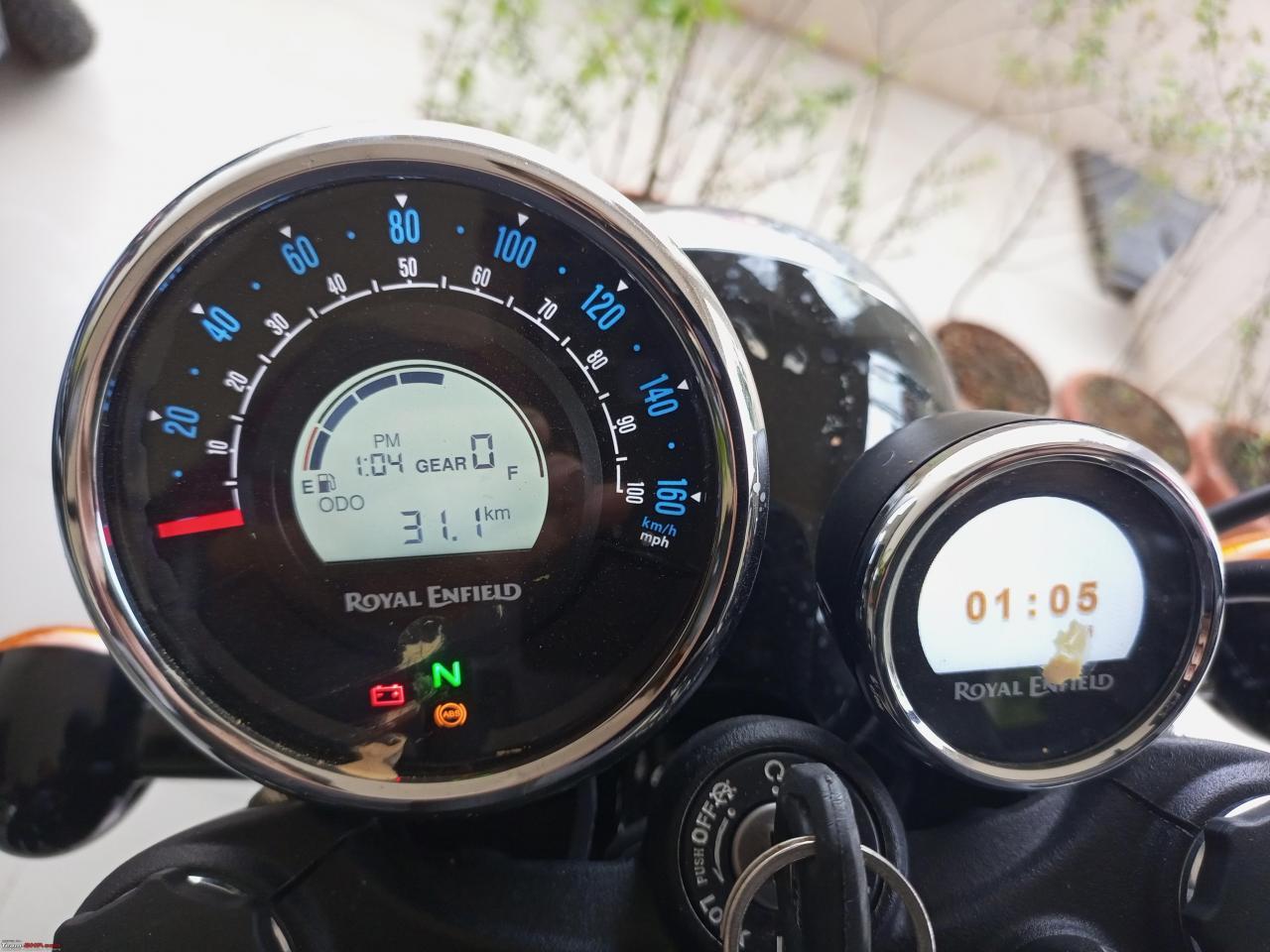
What is Happening: Deletion of the Gear Position Indicator
In October 2025, multiple automotive news outlets reported that Royal Enfield had temporarily removed the gear position indicator from its 350 cc (J-series) motorcycles. Models such as the Meteor 350, Classic 350, Hunter 350, Bullet 350, and Goan Classic 350 are being shipped without the gear position display.
Instead of the full gear readout (showing 1, 2, 3, 4, 5, etc), the bikes will now revert to only a neutral light indicator (i.e., just whether the gearbox is in neutral or not) for the time being. Royal Enfield has reportedly issued a circular to its dealers explaining this change and stating that once the necessary components are available, the gear position indicator will be retrofitted free of cost to affected bikes.
The upside is that the deletion is supposed to be temporary. Royal Enfield says this is a workaround rather than a permanent removal.
Why this Change: Supply Constraints & Rare-Earth Materials
The core reason given is a shortage in supply of certain electronic components—particularly sensors that rely on rare-earth materials and magnetic elements such as neodymium. The gear position sensor in many modern bikes is of a Hall-effect or magnetic sensor type: it detects the magnetic field from a shift drum or magnet, and thus outputs which gear is engaged. That sensor (or its magnet/chip) uses rare-earth magnet materials.
Because supply chains (especially for rare-earth magnets) have been under pressure globally, Royal Enfield has reportedly run into constraints in procuring enough of these sensor assemblies. In effect, to avoid halting production or delivery, the decision was made to omit the gear indicator temporarily.
In simpler terms, the bikes still have the same engine, transmission, electronics, etc. They just lack that extra sensory module (or magnet + chip) needed to tell the instrument cluster which gear you’re in. They will still show neutral.
Other models (e.g., in RE’s 450 or 650 line) are reportedly not yet affected by this deletion.
Practical Implications for Riders
Usability & Rider Experience
- For many experienced riders, losing the gear number display may not be a dealbreaker. Many riders already shift by engine sound, gear feel, or experience.
- However, for new or less experienced riders, having a gear readout is a convenience — especially in mixed traffic, stop-go riding, or on new roads where knowing the gear helps with smooth riding.
- In situations like crawling in traffic or going uphill/downhill, gear indication helps avoid frequent mistakes (e.g., thinking you’re in a higher gear than you are). Without that, riders rely more on intuition.
Customer Concerns & Reactions
- Online forums and communities have flagged this change. Some new buyers noticed their bikes lacked the display and raised questions.
- Some expressed frustration that a modern feature was being removed amid supply issues, while other brands may manage to maintain them.
- Some owners reportedly received communication from RE saying the part would be retrofitted later.
- Discrepancies in batches are also noted—some bikes built earlier still have the gear display, newer ones don’t.
What About Retrofitting and Warranty
- According to reports, Royal Enfield plans to retrofit the gear position indicator later, when the components are available, at no extra cost to the owner.
- The firm has advised dealers to note in service and delivery records which bikes were delivered without the sensor so they can be updated in the future.
- This ensures that owners will eventually receive the full functionality if they maintain contact with their dealers.
Broader Context & Risks
This incident highlights how even “conventional” internal combustion motorcycles depend on global supply chains for seemingly small electronic components. The dependence on rare-earth magnets and semiconductors is not limited to electric vehicles.
This also touches on a risk: when a particular component or resource becomes scarce, manufacturers may have to make compromises (feature removal, model delays, cost increases) to maintain throughput. Royal Enfield’s choice suggests it weighs timely deliveries and maintaining production more heavily than preserving all features in the short term.
If the supply issue persists long-term, there might be implications:
- Delays in resuming full-featured versions
- Increased costs or alternative sensor design
- Possibly reevaluating features that depend on rare or hard-to-source materials
Summary
In summary:
- Royal Enfield has temporarily removed the gear position indicator from its 350 cc line (Meteor 350, Classic 350, Hunter 350, Bullet 350, Goan Classic 350) due to a shortage of gear position sensors, especially the magnet/electronics parts that use rare-earth materials.
- Until further notice, these bikes will offer only a neutral light indicator, with the full gear readout missing.
- Royal Enfield has committed to retrofitting the missing component later (free of cost) once availability improves.
- The change affects usability (especially for newer riders) and reflects how even small components can be bottlenecks in modern vehicle manufacturing.
- The eventual return of the gear indicator depends on component supply stabilization and whether the company can redesign or source alternate sensor solutions.