
Tesla Rolls out Robotaxis: Here’s an enhanced and detailed overview of Tesla’s recent rollout of robotaxis in Texas—a major milestone that sets in motion the next phase of autonomous ride-sharing.
🚕 What Did Tesla Launch in Texas?
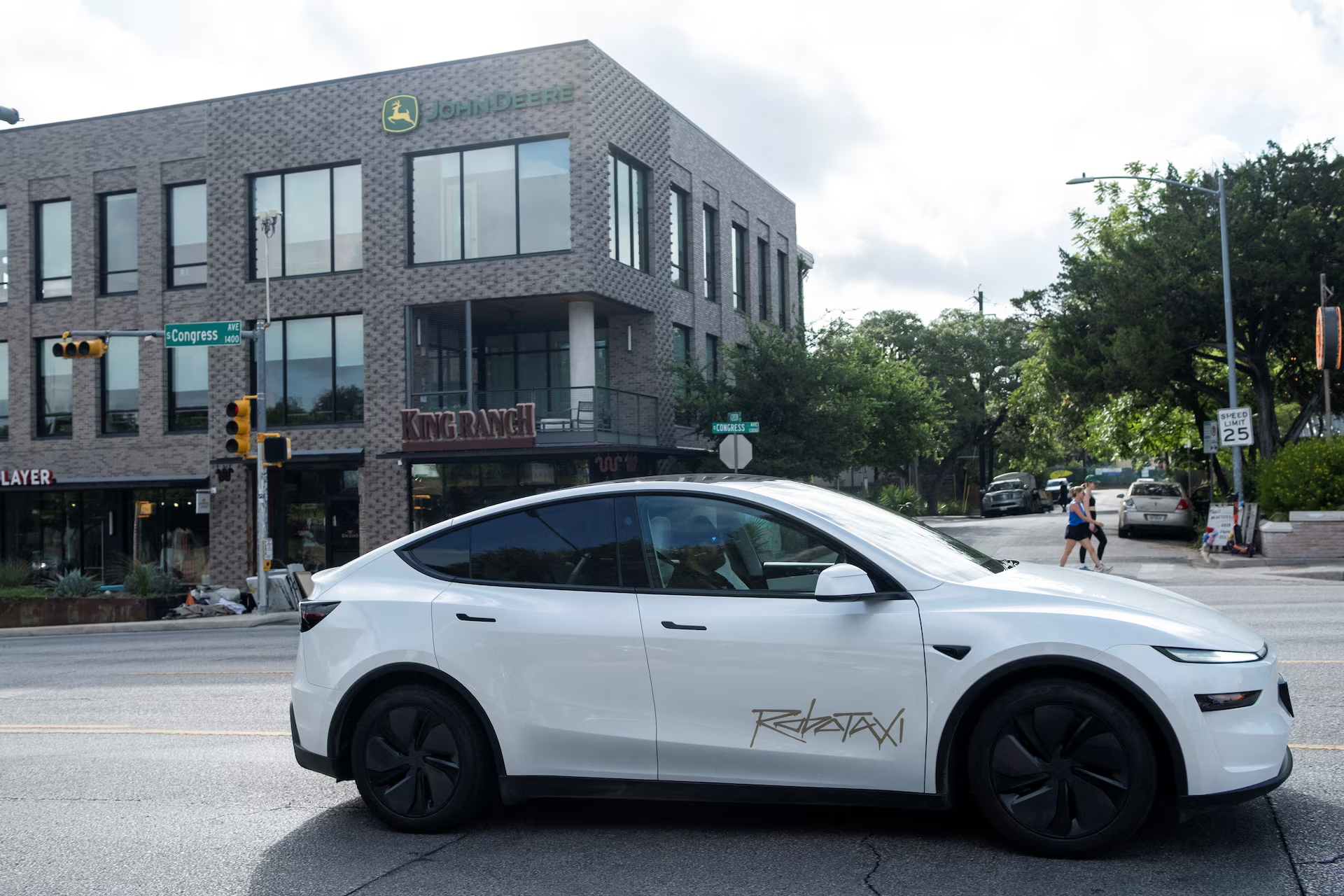
On June 22, 2025, Tesla launched its pilot robotaxi service in Austin, Texas. This marks the first time that Tesla vehicles—with no one behind the wheel—have carried paying passengers.
-
The service is invite-only, available only to select Tesla investors and pro-Tesla influencers, and is not yet open to the public.
-
It’s operating with around 10–20 Model Y SUVs equipped with “Robotaxi” decals, using Tesla’s Full Self‑Driving (FSD) software.
-
Trips are charged at a flat fee of $4.20, Musk’s trademark figure.
— Tesla (@Tesla) June 22, 2025
🛠️ Safety Measures & Constraints
To ensure safety during this initial phase:
-
A safety monitor — a Tesla employee — sits in the front passenger seat, with a hand on a kill switch or door handle.
-
The service is restricted to a mapped, geofenced area in South Austin, enclosed by key roads like Highways 183, 290/71, and the Colorado River.
-
It operates only from 6 AM to midnight, avoiding complex environments such as airports, highways, or during inclement weather.
-
Tesla uses chase cars and remote operators as backup in some instances.
-
The rollout complies with Texas regulations, including a Republican-backed bill effective Sept 1 requiring permits and processes for crash coordination and recording.
🧭 Rider Experience: What It’s Like
-
Access is via a Tesla Robotaxi app, similar to Uber’s interface, where riders summon a vehicle and board after verifying their identity with the safety monitor.
-
Upon arrival, riders interact with in-car screen UIs to confirm seatbelt fastening and begin the ride. Safety features include “support” buttons that connect riders to remote operators.
-
User feedback has been positive overall, describing rides as “smooth,” “great,” or “normal,” with minor hiccups like app access or pickup location delays.
-
Notable quotes:
“This is like Pokémon hunting, but it’s robotaxi hunting.”
🔄 How It Compares in the AV Race
-
Waymo currently operates around 1,500 fully driverless rides across multiple U.S. cities and is expanding.
-
Zoox (Amazon) is preparing its service, and various players like Alphabet and Cruise remain cautious in deployment strategies.
-
Tesla differs in technological approach by relying solely on cameras and neural net FSD, rather than lidar/radar, a method some experts criticize.
🎯 Strategic Timing & Regulatory Context
-
Elon Musk framed the rollout as the “culmination of a decade of work”, with Tesla’s in-house AI and chip teams as foundational.
-
Nonetheless, federal oversight is underway: the U.S. National Highway Traffic Safety Administration (NHTSA) is reviewing Tesla’s safety protocols following past crash incidents.
🛣️ What Lies Ahead
Tesla’s future roadmap includes:
-
Scaling to 1,000 robotaxis within “a few months,” per Musk.
-
Extending rollout to California and possibly more Texas regions—subject to permitting.
-
Eventually,y adding its Cybercab, a fully autonomous sedan without a steering wheel or pedals, is expected around 2026–2027.
-
Converting existing Teslas into robotaxis via over‑the‑air FSD updates, with potential for millions of such vehicles.
🔍 Big Picture: What It All Means
| Dimension | Implication |
|---|---|
| Tech | First real-world test of Tesla’s camera-only FSD on paying customers. |
| Business | New revenue opportunity amid slumping EV sales. Success could unlock a massive ride-hailing fleet. |
| Regulation | Texas’s permissive laws enabled early rollout, but incoming rules and federal probes mean hurdles ahead. |
| Competition | Tesla is now fully dueling Waymo and Zoox in the autonomous ride-sharing space. |
| Public Image | Smooth trials could boost confidence; any incidents could damage trust significantly. |
Final Thoughts
Tesla’s launch of robotaxis in Austin is a historic leap from decades of vision to real-world usage. With a controlled, invite-only approach and built-in safety redundancies, Tesla is treading a cautious path—but one fiercely aimed at aggressive scaling.
Success with these early operations and responsiveness to regulatory feedback will determine whether Tesla can disrupt the ride-sharing market using its existing fleet and over-the-air FSD updates. The coming months—particularly scaling efforts and safety performance—will be critical in determining whether Tesla can truly transform road mobility.