
The third-generation Audi Q3 (often referred to as the 2026 Q3) is shaping up to be a major step forward for the compact premium SUV, and its arrival in India (likely in 2026) is being eagerly watched.
Below is a synthesized outlook based on official teasers, automotive media reporting, and what the new model is expected to bring to the table.
Launch Timeline & Strategy in India
- Audi has confirmed that the global premiere of the third-generation Q3 will take place on June 16, 2025.
- After the global unveiling, international markets are likely to see deliveries from late 2025 onward.
- As for India, several sources expect the Q3 to arrive either late 2025 or early 2026.
- Local assembly (CKD) is a strong possibility to help Audi offer more competitive pricing in India and meet localization targets.
Thus, by mid to late 2026, we could see the new Q3 being sold in India, possibly including the standard SUV and the Sportback version.
Design & Exterior Styling
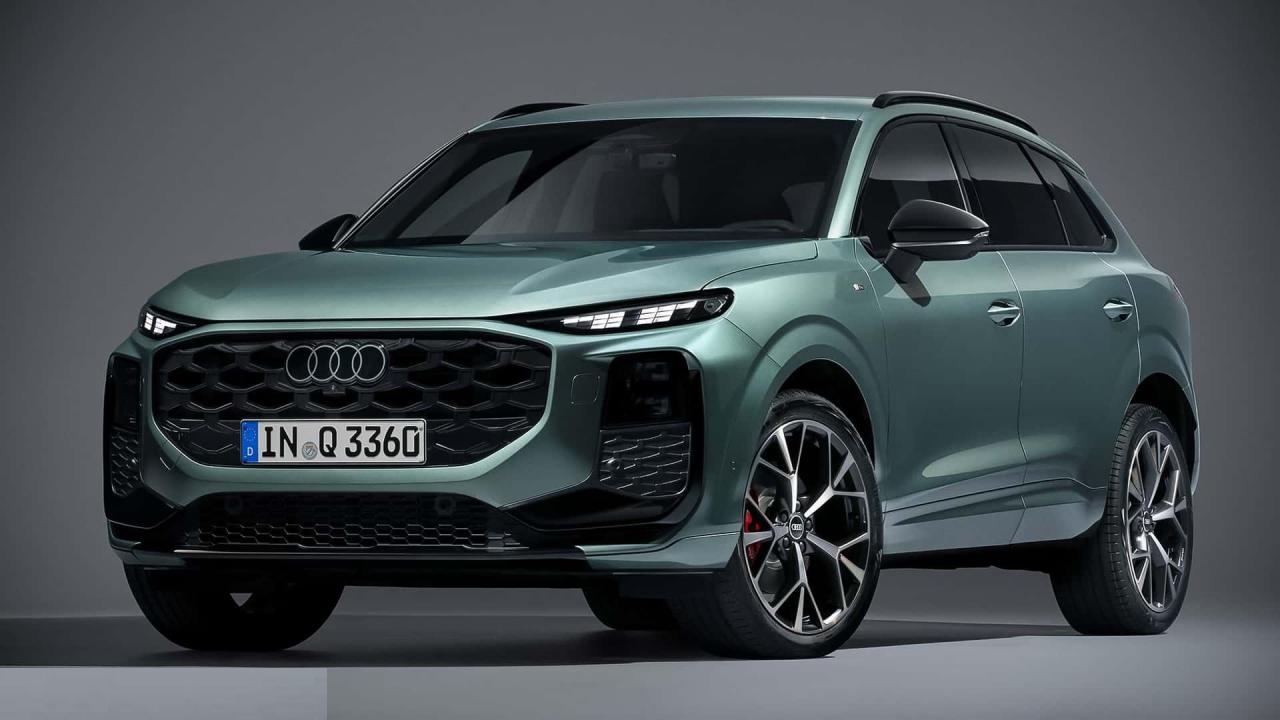
The third-gen Q3 brings a bolder, sharper design language that draws cues from Audi’s newer models (such as the new Q5).
Front end & lighting
- The grille is now more octagonal and finished in a black honeycomb motif, giving it a more aggressive face.
- Lighting is split into discrete modules: slim daytime running lights (DRLs) up top, with the main headlights positioned lower in the fascia. Pixelated LED elements may be used for signature effects.
- The bumper features angular trim elements and prominent intakes to lend a sporty, dynamic stance.
Side & rear profile
- The side character lines are more pronounced, with deeper door sculpting and bold wheel arches.
- Blackened pillars (B- and C-pillars) and flush details may help create a more cohesive, modern look.
- At the rear, the Q3 sports a full-width LED light bar or trim, with tiered taillight modules and an assertive rear bumper design.
There will also be a Sportback variant (i.e., a more coupe-style roofline) introduced, which trades a bit of rear headroom and cargo space for sportier proportions.
Platform & Mechanical Underpinnings
- The new Q3 rides on an evolved version of the MQB Evo architecture (which is shared across many Volkswagen Group vehicles).
- Audi is expected to offer a more differentiated suspension and chassis tuning compared to sister models (e.g. VW Tiguan) to maintain brand identity.
- Dimensions (wheelbase, length, etc.) are expected to grow modestly over the outgoing generation, for more interior space and better proportions.
From German-language specs, the new (third-gen) Q3 (code “FJ”) is listed with:
| Variant | Displacement / Type | Key Outputs* | Approx Weight / 0–100 km/h |
|---|---|---|---|
| 1.5 litre (entry) | 1,498 cc, likely turbo / mild hybrid | ~150 PS (110 kW) | ~1,635 kg; ~9.1 s |
| 2.0 litre / mid level | 1,984 cc | ~204 PS (150 kW), torque ~320 Nm | ~1,735 kg; ~7.1 s |
| Top / performance | 2.0 litre (high tuning) | ~265 PS (195 kW) | ~1,750 kg; ~5.7 s |
* These figures are drawn from German-spec data and may vary in India.
Transmission is likely to be a 7-speed dual-clutch (S-Tronic) system across variants.
For the Indian market, Audi may adapt powertrains (e.g., taking a petrol focus, or offering mild-hybrid versions) to meet emissions and market preferences.
Powertrain & Electrification
The trend for the new Q3 is clear: greater electrification across the range.
- Audi is expected to offer mild‐hybrid (MHEV) versions, especially for the base 1.5-litre models, to improve efficiency and comply with stricter emissions norms.
- A plug-in hybrid (PHEV) option is also likely, leveraging the MQB Evo-derived electrification hardware. In some reports, the PHEV version is claimed to deliver over 100 km of electric-only range in ideal conditions.
- The gasoline engine line-up will include turbocharged 4-cylinder units, and in some markets, diesel may still be offered (though India is moving away from diesel in many premium SUVs).
- Some media speculation suggests a future high-performance RS Q3 may continue in limited form (possibly with turbocharged 5-cylinder or high-output 2.0 petrol), though that is still uncertain.
In India, given fuel costs and emission norms, Audi may emphasize petrol + mild-hybrid versions, possibly introducing PHEV only in higher variants.
Interior, Cabin & Technology
One of the most exciting areas of upgrade is the interior tech and design.
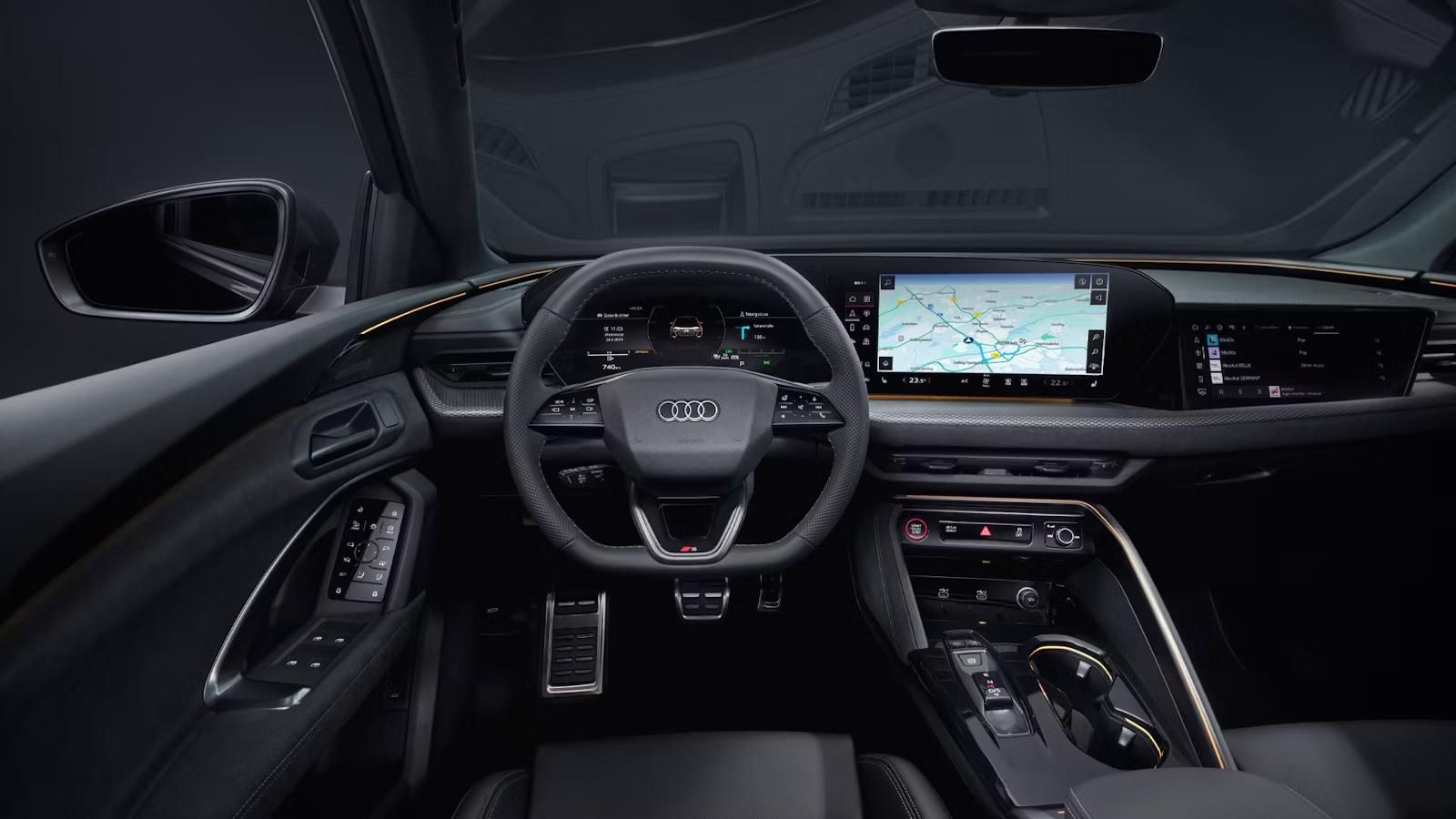
- The dashboard is expected to follow Audi’s modern aesthetic, with a flowing, integrated display architecture.
- The Q3 will reportedly feature an 11.9-inch digital instrument cluster and a 12.8-inch (or in some reports 14.5-inch) infotainment touchscreen in a curved, unified format.
- An optional 10.9-inch passenger display may also be offered in higher variants.
- Android Automotive OS is likely to power the infotainment system, with voice recognition, AI features, and deep connectivity.
- Other highlights include a heads-up display (HUD), multiple USB-C ports (front and rear), advanced ambient lighting, and a premium audio system (e.g., a 12-speaker setup).
- Controls are being modernized: some features may move to stalks behind the steering wheel or digital nub controls, reducing reliance on physical buttons.
In summary, the cabin is expected to deliver a far more digital, premium, and seamless experience compared to the outgoing Q3.
Safety, Driver Assistance & Features
Audi will likely equip the third-gen Q3 with an advanced suite of driver assistance and safety tech to maintain competitiveness:
- Standard features may include automatic emergency braking (AEB), forward collision warning, lane-keeping assist, blind-spot monitoring, rear cross-traffic alert, parking sensors, and traffic sign recognition.
- In higher trims, features such as adaptive cruise control with lane centering, 360° cameras, parking assist, and more advanced Level-2 autonomous capabilities may be available. (While not officially confirmed, this is consistent with trends in this class.)
- Audi could also include over-the-air software update capability and OTA tuning for infotainment or comfort systems (speculative but increasingly common).
Expected Positioning & Competitors in India
Once launched in India, the Q3 will compete in the premium compact crossover space. Key rival models will include:
- BMW X1 / X2
- Mercedes-Benz GLA / GLB
- Volvo XC40
- Lexus UX / NX
- For the Sportback variant, it may also compete more directly with coupe-style compact SUVs
Pricing will matter a lot. Given the enhancements, expect the third-gen Q3 to command a premium over the current generation. Some Indian spec sheets estimate an ex-showroom price around ₹48 lakh (as a ballpark for higher variants), though this is speculative.
What to Watch Out For / Risks
- Local adaptation: Some features or powertrains might be modified (or even dropped) for the Indian market to reduce costs or comply with regulations.
- Price sensitivity: The premium SUV segment in India is competitive, and the success of the new Q3 will depend heavily on striking the right balance between features and pricing.
- After-sales & service: Audi’s ability to support new, technically advanced components (electric, hybrid systems, digital features) nationwide will be critical to customer confidence.
- Variant stratification: Audi will need to carefully design variant and trim options so that customers have meaningful upgrades (not just superficial ones).
Conclusion
The third-generation Audi Q3, unveiled globally in mid-2025 and expected to reach India by 2026, represents a bold leap forward for Audi’s compact SUV. With more aggressive styling, significantly upgraded interior and digital systems, and a stronger push toward electrified powertrains, the new Q3 is aiming to stay ahead in a fiercely competitive premium crossover market.
If Audi plays its cards right with localization, variant strategy, and pricing, this generation could further strengthen the Q3’s reputation in India as a door opener into the Audi SUV lineup.