
Uber Joins Forces with Nuro strategic alliance with Nuro and Lucid to roll out robotaxis. This marks a pivotal shift in Uber’s autonomous vehicle strategy and could significantly impact the future of urban mobility.
🤝 A Strategic Alliance: Uber, Lucid & Nuro
On July 17, 2025, Uber announced its partnership with Lucid Motors and Nuro to deploy over 20,000 robotaxis—autonomous, electric SUVs—by 2032. The joint venture is set to launch in an unnamed major U.S. city by late 2026.
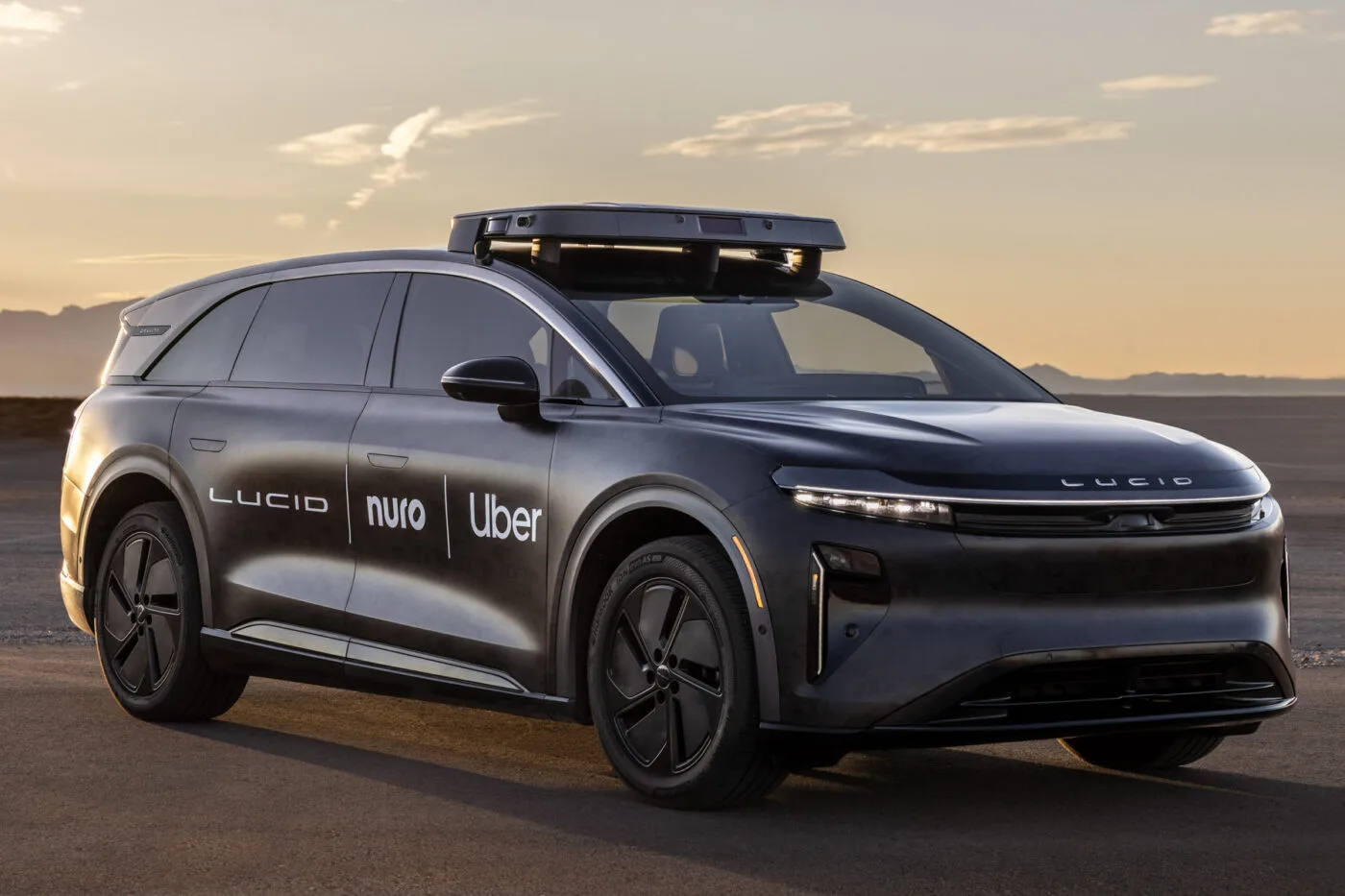
- Lucid will manufacture its flagship Gravity SUV, a luxury electric vehicle (EV) boasting a 450-mile (≈724 km) EPA range. With a starting price near $79,900, these vehicles are premium offerings.
- Nuro brings its Nuro Driver™, a Level 4 autonomy software platform that has accumulated several years of real-world testing and zero at-fault incidents.
Financial Investment & Stakes
Uber isn’t just arranging a deployment—it’s heavily investing:
- $300 million directly into Lucid, securing a significant stake (~3.3% of its market cap), making Uber its second-largest investor after PIF.
- A binding agreement to procure a minimum of 20,000 Lucid Gravity vehicles over six years, supporting a potential $1.6 billion baseline fleet investment (20k × $80k) plus autonomy hardware.
This dual financial and procurement strategy aligns incentives across the three firms, ensuring the rapid scale-up Uber requires.
Technology Fusion: Luxury Meets Autonomy
Lucid Gravity
- A three-row luxury SUV, optimized for autonomy with a zonal electrical architecture and redundant critical systems.
- Promises low downtime thanks to its ultra-long 450‑mile EPA range, ideal for ride-hailing deployment.
Nuro Driver™ Level 4
- First earned its stripes over nearly a decade in cargo and limited robotaxi applications.
- Proven zero at-fault record, trained across 150+ U.S. cities using simulation and real-world scenarios.
- Hardware will be factory-integrated during production to streamline rollout.
- This synergy forms a “premium, scalable automation platform,” combining comfort, safety, and efficiency for high-utilization ride fleets.
Uber’s New AV Strategy: Partnerships Over In-House
Under CEO Dara Khosrowshahi, Uber has shifted from internal AV development (formerly led by Travis Kalanick) to building an ecosystem through strategic investment and partnerships.
This alliance is the latest in a series of agreements:
- Baidu Apollo Go: Autonomous vehicles for Asia and the Middle East.
- Volkswagen: EV ID.Buzz vans for LA.
- Collaborations with May Mobility, Momenta, Pony.ai, and WeRide.
By embedding itself in diverse vehicle and autonomy ecosystems, Uber hedges technological risk and builds a strong foundation for international robotaxi rollout.
Market Implications & Competitive Landscape
Lucid
- Shares shot up 35‑36% on the announcement, reversing earlier market losses.
- Gains capital, credibility, and production scale; needed after losses nearing $6 billion in 2023–2024.
Nuro
- Grows from delivery bots into a full-fledged robotaxi provider.
- Gains a stable revenue stream and institutional backing from Uber’s investment and board involvement.
Uber
- cements its position in autonomous EV mobility.
- Offers an alternative to competitors like Waymo, Tesla, Lyft, and Baidu.
- Maintains current human drivers, with robotaxis expected to play a complementary role over the next decade.
Challenges & Risks Ahead
| Area | Risk Description |
|---|---|
| Regulatory Hurdles | Autonomous vehicles face a patchwork of state/federal laws. Deployment speed depends on favorable legislation. |
| Production Volume | Lucid currently makes ~9,000 cars/year; scaling to 20,000 robotaxis plus consumer demand strains capacity. |
| Cost & Profitability | Premium SUVs (~$80k) plus hardware overhead; pricing must outcompete cheaper options from Waymo, Tesla, Hyundai, et al. |
| Tech Reliability | Any autonomous failure could damage consumer trust and invite regulatory setbacks. Robust testing is vital. |
| Labor & Ethics | Autonomous fleets may displace current drivers, raising social and ethical concerns (safety, accountability) |
While formidable, these challenges are mitigated by the partners’ combined expertise and deep pockets.
What’s Next?
- Late 2026: Soft launch in an unnamed U.S. city, with closed-course and supervised road tests already underway in Las Vegas.
- 2026–2032: Gradual rollout of a 20,000+ Lucid–Nuro fleet across multiple U.S. cities—and likely international markets.
Broader Significance
This initiative aligns with broader trends in mobility:
- Electrification: An electric fleet reduces emissions and fuel dependency.
- Automation: Level 4 autonomy signals shift toward hands-off ride-hailing.
- Strategic Partnerships: Uber moves from a self-reliant model to a collaborator-in-chief.
- Consumer Shift: Luxury may become mainstream if operational costs allow scalability.
In short, this move could redefine urban transport in the coming decade, transforming ride-hailing into an environmentally friendly, automated service.
🚀 In Summary
- Scale: 20,000+ ultra-long-range EV robotaxis by 2032.
- Tech: Best-in-class Level 4 autonomy integrated into a luxury platform.
- Capital: Uber’s $300+ million investments align all partners’ incentives.
- Strategy: A shift from internal R&D to leveraged partnerships.
- Competition: Aiming to lead against Waymo, Tesla, Lyft, Baidu, and beyond.
If Uber can master operations, infrastructure, and regulatory rollout, this alliance could shift the future of urban transportation.
Let me know if you’d like a visual or SWOT analysis next!