
Here’s a balanced look at the 2025 Ultraviolette X-47 Crossover, with six pros and six cons based on available specifications, reviews, and early impressions.
Pros
- Strong Range Option & Flexibility
The X-47 offers two battery variants: a 7.1 kWh pack (claimed ~ 211 km IDC) and a 10.3 kWh pack (claimed ~ 323 km IDC). This flexibility allows buyers to pick according to their daily use or budget constraints. - Advanced Rider-Assistance (Radar + ADAS) Suite
One of the standout features is the “UV Hypersense” system: a 77 GHz radar with a 150° blind-spot view, object tracking up to 200 m, and features like blind-spot detection, lane-change assist, overtake alerts, and rear collision warning. The radar system is adapted for lean and roll behavior. - Integrated Dual Dashcams & Display System
The X-47 comes with synchronized front and rear 1080p cameras (dual dashcams), and a secondary touchscreen (above the main 5-inch TFT) to view video feeds, ADAS alerts, etc., with built-in storage (32 GB, expandable). This is rare in its segment and gives extra safety/recording capability. - Good Performance & Torque Delivery
The electric motor produces about 30 kW (~ 40 bhp) and claims 100 Nm (or 610 Nm at the wheel, depending on interpretation) of peak torque. Acceleration claims include 0–60 km/h in 2.7 s and 0–100 km/h in 8.1 s, with a top speed capped at ~145 km/h. - Purpose-Built for Indian Roads & Adventure Use
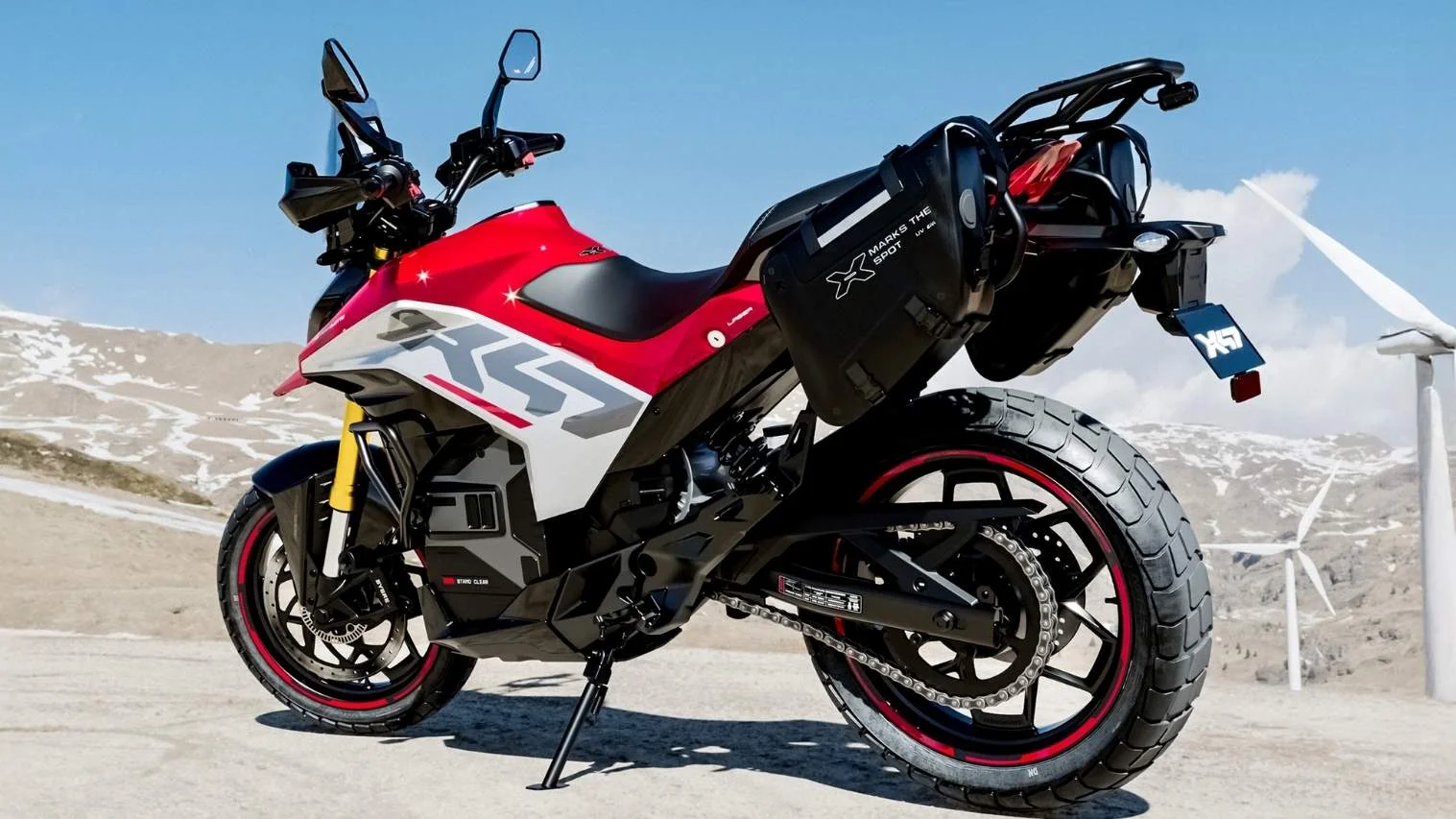
The bike adopts adventure/dual-purpose cues: 200 mm ground clearance, all-terrain radial tyres, a cast-aluminium subframe, offshore accessories support (panniers, etc.), and a sturdy chassis. The ergonomics are upright but slightly sporty to balance city and highway usability. - Onboard Charger & Integrated Charging Ease
The X-47 includes a 1.6 kW onboard charger built into the chassis, so riders don’t need to carry a heavy external charger brick. The charger claims tolerance for power fluctuations and operates in India’s harsh conditions. It also supports “parallel charging” (using an external charger in conjunction) to reduce charging time.
Cons (or Potential Drawbacks)
- Real-World Range vs Claimed Figures
As with most EVs, the IDC (Indian Driving Cycle) figures are optimistic. On highways, hilly terrain, or with aggressive riding/loads, real range may drop significantly — especially for the smaller battery version (211 km claimed). Users may find the larger battery variant almost mandatory for longer rides. - Weight & Maneuverability Penalty
The kerb weight is fairly heavy: ~ 197 kg for the base, ~ 208 kg for the larger battery version. Such weight, combined with the battery mass and radar gear, can affect low-speed maneuvering, handling in tight turns, and parking. Also, heavy bikes are more challenging on less-than-ideal roads or when stationary. - Performance vs Expectations
While 0–60 in 2.7 s is worthy for urban sprints, the pick-up from 60–100 km/h (8.1 s) and top speed of 145 km/h are modest compared to some sporty ICE or other high-performance EVs. Some critics may find the mid-range lacking in certain overtaking scenarios or on highways at high speeds. - Cost & Pricing Strategy
The introductory ex-showroom price is ₹2.49 lakh (for the first 1,000 buyers), rising to ~ ₹2.74 lakh later. While this is competitive among premium EV bikes, it is still expensive relative to many ICE or lower-spec electric motorcycles, especially for buyers looking for a value commuter. - Unproven Reliability for New Tech (Radar, Cameras, Software)
The ADAS, radar, and camera systems are novel for this price range and market. Long-term reliability, maintenance, firmware updates, sensor calibration, or harsh-condition endurance (dust, heavy rain, vibration) remain to be proven. Buyers will need to trust the company’s after-sales, availability of spares, and software support. - Charging Infrastructure & Long-Distance Practicality
Although the onboard charger is helpful, the charging speed (1.6 kW) is modest. Without widespread fast-charging infrastructure, long-distance touring can become a challenge. Users may face lengthy charging stops or range anxiety in regions with sparse EV infrastructure. Also, “parallel charging” helps but still demands external chargers or infrastructure.
Conclusion
The 2025 Ultraviolette X-47 Crossover is a bold, feature-rich offering that pushes the envelope in the Indian electric motorcycle space. Its standout features—radar-based ADAS, dual dashcams, integrated charger, flexible battery options—make it a serious contender for tech-savvy riders who want more than just basic EV mobility.
However, it’s not without compromises: real-world range, weight, pricing, and the nascent nature of its feature set raise valid concerns. If Ultraviolette can back its promises with solid after-sales support and firmware improvement over time, the X-47 has the potential to set a new benchmark in its class.