
Mahindra & Mahindra (M&M) has achieved a notable milestone in its transition towards electric vehicles (EVs): in the first ten months of 2025, EVs accounted for 7.5 % of its overall vehicle dispatches.
Why This Figure Matters
Rapid Growth Year-on-Year
A year earlier (Jan–Oct 2024), M&M’s EV share was barely 1 %. Jumping to 7.5 % within a year is a significant acceleration, especially in a market where the EV segment is still relatively small.
Portfolio Transition Underway
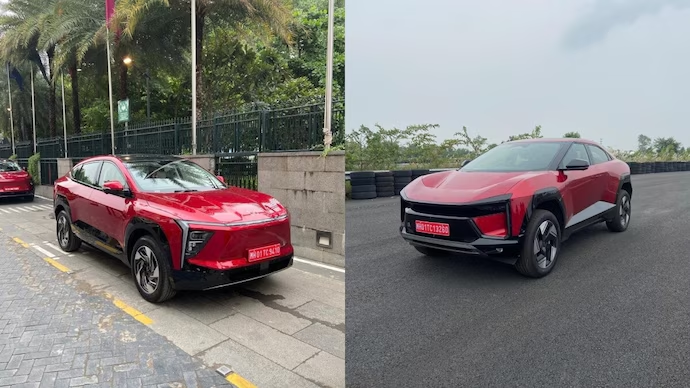
That leap has been driven largely by the launch of what M&M calls “born-electric” models: the Mahindra BE 6 and Mahindra XEV 9e. These two models have together contributed around 7 % of total sales during this period. M&M’s earlier EV offering (the Mahindra XUV 400) had far more limited impact.
Alignment with Regulatory Goals
The company has set a target of EVs comprising 15–25 % of its sales by 2027, partly to comply with India’s evolving fuel-efficiency and emission norms (CAFE regulations). Achieving 7.5 % in 2025 puts M&M on a stronger footing to hit that future target.
What This Tells Us About M&M’s Strategy
- Product Rollout and Platform Investment: M&M has invested in newer EV-specific platforms (e.g., INGLO) and is positioning the BE 6 and XEV 9e as significant contributors rather than niche models. This signals a shift from “EVs as experiment” to “EVs as growth pillar”.
- Volumetric Scale: With ~38,464 EV units dispatched in the first ten months of 2025 (per one report) as part of that 7.5 % share. While this is still modest in absolute terms compared to its ICE (internal combustion engine) volumes, the growth trajectory matters.
- Market Positioning: M&M is traditionally strong in SUVs and utility vehicles in India. Leveraging that brand strength into the EV space could give it an edge — especially as buyers increasingly consider electric SUVs.
- Regulatory Compliance Impetus: As emission/fuel efficiency norms tighten in India, OEMs (original equipment manufacturers) are under pressure to increase the share of low-/zero-emission vehicles. M&M’s EV ambitions align with this structural requirement.
Challenges and Caveats
- 7.5 % is Still Modest: Even though the growth is impressive, EVs remain a small part of M&M’s overall volumes. The bulk of its business is still ICE vehicles. So to hit 15–25 % by 2027, M&M will need to maintain or accelerate this growth.
- Infrastructure and Ecosystem Dependence: For EVs to scale sustainably, charging infrastructure, battery supply chains, and customer acceptance have to mature. M&M (and the industry) will face headwinds in these areas.
- Competition and Margin Pressures: As more brands enter the EV space and competition intensifies (both domestic and global), pricing pressure and feature expectations will increase. M&M will need to manage costs, supply chain, and differentiation.
- Supply Chain & Technology Risks: Battery sourcing, raw-material inflation, foreign currency exposure, and technology (range, charging speed) remain key variables. M&M will need to stay agile.
Implications For Stakeholders
- For Investors: This shift suggests that M&M is taking the EV transition seriously, which may de-risk its exposure to future regulatory/fuel-efficiency headwinds. Growth in the EV segment could contribute more meaningfully to overall profitability in the coming years.
- For Consumers: The growing EV share means more choice in the market. M&M’s launch of newer EVs indicates that buyers interested in electric SUVs will find more mature offerings soon.
- For the Industry: M&M’s progress may act as a signal to other Indian automakers that EV scaling is viable in India, provided the strategy, product, and execution align. It also strengthens the case for policy support, charging infrastructure build-out, and ecosystem investment.
- For Policy/Regulatory: M&M’s achievement helps demonstrate that OEMs can shift towards EVs at a meaningful pace, which may support further policy/market incentives and infrastructure financing.
Outlook
If M&M continues at a similar or faster growth rate in its EV business, it stands a reasonable chance of hitting its stated 15–25 % EV share by 2027. Key levers will include:
- Launching additional models (e.g., upcoming Mahindra XEV 9S) and expanding EV variants in popular segments.
- Expanding production capacity and supply-chain readiness for EVs.
- Ensuring compelling value (range, features, cost) to convert more ICE buyers to EVs.
- Supporting infrastructure/charging partnerships and after-sales readiness (crucial for consumer confidence).
- Managing ICE business effectively so that growth in EVs isn’t offset by decline elsewhere.
Summary
In summary, the 7.5 % figure may appear modest in isolation, but in the context of a brand transitioning from essentially 1 % EV share a year ago, it is a strong signal. It shows that Mahindra & Mahindra is moving beyond experimentation to scaling in the EV space — and positioning itself to be a meaningful player as India’s electrification journey accelerates.