
Launch Timeline & Background
The Indian carmaker Maruti Suzuki India Ltd. (MSIL) is preparing to introduce a flex-fuel version of the Fronx — popularly known as the Fronx Flex Fuel — in India during 2026.
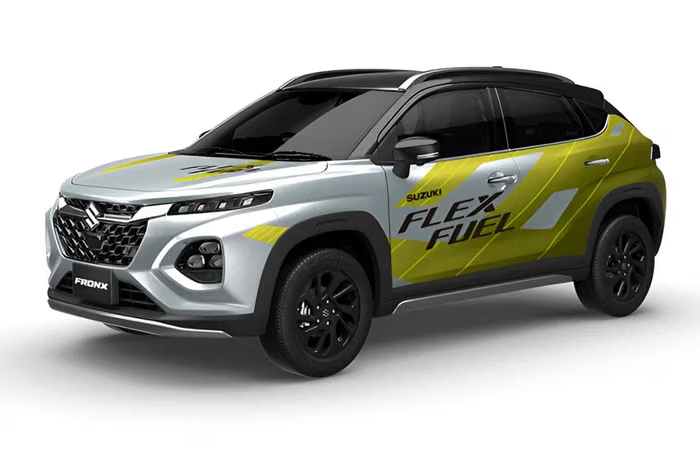
- The vehicle was showcased in concept form as the Fronx FFV (Flex Fuel Vehicle) at the Japan Mobility Show 2025.
- MSIL has confirmed that its first flex-fuel vehicle for the Indian market will debut by March 2026.
- This move aligns with the growing focus on ethanol blend fuels (E20 and beyond) in India’s fuel policy.
Key Technical Highlights
- The Fronx Flex Fuel is built to run on petrol blended with ethanol in a wide range, specifically from E20 (20 % ethanol) up to E85 (85 % ethanol).
- For context, India currently has E20 (20% ethanol) as part of its fuel-blend targets, and the Fronx Flex Fuel is future-proofed to handle even higher blends.
- On the design front, visually, the flex-fuel version remains almost identical to the standard Fronx: same dimensions (3,995 mm length, 1,765 mm width, 1,550 mm height) as per the global concept.
- The differentiators: special “green” fuel badges or flex-fuel stickers on bodywork to signal its ethanol-blend capability.
- Powertrain specifics for India remain unconfirmed: while the Japan-spec version uses a 1.5-litre petrol engine with options of manual or automatic, and even optional AWD. In India, the current Fronx uses 1.2-litre or 1.0-litre turbo-petrol engines, so MSIL may adapt one of these.
Strategic Importance For India
- Ethanol Blending Policy: The Indian government is targeting higher ethanol blends (E30 and beyond) in petrol as part of its biofuel and energy security strategy. The Fronx Flex Fuel anticipates this shift.
- Regulatory push: Upcoming CAFE (Corporate Average Fuel Efficiency) norms and government incentives may favour flex-fuel vehicles alongside EVs. While this is broader auto-industry news, it underlines why MSIL is moving ahead with an FFV in India.
- “Made-in-India, for India”: The Fronx is already assembled in India and marketed here; introducing a flex-fuel variant strengthens MSIL’s positioning in a changing regulatory & fuel-eco environment.
- Consumer readiness: By offering a vehicle capable of using high-ethanol blends, MSIL is addressing future fuel availability, giving buyers “fuel flexibility” that could matter as fuel infrastructure and policy evolve.
Expected Features & Market Positioning
- Since the flex-fuel variant largely retains the standard Fronx’s design and dimensions, expect similar comfort & convenience features (9-inch infotainment, dual-tone interiors, dual airbags or more, etc) subject to variant.
- Price positioning will likely carry a small premium because of the flex-fuel hardware (engine calibrations, fuel system modifications for high ethanol) and “future-proof” value proposition.
- MSIL may offer it in suitable trims (perhaps mid-to-top) to gauge consumer acceptance and to justify the technology investment.
- It may serve as a stepping stone until broader ethanol infrastructure (E30/E85 pumps) becomes commonplace in India, giving early adopters an edge.
Implications For Buyers & Market
- For buyers: The Flex Fuel Fronx may appeal to those conscious of fuel economy, future-proofing, and anticipating ethanol-blend fuel availability. They’ll need to weigh typical factors (brand/service, resale, features) plus the flex-fuel value proposition.
- For the market: This launch may nudge other manufacturers to bring flex-fuel vehicles to India, thus expanding options and perhaps accelerating ethanol-fuel infrastructure roll-out.
- For fuel infrastructure: If vehicles capable of high ethanol blends become more common, fuel stations may feel more impetus to upgrade to E30/E85 pumps — though that transition has its own pace and economics.
Things To Watch/Open Questions
- Fuel Availability: While the vehicle may handle up to E85, whether fuel stations will supply E85 (or even widely E30) in India remains a key factor. Compatibility matters only if fuel is available.
- Mileage performance: Ethanol blends typically reduce fuel economy (because ethanol has lower energy density) compared to pure petrol; how MSIL mitigates this will matter for consumer acceptance.
- Resale & Service Support: How MSIL markets the variant, and whether servicing/fuel-system maintenance costs differ, will influence ownership cost.
- Safety & Variant Specification: Standard Fronx now comes with 6 airbags in India. Will the flex-fuel variant match or exceed this? Also, will advanced driver-assistance systems (ADAS) be included? The export version has them.
- Pricing: The premium over the standard petrol Fronx and how that compares to other technology options (like hybrid or CNG) will determine market traction.
Summary
The Fronx Flex Fuel (FFV) marks a significant step by Maruti Suzuki India into the next phase of fuel technology for India. By planning a 2026 launch, the company is positioning itself ahead of regulatory and fuel-blend shifts (E30/E85) and giving the Indian consumer a flex-fuel option in a mainstream compact-crossover segment.
While many details (exact engine, pricing, mileage, feature differentiation) remain to be confirmed, the core value proposition is clear: a vehicle that can adapt to higher-ethanol fuel blends and offers fuel flexibility in a changing policy/fuel environment.