
The iconic Indian scooter, Suzuki Access, has taken a significant step into alternative-fuel mobility with the showcase of a special CNG/CBG-fuelled version at the Japan Mobility Show 2025 (Tokyo, 30 Oct–9 Nov 2025).
Here’s a detailed look at what the prototype represents, its key specifications and context, and implications for the Indian market and beyond.
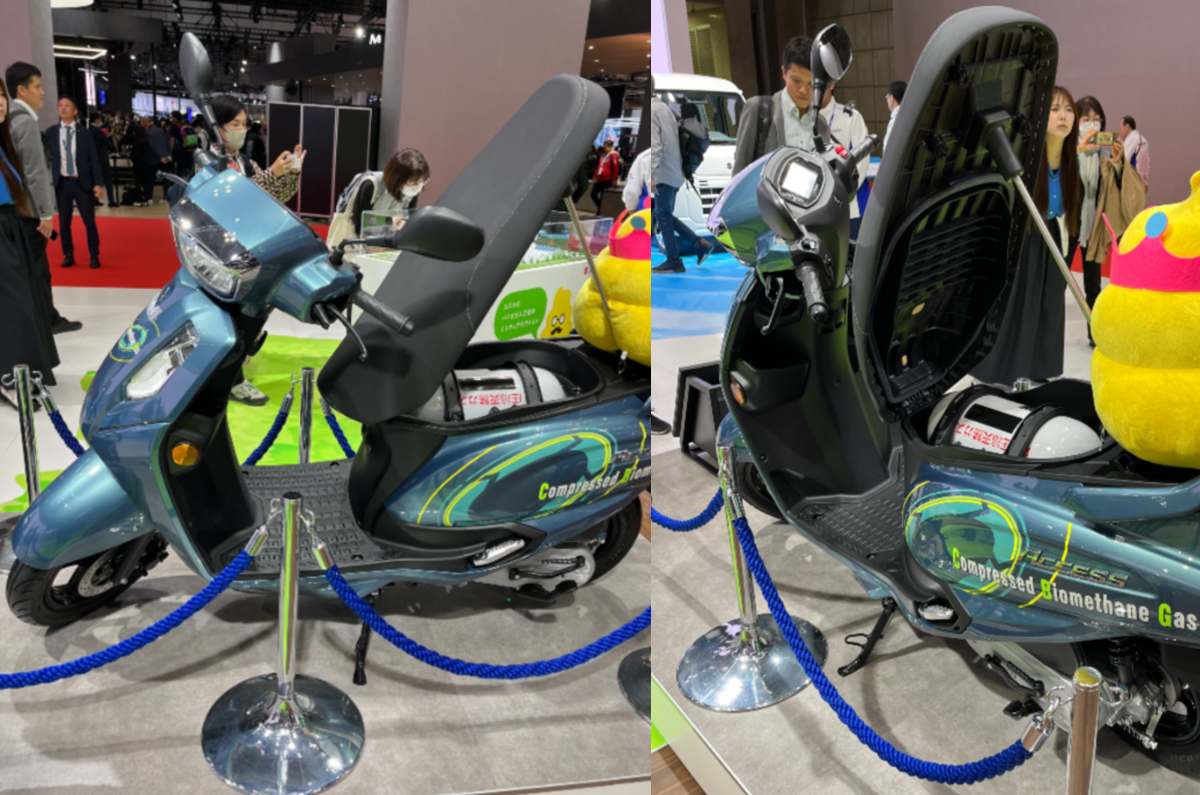
What Was Displayed
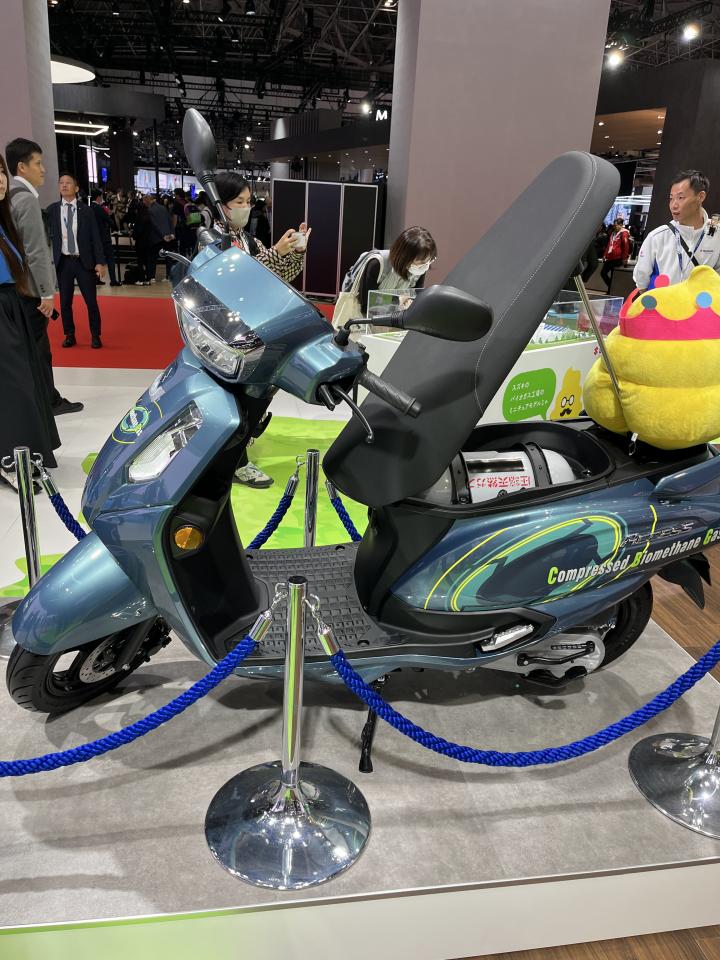
At the show, Suzuki Motor Corporation presented a prototype of the Access scooter modified to work on CNG (Compressed Natural Gas) as well as CBG (Compressed Biomethane Gas).
- The scooter retains the outward styling of the standard India-market Access, making it familiar to Indian customers.
- Under the seat is a gas tank with an approximate 6-litre capacity for CNG/CBG, plus a small petrol tank (2 litres) to ensure continuity of operation.
- With both fuels topped up, Suzuki estimates a combined range of around 170 km.
- The additional hardware (tank, filler nozzle, fuel system) results in about a 10% increase in weight compared to the standard scooter.
The prototype is part of Suzuki’s wider “multi-pathway” approach to carbon-neutral mobility: rather than relying solely on battery-electric vehicles (BEVs), the firm is exploring CNG, biomethane, hydrogen engines, and flexible fuel applications.
Why This Matters
- India-Centric but Global Relevance
The Access is primarily an Indian‐market scooter, so adapting it to CNG/CBG makes sense for India’s large two‐wheeler fleet and emerging bio-gas opportunities. Presenting it at a global show signals that Suzuki views alternative fuels not just for India, but as a part of its global mobility solutions. - Bio-Gas Link to Rural Economies
As reported, Suzuki is partnering with an Indian dairy cooperative to convert dairy waste into biogas (CBG), which can then be used in vehicles like this Access prototype. This coupling of waste-to-fuel with mobility gives an interesting socio-economic and environmental narrative. - Range and Practicality
The quoted ~170 km range is a practical figure for urban/sub-urban commuting and aligns with what Indian scooter users expect: daily errands, commuting, short trips. Moreover, the dual‐fuel arrangement (gas + petrol) ensures flexibility and reduces range anxiety. - Weight & Packaging Trade-off
The ~10% weight penalty is non‐trivial in scooter use (where agility, ride comfort, and economy matter). It shows that retrofitting CNG/CBG into a conventional scooter entails compromises—packaging tanks, maintaining space, managing weight. - Sign of Broader Strategy
Under its mid-term plan, Suzuki states that its booth at the show is themed “By Your Side” and emphasises solutions for local mobility, infrastructure, and fuel options. The Access CNG/CBG is a good illustration of that: a locally relevant fuel solution, not just global BEVs.
Potential Implications For India
Given that the Access is already produced in India by Maruti Suzuki India Limited / Suzuki Motorcycle division, and that India is actively promoting CNG/CBG as alternative fuels in transport, here are some likely implications:
- If Suzuki decides to bring the CNG/CBG version into production, India could see one of the first factory‐fitted CNG scooters (as currently most two‐wheelers are petrol/diesel/electric).
- From a cost-of-ownership perspective, operating on CNG/CBG can reduce fuel cost and emissions—valuable in a country with fuel-economy pressures and rising oil prices.
- Infrastructure remains a challenge: CNG or CBG refuelling locations for two‐wheelers are less common than for four-wheelers in India. Partnering with dairy biogas projects may help, but scale and refuelling convenience must improve.
- The weight increase and possible higher cost will need to be justified in the market. Scooter buyers are very cost‐sensitive. The dual tank arrangement might increase the price compared to the standard Access.
- For used/resale value, robustness of the CNG/CBG system, servicing, and safety (gas tank integrity) will be key.
What We Don’t Yet Know
- Suzuki has not announced whether the Access CNG/CBG version is slated for commercial launch, and if so, in what markets and timetable. The showpiece is described as a “prototype” or “R&D version”.
- Precise performance figures (e.g., fuel economy in km/kg of CNG, acceleration, top speed) are not yet publicly detailed.
- Cost impact: how much more expensive the gas‐fitted version will be compared to the regular Access.
- How the packaging affects storage space (under-seat volume) or ergonomics for riders.
- Safety, durability & certification issues for CNG/CBG in two‐wheelers—a novel area in many markets.

Conclusion
The Access CNG/CBG prototype showcased by Suzuki at the Japan Mobility Show is a smart move: it signals that in the rush towards electric vehicles, alternative fuels like CNG and biomethane still have a role—especially in emerging markets where existing fuel infrastructure, manufacturing base, and two‐wheeler volumes favour such solutions. For India in particular, this could create a meaningful alternative in the scooter segment.
That said, the transition from prototype to mass-market product will depend on infrastructure build-out (refuelling, service), pricing, certification, and user acceptance. For riders in India, what will matter is: can this version offer the same convenience, reliability, and cost savings as the regular Access, without penalising ride quality or increasing cost too much?