
Suzuki has just unveiled its Vision e-Sky electric concept — a striking pointer to its next-generation kei-class EV ambitions.
Positioned as a spiritual successor (or electric sibling) of the Wagon R line in Japan, the Vision e-Sky blends familiar tallboy styling with fresh EV design cues, hinting at how Suzuki plans to navigate the shift toward battery power.
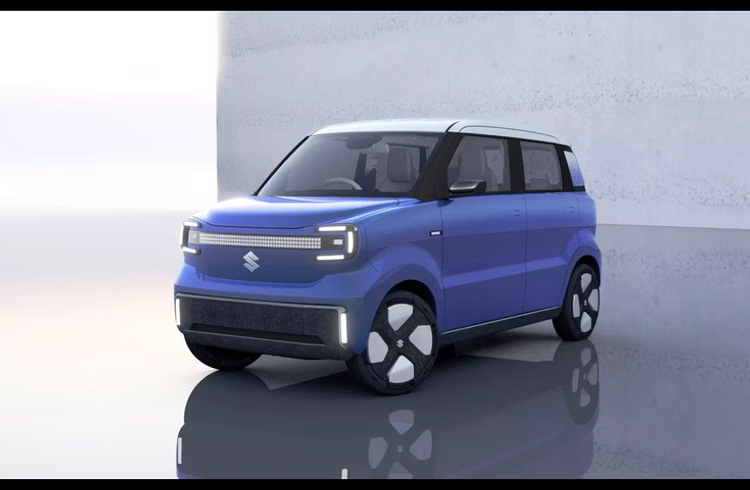
Design & Styling: A Futuristic Take on the Tallboy Formula
One of the most immediately noticeable things about the Vision e-Sky is that it retains the upright, compact “tall” silhouette typical of Japanese kei cars — much like the petrol Wagon R — but reinterprets it with a contemporary electric vehicle aesthetic.
- Up front, the concept sports a closed “grille” panel (as an EV doesn’t require the same cooling) with pixel-style lighting and modern C-shaped LED DRLs.
- The bumper is clean and flat, with minimal openings — a visual cue often used to show aerodynamic and streamlined EV design.
- From the side, there are pronounced wheel arches, retractable (flush) door handles, and blacked-out A and B pillars that help give a slightly more dynamic shape to the silhouette.
- Rather than a completely boxy roof, the e-Sky’s roofline gently tapers, giving it a more lively presence, while retaining the practical height for headroom.
- At the rear, C-shaped tail lights, a flat bumper, and a wide rear windscreen carry the design language through. A spoiler-mounted stop lamp caps off the visual.
In dimension terms, Suzuki lists the concept as 3,395 mm long, 1,475 mm wide, and 1,625 mm tall — sizes in line with kei car regulations. The wheelbase isn’t confirmed, but industry watchers expect something around 2,450 mm — likely close to what the current Wagon R sits on.
Suzuki describes the design ethos as “Unique, Smart, Positive”, aiming for a cheerful, user-friendly look rather than an overly aggressive or futuristic one.
Interior: Minimalist, Practical, and EV-Centric
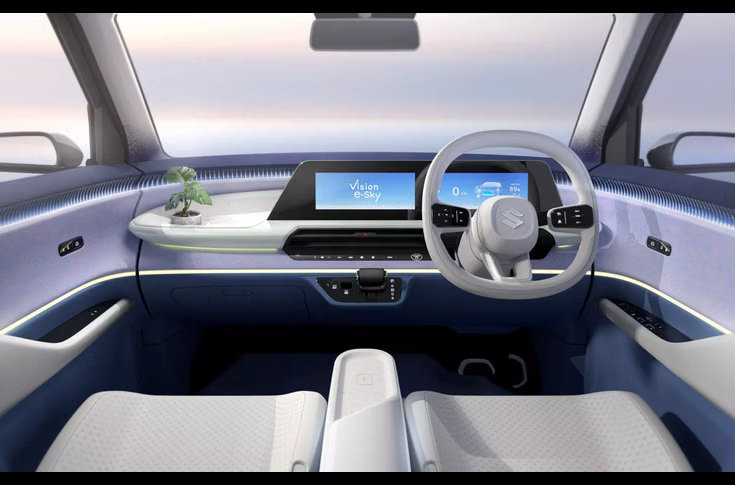
The interior of the Vision e-Sky shares the same design DNA: clean, modern, and more “production-ready” than most far-out show cars.
- Suzuki has revealed a dual digital display setup: one for the instrument cluster, another for infotainment/control.
- The dashboard is recessed and tray-style, intended for practical storage (e.g., placing small items).
- A floating console lies between the front seats, and it includes a wireless charging pad for smartphones.
- Physical buttons are kept minimum, reinforcing the clean layout.
- The cabin uses lighter, soothing tones and a multi-coloured scheme, presumably to evoke a calm, pleasant environment rather than a stark tech feel.
- Perhaps a fun “concept touch” is a small pot/plant on the dashboard shown in some renders — though that may not make it into the production version.
Overall, the interior presentation suggests Suzuki is aiming for something that bridges concept flair and realistic usability.
Technicals & Range: What Suzuki Has Shared (and What’s Still Unknown)
Suzuki has been conservative in releasing detailed technical specs, but a few key figures have been confirmed:
- Driving range: The company confirms the Vision e-Sky will deliver “more than 270 km” (in the Japanese test cycle) on a single charge.
- Suzuki also states that the concept is intended for commercialization by FY2026, implying that this isn’t just a far-off dream but a real near-term goal.
Beyond that, battery size, motor output, charging speeds, and detailed performance metrics remain undisclosed — likely held back until closer to launch.
Analysts speculate that a battery in the 20–25 kWh bracket would be a logical fit, given the compact size and claimed range.
How Much Is It a “Next-Gen Wagon R EV”?
One natural question is: is the Vision e-Sky basically the next-generation Wagon R — but electric? The answer is: yes and no.
- Yes, in the sense that it borrows the tallboy, upright, space-efficient ethos of the Wagon R. The same philosophy of maximizing interior volume within a small footprint is present.
- But no, because it isn’t simply a Wagon R with an EV powertrain. The styling, front fascia, lighting signature, and interior layout are fundamentally rethought for an electric future.
Also, Suzuki seems to suggest that while the e-Sky may or may not reach the Indian market in its exact form, a sibling or derivative — such as the Maruti Suzuki eWX — could emerge locally, borrowing many design cues.
Challenges & Considerations
While the Vision e-Sky is promising, there are a few challenges and caveats to keep in mind:
- Regulation & Segment Constraints
As a kei car concept, the e-Sky must abide by strict size and power limits in Japan. If Suzuki wants to export or adapt it for other markets, some reengineering might be necessary. - Battery & Charging Technology
To reach “more than 270 km,” Suzuki will need to optimize battery efficiency, weight, and thermal management. The charging infrastructure and speed will also be key to real-world usability. - Cost & Market Positioning
Kei cars are typically low-cost, high-volume vehicles. Translating that ethos into EVs — which tend to carry expensive battery costs — will require careful balance to keep pricing attractive. - Localization / Export Strategy
Whether this concept (or its derivatives) will be adapted for markets like India remains uncertain. Localization demands (e.g., climate, roads, and charging availability) could necessitate changes.
Why It Matters
- Signifies Suzuki’s EV commitment: The near-term target for commercialization (FY2026) shows Suzuki is serious about electrification.
- Shifts in small-car strategy: For many buyers, entry-level and compact vehicles are the first touchpoints with EVs. A well-executed offering here could accelerate public adoption.
- Design identity evolution: The e-Sky shows how Suzuki intends to carry its DNA into an electric future — blending familiarity (tallboy shape) with new signals (pixel LEDs, flush surfaces).
- Potential India link: Maruti Suzuki’s EV roadmap includes electric city cars; if a variant or relative of the e-Sky arrives in India, it could be a game changer in the subcompact EV segment.
Summary
In summary, the Vision e-Sky is an important concept from Suzuki that bridges the past and future. It nods to the Wagon R’s legacy while staking a fresh claim in the electric mobility era.
While many technical details remain under wraps, the glimpses we’ve been given — of a cheerful, practical, compact EV with sensible range — suggest Suzuki is serious about making electric mobility accessible and relevant in urban environments. The real test will be the production version and whether it can deliver on efficiency, usability, and cost.