
Tesla’s entry into India has turned a new page with its first full month of deliveries — 60 units of the Model Y were delivered in September 2025. While modest by global standards, this milestone marks the real start of Tesla’s operations in India.

Bookings, Launch, and Strategy
Tesla opened bookings for the Model Y in India in July 2025, and by early September, it had crossed ~600 confirmed orders. That number, however, fell short of internal targets. Initially, Tesla had plans to bring in up to 2,500 units for the year, using India’s import quota for completely built units (CBUs). But due to soft demand, Tesla is reportedly revising the 2025 target downward to 350–500 units.
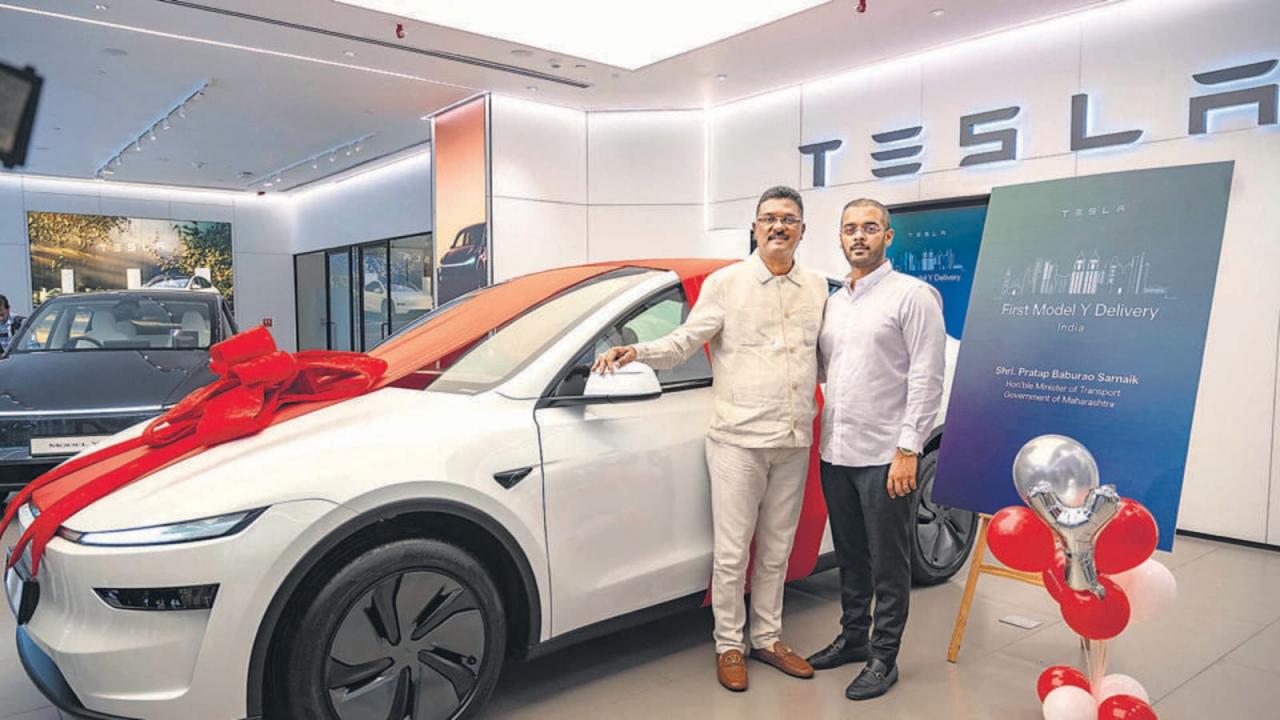
Tesla’s first deliveries officially commenced on 29 September, following the formal launch of the Model Y earlier in the year. The company has confined its operations (for now) to a few metro areas — namely Mumbai, Delhi, Pune, and Gurugram — where showrooms, experience centers, and charging infrastructure are being rolled out.
Tesla offers two variants of the Model Y in India: a Rear-Wheel Drive (RWD) base version and a Long-Range RWD version. The base trim is priced at ₹59.89 lakh (ex-showroom), while the Long Range trim is ₹67.89 lakh. In performance terms, the base variant offers a WLTP-quoted range of 500 km, accelerates from 0–100 km/h in around 5.9 seconds, and has a top speed of 201 km/h. The Long-Range version boasts 622 km of WLTP range and reaches 0–100 km/h in about 5.6 seconds.
New owners also receive a complimentary Tesla Wall Connector for home charging, and Tesla is installing charging stations (Superchargers + destination chargers) in Delhi and Mumbai to support delivery and early usage.
Interpretation: Modest Start, Big Challenges
To put the 60-unit delivery number in perspective: it’s small relative to Tesla’s performance in mature markets (where 600 units may be sold in just a few hours), but it is not entirely out of line with how luxury EVs tend to move in India’s nascent premium EV space.
In fact, for September 2025, BMW led premium EV deliveries in India with 307 units, followed by Mercedes-Benz at 95 units; Tesla’s 60 units place it in respectable company, given that it currently has only one model in its portfolio here.
Still, the subdued number underscores several headwinds Tesla must navigate:
- High import duties and pricing pressure: Because Tesla is importing vehicles as CBUs (rather than manufacturing locally), it cannot benefit from many incentives or lower taxes. That inflates the cost for consumers.
- Demand sensitivity: India’s car buyers are highly cost-conscious, especially in the EV segment. The steep price point of the Model Y limits its addressable market.
- Limited service and charging network: To scale, Tesla will need to expand after-sales coverage and charging stations beyond just the initial metros.
- Scale expectations vs reality: Tesla’s original target and capability to import 2,500 units may have been overly ambitious given market reception. The revision to 350–500 units suggests a more cautious approach.
Analysts point out that for Tesla to break out of a niche play, it must commit seriously to localisation (manufacturing and parts), broaden its model lineup, and improve affordability through cost efficiencies or favorable policy changes.
Outlook: What Comes Next
- Scaling deliveries: The coming months will be crucial. If Tesla can steadily increase deliveries month over month, it may justify expansion and investment in Indian operations.
- Expanding footprint: Moving beyond the four launch cities is key. To attract buyers in Tier-2 and Tier-3 markets, Tesla needs dealerships, service centers, and chargers in many more cities.
- Local manufacturing prospects: If Tesla ever sets up manufacturing or component plants in India, it can slash costs and access various incentive schemes. That could be transformative.
- Competition intensifies: Indian and foreign automakers are pushing EVs aggressively at lower price points. Tesla will have to defend its premium positioning while adapting to local demands.
- Policy role: Indian government incentives, regulatory support (for imports, charging infrastructure, tax breaks), and tariff negotiations could shift the economics favorably for Tesla and other entrants.
Summary
In sum, the delivery of 60 Model Ys in September is a symbolic and concrete start for Tesla in India. It reflects both the excitement of a new entrant and the toughest realities of doing business in a price-sensitive, infrastructure-challenged market.
The next few quarters will show whether Tesla can turn this modest start into sustainable growth, or whether it will remain an exotic niche in India’s EV landscape.