
Here’s a comprehensive deep dive into the first documented Tesla Robotaxi First intervention by a safety monitor, unpacking what happened, why it matters, and what it tells us about the future of autonomous mobility.
🚕 What Happened: The First Real Intervention
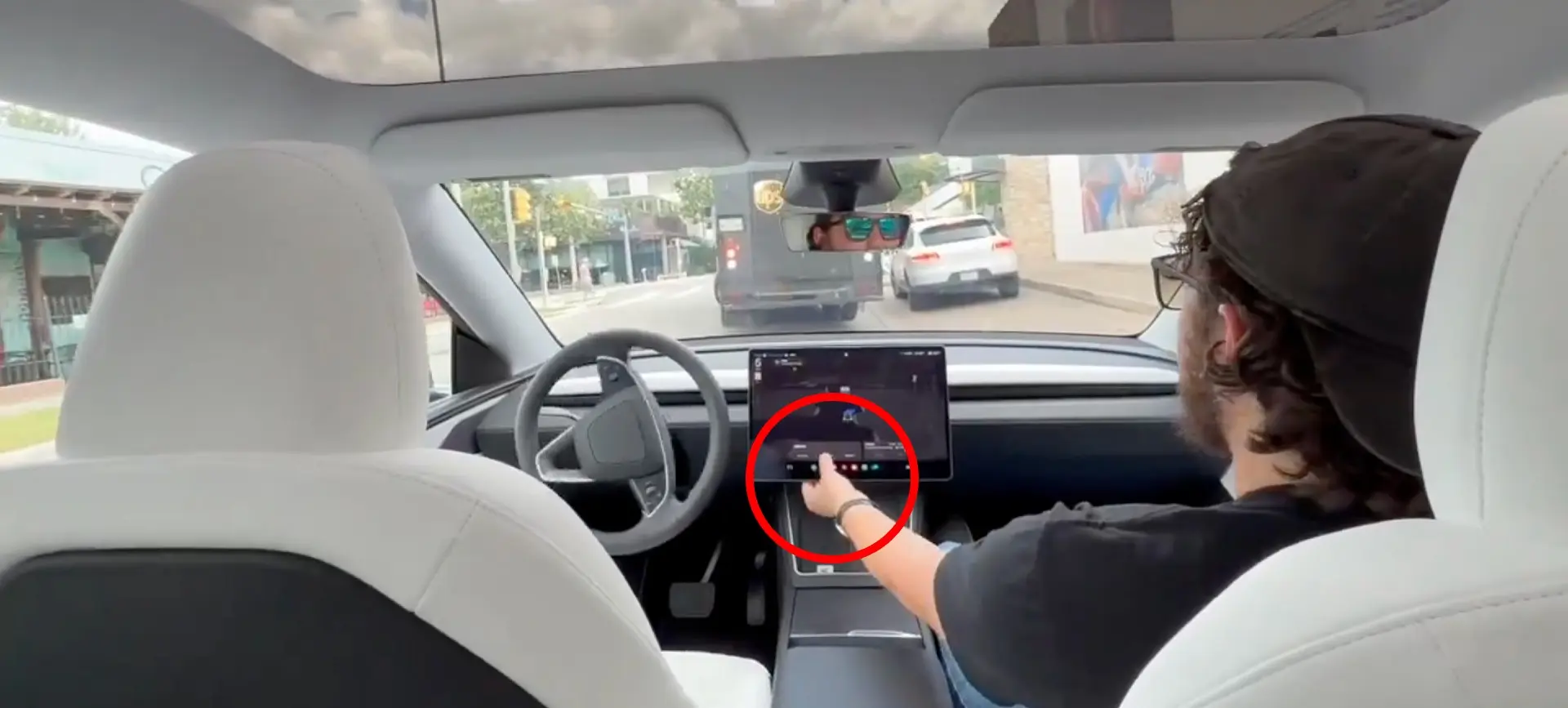
About 60 hours after launching the Robotaxi pilot in Austin, a video emerged featuring Tesla investor Dave Lee riding in a driverless Model Y equipped with Full Self-Driving (FSD). A UPS truck was attempting to squeeze into a tight parking spot directly ahead of the Robotaxi.
The vehicle appeared uncertain, beginning to steer sharply toward the space—and that’s when the safety monitor in the front passenger seat hit the “Stop in Lane” button on the touchscreen, bringing the car to an immediate halt.
Tesla had previously shared glimpses of minor misrules—like drifting across yellow lines while changing lanes—but none required intervention. This was the first clear instance where human backup was necessary to correct an automated vehicle decision.
🛠 Safety Monitor Controls: Two-Button Setup
From industry footage and Reddit conversations, we now understand that safety monitors have access to two emergency stops.
-
“Stop in Lane” – soft stop via touchscreen.
This redundancy provides layered intervention: a quick soft stop or a hard brake in case of more dangerous scenarios. Their thumbs are constantly near the emergency button—a telling sign that Tesla is testing human oversight closely.
🎯 Why It Matters: Autonomy vs. Human Backup
Tesla’s Robotaxi experiment hinges on the tension between full autonomy and safety-first supervision:
-
Achieving trust without hands-on control:
Elon Musk has long promised “no one in the car” by summer 2025. However, this incident highlights that safety monitors are still essential, as seen in a nod to both cautious deployment and regulatory demands. -
Learning from rare edge cases:
The UPS-truck scenario was unpredictable—Tesla’s FSD didn’t recognize the parked truck’s intention. These real-world edge cases are hard to simulate, so playing them out with human fallback helps refine the system. -
Transparency in risk:
We can compare these incidents to Waymo’s past failures, like getting stuck at intersections. Such hiccups are expected in autonomy’s growing pains, and Tesla’s monitor setup aims to mitigate danger while the system learns.
⏩ The Broader Robotaxi Landscape
Tesla isn’t alone in autonomous ridesharing innovation, but its path stands out:
-
Launch Profile:
-
Comparison to competitors:
Unlike Waymo and Cruise, Tesla exclusively uses camera-based autonomy—no lidar or radar. Waymo has safely logged over 10 million paid rides, but Tesla’s “vision only” approach counts on scale and continuous Over-The-Air updates. -
Regulators are watching:
Videos of early missteps—like driving in the wrong lanes or braking suddenly—have prompted scrutiny from NHTSA. They’ve formally requested data from Tesla. -
Public and investor reaction:
Passenger reviews remain positive overall: “smooth,” “comfortable,” and “indistinguishable from human driving”.
👀 What the Intervention Reveals
-
Proactive Human Oversight is Core:
Tesla is not hiding the fact that monitors are required, for now. They’re critical for handling edge cases and safer than expecting the system to self-resolve. -
System Maturity is Still Growing:
Instances like the UPS truck show continued gaps in predicting atypical road behavior, proving that full autonomy is still evolving. -
Design Intent vs. Reality:
🔮 What Comes Next For Robotaxis
-
Data-driven evolution:
Each intervention offers Tesla valuable feedback to train its neural networks—how to better anticipate odd obstacles, parked vehicles, or roadside hazards. -
Toward Cybercab and Supervision-Free Rides:
Tesla aims to unveil full-featured Cybercab vehicles later and remove onboard monitors entirely. But regulator trust—and public confidence—will depend on real-world reliability and transparency. -
Gradual scaling:
Expansion to San Francisco, LA, and San Antonio is planned. Larger fleets mean more benefits from scaling, but also more complexity in proving safety across diverse road systems. -
Competitor divergence:
Waymo and Cruise continue with redundant sensors and remote operators. Tesla’s “vision-first” philosophy is leaner, but it must demonstrate parity or superiority in safety and efficiency. -
Regulatory spotlight:
Ongoing NHTSA investigations raise the stakes. Any high-profile failure could significantly delay unsupervised rollout.
🧭 Final Takeaways
The first true intervention by a safety monitor is a watershed moment for Tesla’s autonomy journey. It signals both the fragility of early-stage self-driving tech and Tesla’s commitment to cautious, evidence-driven rollout.
-
🚨 Edge-case handling: The UPS scenario showed Tesla still misses unpredictable road behaviors.
-
☑️ Active control: Monitors with dual-stop controls underline Tesla’s emphasis on layered safety.
-
🧭 Careful progression: The pilot is invite-only, geofenced, and closely watched—all key to managing risk.
-
🔍 Still under scrutiny: Regulator inquiries highlight that Tesla’s journey isn’t autonomous acclaim—it’s subject to continued checks.
This intervention doesn’t diminish Tesla’s roadmap—it adds credibility to its data-first, iterative approach. If properly learned from and integrated, incidents like this could help build an even more robust system.
With each minor setback and rescue by human monitors, Tesla is effectively logging lessons that won’t make the news but will make the system safer. The Robotaxi Pilot, with its emergency stop buttons and safety monitors, isn’t just an experiment—it’s a critical stepping stone toward safe, scalable autonomy.