
Toyota Announces New bZ4X Production: Here’s an in-depth overview of Toyota’s announcement and the broader context surrounding the new bZ4X production in Indonesia — covering the “what,” “why,” and “how,” as well as implications for consumers, industry, and the environment.
🌱 What Did Toyota Announce?
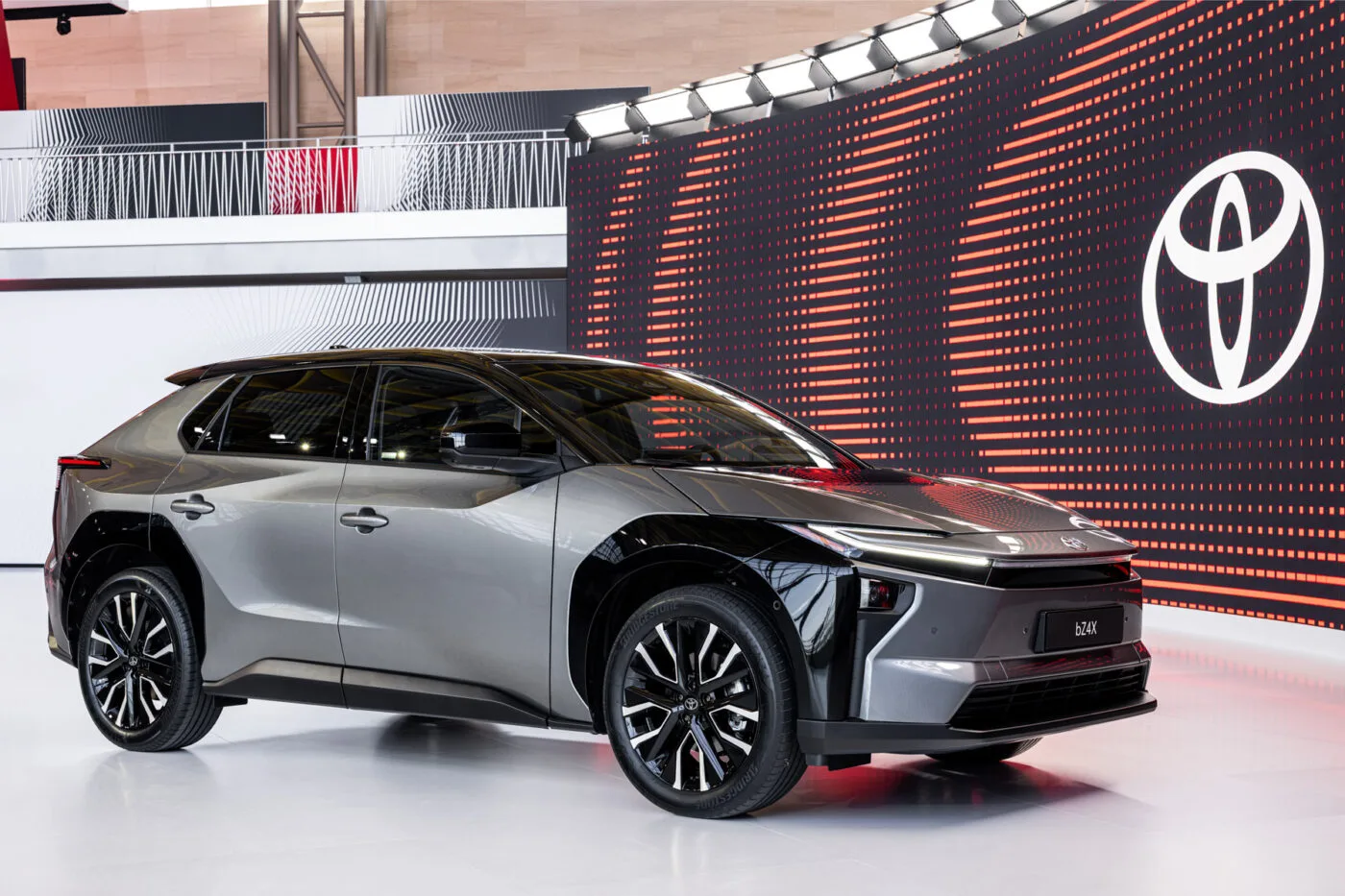
Toyota revealed that it will begin local production, assembly, and launches of the facelifted bZ4X electric SUV at its Indonesia facility in Karawang, West Java, by late 2025.
Unlike the earlier imported version, the locally produced model will arrive only in a front‑wheel drive (FWD) configuration — Toyota hasn’t confirmed availability of all‑wheel‑drive versions. The announcement included technical specs aligned with European options: two FWD trims featuring a 57.7 kWh battery with 123 kW motor and a 73.1 kWh battery with 165 kW motor, delivering 0–100 km/h acceleration in 8.6 sec and 7.4 sec, respectively, top speeds between 140–160 km/h, and ranges from approximately 444 km to 568 km (WLTP).
Alongside the bZ4X, Toyota showcased the Urban Cruiser EV and reaffirmed its support for Indonesia’s EV strategy.
Why Indonesia?
📈 Strategic Market Dynamics
Indonesia is a major growth market in Southeast Asia and currently ranks as Toyota’s fourth-largest global single market, following the U.S., China, and Japan. In recent years, Chinese EV brands have made significant headway in the country, prompting Toyota to defend its market leadership by introducing locally made EVs.
🏛 Government Incentives
The Indonesian government has rolled out aggressive support measures, such as:
- 1% VAT on EVs with at least 40% local content.
- Full exemption from import duties, versus 11% VAT for vehicles under that threshold.
- Support for domestic EV assembly and component manufacturing.
These make local production not only economically viable but strategically necessary.
🤝 Local Industrial Integration
The Karawang plant, already producing models like the Innova, Fortuner, Yaris, and Avanza, has been gradually integrating electrified vehicle production, including hybrids. Adding the bZ4X BEV aligns with this transition toward electrification.
Production Setup & Localization
- The Karawang plant, owned 95% by Toyota and 5% by Astra, has a long history of high-volume vehicle assembly. It will now add the e‑TNGA i‑EV platform, accommodating the bZ4X as one of the first battery-electric vehicles in Indonesia.
- Toyota has refrained from disclosing precise details of its localization ratio or sourcing targets for parts and batteries. This likely reflects a cautious strategy until supplier capabilities are fully established.
- Anticipated production volume, capacity expansion, and possible export plans remain undisclosed but could follow Toyota’s previous model of exporting locally built HEVs such as the Innova Zenix.
What’s New About the bZ4X?
The locally built model will mirror Toyota’s mid‑cycle facelift introduced earlier this year. Key improvements include:
⚡Drivetrain & battery
- Two battery-motor options: 57.7 kWh/123 kW and 73.1 kWh/165 kW.
- Respectively, 0–100 km/h in 8.6 sec and 7.4 sec.
- Range between 444–568 km (WLTP).
🔧 Exterior & Interior Refresh
- New “Hammerhead” front fascia
- Color-matched bumper panels are replacing the old black plastic cladding
- Upgraded interior with 14″ touchscreen, physical knobs, and removal of the bulky frame between the wheel and gauge cluster.
🔌 Improved Charging Performance
- From 10% to 80% in around 30 minutes via 150 kW DC fast charging.
- A significant improvement over the older model’s slower charging.
🚗 Safety
- Earned Top Safety Pick+ designation from US IIHS in 2025.
- Preserves 5-star Euro NCAP and JNCAP ratings.
How it fits into Toyota’s ASEAN & Global BEV Strategy
- Toyota adopts what it calls a “multi-pathway strategy”, focusing not just on hybrids but also on BEVs and fuel-cell vehicles depending on market needs.
- Indonesia marks Toyota’s third country to produce BEVs—after Japan and China — and follows its collaboration with Suzuki in Thailand for the Urban Cruiser EV.
Implications
✅ Consumers
- Lower prices and greater availability from local production vs. imports.
- Likely to benefit from incentives, including tax credits and financing deals.
- Full access to the facelifted model’s improvements on charging, safety, and comfort.
🏭 Industrial & Economic
- Investment in the supply chain and job creation in Indonesia.
- Building expertise in electric drivetrains, batteries, and assembly lines.
- Preventing cost inflation against surging imports of Chinese EVs.
🔄 Competitors
- Signals Toyota’s intent to compete with brands like BYD, Geely, SAIC, and Wuling, all of which are aggressively pursuing Indonesian electrification by investing and bringing BEVs to market.
- Other OEMs will likely ramp up local EV production to leverage tax advantages and economies of scale.
🌏 Environmental & policy
- Supports Indonesia’s goal of reducing carbon emissions through electric mobility
- Helps the automotive industry shift from internal combustion engines to BEVs
- May attract more capital and innovation into the local EV ecosystem
Outlook & Timeline
- Local production begins in late 2025, with domestic launch shortly thereafter.
- Initial launch FWD only, though AWD could appear later depending on demand & localization progress.
- The Urban Cruiser EV being showcased could launch in early to mid‑2026.
- Toyota may scale local sourcing progressively, potentially unlocking more tax benefits as it approaches or surpasses the 40% local content threshold.
- Export potential remains uncertain but feasible once local volumes and quality consistency are assured.
Challenges Ahead
- Localization hurdles: Indonesia’s supplier base for EV parts—especially high-tech components like battery cells, electric motors, and power electronics—is still evolving. Toyota will need to develop these partnerships quickly to dial up localization.
- Infrastructure readiness: While vehicle production is scaling up, Indonesia must roll out robust charging networks, grid upgrades, and regulatory norms to support widespread EV adoption.
- Cost pressure: Keeping prices competitive against heavily subsidized Chinese models (often from JV plants like SGMW’s Wuling Air EV) will test Toyota’s operational efficiency.
- Consumer mindset: Transitioning from hybrids (Toyota’s historical strength) to full EVs may require education on charging habits, resale value, incentives, and lifecycle performance.
Conclusion
Toyota’s decision to locally produce the bZ4X in Indonesia is a landmark moment in the region’s move toward electrification. Tapping into:
- Growing EV demand
- Attractive government incentives
- Toyota’s established industrial footprint
This is a smart—though complex—play by Toyota to maintain dominance in Southeast Asia’s largest emerging auto market. The facelifted bZ4X FWD, with modern aesthetics, improved charging, a solid battery range, and top-tier safety, is well-positioned to appeal to mainstream consumers.
Success hinges on Toyota’s ability to build supplier ecosystems, work with regulators, establish charging infrastructure, and navigate competitive pricing. If executed well, the Karawang plant could become a cornerstone of Toyota’s regional EV strategy—and a potential export hub across ASEAN.