
Here’s a detailed look at the rumour that Triumph / Bajaj are planning a smaller ~350cc engine version of the Speed 400 (and the broader Triumph 400 line), including what’s being claimed, the possible motivations, what this would mean, and how credible it seems. Let me know if you want a shorter summary too.
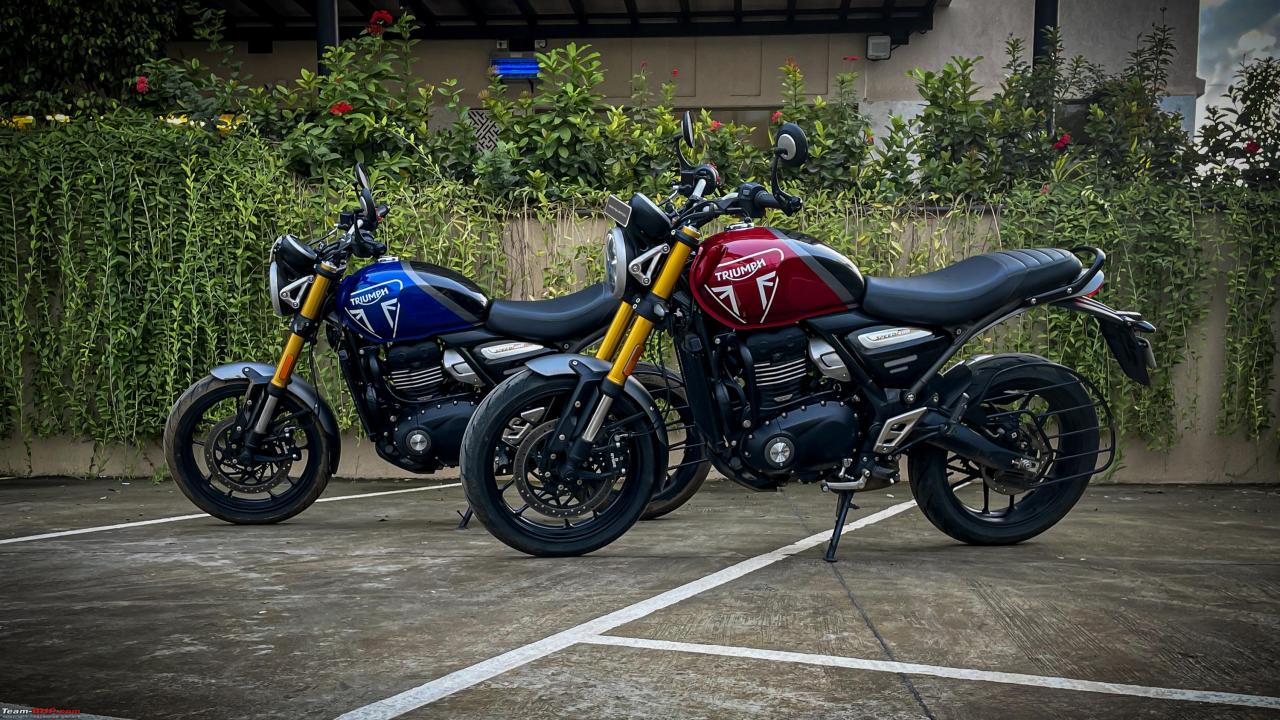
What the Rumour Says
- Engine Downsizing: The rumour is that Bajaj is developing a modified version of the existing 399cc motor used in Triumph’s 400cc bikes (Speed 400, Scrambler 400 X / XC, Thruxton 400, etc.), by reducing the bore (i.e, making the cylinder diameter smaller) so that displacement drops below 350cc.
- Power / Output Expectations: The smaller engine is expected to have slightly lower peak power. For instance, the current Speed 400 produces about 39-40 BHP and ~37.5 Nm torque. The downsized 350cc version might lose 3-5 HP (or perhaps torque too), though exact figures aren’t confirmed.
- Which Models Affected: It’s not just the Speed 400 — the plan would cover the entire Triumph 400 range sold locally in India. That includes Speed T4, Speed 400, Scrambler 400 X, Scrambler 400 XC, and Thruxton 400. For export markets, the 400cc versions might continue unchanged.
- Timing: According to reports, the smaller 350cc engine is likely to be ready in “six months or less.” This suggests development is already underway.
Why This Move Is Being Considered
This is less speculative; there are several strong economic and regulatory factors making it a likely decision:
GST Tax Changes in India
-
- As of 22 September 2025, motorcycles under 350cc now attract 18% GST, down from 28%.
- Bikes above 350cc are now taxed at 40% as part of a “sin goods / ultra-luxury / premium” category.
- That jump in tax burden for >350cc bikes is significant — it makes those motorcycles much more expensive. So, bringing the displacement just under the threshold reduces taxes significantly, which could help price competitiveness.
Competitive Pressures
-
-
- The Indian market has many popular 350cc bikes (Royal Enfield’s Classic 350, Hunter 350, etc.). Triumph’s 400s are seen as premium in that segment, but if the cost goes up due to tax, they risk losing to more affordable rivals.
- By offering sub-350cc variants, Triumph can better compete with these models in both perception (same cc class) and cost.
-
Export vs Domestic
-
- The rumour suggests that export markets may continue to get the full 400cc versions, since they do not face the same local GST structure. So there may effectively be two variants: a lower-displacement version for domestic sales, and a full-power 400cc for exports.
Regulatory / Tax Strategy
-
- It’s not just about tax; sometimes governments use a higher GST on higher displacement bikes as a policy tool (e.g., to limit emissions, or as a luxury tax). When the tax structure shifts as it has, manufacturers have to adapt or suffer a drop in demand.
What Would Change / What Would Stay
If this rumour turns out to be true, here are the likely implications and trade-offs.
What May Change
- Power / Torque: Expect a small drop in peak power, perhaps 3-5 BHP or more, depending on how much the bore is reduced. Torque may also drop, especially at high RPM. However, tuning and other changes (compression, cam profiles, fuel injection) might try to minimize the loss.
- Engine Character: With a smaller bore, it might rev differently; perhaps a narrower powerband, possibly slightly less punch at high revs. It could be more tuned for usability rather than outright performance.
- Pricing: Likely lower than the current 400cc version due to lower GST, though the cost of reengineering, certification, etc., also matters. The net effect should be more attractive pricing for consumers under the new tax regime.
- Marketing & Positioning: The bike might be repositioned somewhat, to acknowledge that it’s “sub-350cc”, maybe offering a more accessible entry into the Triumph 400 styling/brand. Might highlight the tax benefit as part of the value proposition.
What May Remain
- Styling / Chassis / Gearbox: Much of the rest of the bike (frame, styling, chassis, suspension, brakes, etc.) could remain largely the same (or have minimal changes). That helps keep costs down. It’s just the engine’s bore (and possibly related internals) that need modification.
- Parts Sharing: Triumph / Bajaj may continue to share many parts across 350cc and 400cc variants, to economize on production, inventory, maintenance, etc.
- Export Variants: As mentioned, for markets outside India, they might continue with the 399cc version (or similar) where the 40% GST (or equivalent tax) doesn’t apply, or different tax regimes exist. So, two variants in parallel are plausible.
Challenges & Risks
Every change brings its own set of risks. Some of the things that Triumph / Bajaj would need to manage, if going ahead with this:
- Balancing Performance vs Displacement: Lowering displacement while keeping good power/torque is not trivial. You might lose some of the appeal that comes with the current 400cc variant, which is seen as having premium performance. If the drop is too much, customers may feel short-changed.
- Engineering, Testing & Cost: Reengineering the engine (new bore size, possibly different piston, cylinder head modifications, possible changes to cooling, mapping, etc.), validation, emission & compliance testing can be costly. The cost saved via lower taxes may be offset partially by these investments.
- Brand Perception: If marketed poorly, customers may see the sub-350cc version as a watered-down model. Triumph has to ensure that the sub-350cc model still delivers the refinement, build quality, and “feel” expected of the brand, or risk diluting its premium image.
- After-market & Accessories: If the engine changes, compatibility of certain accessories, performance parts, servicing, etc., must be addressed. Spare-parts strategy must cover both 350cc and 400cc variants, which can complicate logistics and support.
- Customer Acceptance: Some buyers prefer the 400cc because of the “bigger is better” psychology. Even if tax differences are significant, the perception among some buyers may be that they’re getting less. Triumph will have to communicate clearly.
How Credible is the Rumour?
Looking at the sources and the logic, the rumour seems quite credible. Here’s why:
- The reports come from several reputable outlets in India: Autocar India, Team-BHP, Visordown, etc.
- The timing lines up with the GST change — since the tax rules changed recently, the economic pressure to adjust models is immediate.
- It seems logical that Bajaj, which is manufacturing these Triumph 400s in India, would want to adapt for the domestic market rather than absorb the entire cost burden. Reports even state that Bajaj has confirmed “realigning” portions of its portfolio to be under 350cc.
On the flip side:
- No official announcement yet from Triumph or Bajaj confirming exact specifications, power numbers, pricing, etc. So key details are still speculative.
- Engineering and homologation can take time, so while “six months or less” is cited, delays are possible.
Possible Scenarios / What to Expect
Here are some likely scenarios, based on how this could play out:
Scenario A: Dual Variant Strategy
Triumph/Bajaj launches the sub-350cc variant for India at reduced GST, while keeping the 400cc version for export markets and possibly as a premium option domestically (for buyers willing to pay more). This gives buyers choice and helps retain brand prestige while offering affordability.
Scenario B: Phased Transition
They may start with certain models first (say, Speed 400 gets the 350cc version), then progressively update the others (Scrambler, Thruxton, etc.) as development completes.
Scenario C: Harmonised Displacement Change for All
Less likely, but possible: if market response and regulatory pressure are strong, the sub-350cc could become standard for most markets (or at least most models), and 400cc versions could be phased out or reserved only for exports or special editions.
Scenario D: Limited Edition / Special Trim
Another angle could be to offer the 350cc as a stripped-down trim or variant (with fewer accessories) to hit a target price, alongside the full version with richer features.
Implications For Buyers & the Market
- For prospective buyers, this could mean more affordable access to Triumph styling and build, particularly for those who wanted the 400cc line but were put off by price (once GST increases kicked in).
- It could shift competitive dynamics: Royal Enfield and other brands with strong 350cc offerings might face tighter competition from Triumph with similar cc but better refinement or performance.
- It may encourage more buyers to opt for sub-350cc displacement bikes, due to lower tax and potentially lower ownership costs, insurance, etc.
- On the flip side, those who want maximum performance might wait for the 400cc export variants, or pay a higher cost locally if the 350cc version is felt to be underpowered relative to expectations.
Conclusion
The rumour that Triumph (via Bajaj) is developing a ~350cc version of the Speed 400 (and other 400-cc bikes) is very plausible and seems to be driven by real regulatory/tax shifts in India (GST changes). The motive makes sense: reduce tax burden, maintain competitiveness, align price points. The trade-offs will be in power loss/perception/engineering cost, but these seem manageable.
If I had to guess, I think within 6–12 months we’ll start seeing official announcements or even product launches of one or more of the 350cc variants in India. Triumph will likely preserve the premium feel as much as possible so that the sub-350 is not seen as a lesser “cheap” bike, but as a sweet-spot offering: near to the 400 in feel, but more affordable.