
Maruti Suzuki’s commencement of e‑Vitara exports to Europe, blending factual reporting with strategic context and analysis:
1. A Milestone Moment: Launch & Export Initiation
Production Kick-off in Gujarat
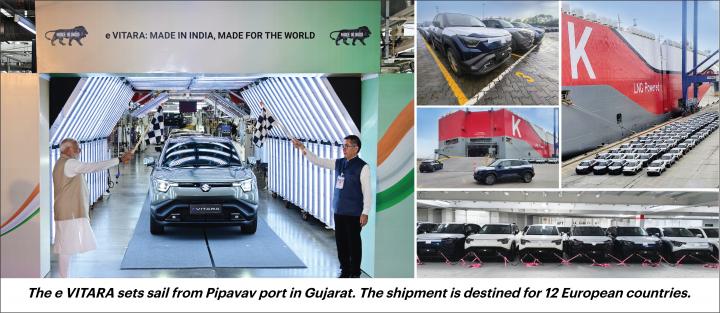
On 26 August 2025, Maruti Suzuki began mass production of its first battery-electric vehicle (BEV), the e‑Vitara, at the Hansalpur facility in Gujarat. The launch was ceremonially flagged off by Prime Minister Narendra Modi, underscoring its importance in India’s mobility and manufacturing narrative.
This facility is envisioned as a global EV hub, configured to produce both right‑ and left‑hand drive variants for more than 100 international markets, emphasizing Europe and Japan as key targets. Notably, the plant is part of a broader investment plan: ₹70,000 crore (~$8 billion) over the next 5–6 years, strengthening EV production capabilities and battery manufacturing capacities.
Design, Platform & Variants
The e‑Vitara is built on Suzuki’s new HEARTECT‑e platform, specifically tailored for electric powertrains.
It is offered with two LFP (lithium iron phosphate) battery options:
- 49 kWh pack (single-motor FWD, ~106 kW, WLTP range ~344 km),
- 61 kWh pack (single-motor FWD, ~128 kW, WLTP range ~426 km),
- Plus a dual-motor AWD version (“ALLGRIP‑e”) delivering ~135 kW with a range of ~395 km.
Additional features include nimble driving dynamics, connected-car technology, and driver-assist systems aligned with global EV standards
2. Export Commencement: Europe Beckons
In August 2025, Maruti Suzuki dispatched over 2,900 e‑Vitara units from Pipavav Port in Gujarat to 12 European countries: the UK, Germany, Norway, France, Denmark, Switzerland, the Netherlands, Sweden, Hungary, Iceland, Austria, and Belgium.
Hisashi Takeuchi, MD & CEO of Maruti Suzuki India, described the moment as “a proud and defining moment”—a testament to how a product must deliver world-class standards in technology, design, safety, and performance to delight European consumers.
3. Strategic Significance: Make in India Goes Global
Boosting Indian EV Leadership
With exports to Europe now underway, Maruti Suzuki is making a bold statement—India is emerging as a credible manufacturing base for global electric mobility. The government’s “Make in India” initiative finds a powerful symbol in the e‑Vitara, both in production and dispatch.
Supply Chain & Localization
Battery production is embedded within this strategy. The TDSG joint venture (Suzuki + Toshiba + Denso) in Gujarat produces lithium-ion batteries and electrodes locally, ensuring a high degree of indigenization—a key pillar of self-reliance.
Investment & Capacity Ramp-Up
The Hansalpur facility currently houses three production lines, each capable of 250,000 units per year. A dedicated EV line is slated for completion by March 2026, doubling EV production capacity.
Initial targets projected around 70,000 e‑Vitaras in FY 2026, with most geared for export.
4. Challenges & Course Corrections
Rare Earth Supply Constraints
In June 2025, Maruti Suzuki slashed its H1 e‑Vitara production target from 26,500 to about 8,200 units due to China’s export curbs on rare earths—critical for EV components. Despite the setback, the company plans to ramp up production in H2 to meet the full 67,000-unit annual goal.
Domestic Market Entry
While exports gain momentum, domestic sales remain on the horizon. Initial deployment focuses on global markets, with a plan to gradually introduce the e‑Vitara to Indian consumers.
5. Global Implications: What This Move Signals
Emerging Global Player
By exporting a domestically produced EV to demanding European markets, Maruti Suzuki joins a select group of automakers showcasing India’s growing prowess in high-tech manufacturing.
Investment Magnet
A meticulously planned ₹70,000 crore investment signals not just ambition but also confidence from Suzuki—a likely attractor for complementary industries and foreign investors.
Green Transition Catalyst
Maruti Suzuki’s e‑Vitara contributes meaningfully to India’s EV transition, aligning with national goals of 30% EV adoption by 2030 while positioning India as a green-tech exporter.
Geopolitical Impact
This export drive strengthens ties with Europe and Japan, reinforcing India’s diplomatic and economic positioning as a resilient manufacturing partner.
6. Looking Ahead: What to Watch
- Scale of Exports: Will volumes sustainably increase beyond the initial 2,900 units?
- Domestic Rollout: When will the e-Vitara become available in India, and at what price point?
- Global Reception: Will it resonate with European EV buyers, especially in terms of performance, price, and service?
- Competition Dynamics: How will this impact Maruti’s position against Tata, Mahindra, and global EV makers both at home and abroad?
- Supply Chain Resilience: Can Maruti shore up rare earth sourcing or enhance localization to avoid future disruptions?
Conclusion
With the August 2025 launch of exports of the e-Vitara to 12 European countries, Maruti Suzuki has crossed a pivotal threshold—from a domestic stalwart to a globally relevant EV exporter. Built on a locally manufactured EV platform, powered by domestic battery production, and backed by bold investment, the e-Vitara is not merely a new model—it is a symbol of India’s ascent in the global electric mobility landscape.
While challenges like rare earth shortages and domestic market readiness linger, the strategic footprint and ambition behind this foray signal a promising trajectory—not just for Maruti Suzuki, but for India’s manufacturing ambition writ large.